
Four Seconds of Eye Contact
An action director once asked Park Sun-jae how to shoot a love scene. The answer was four seconds long. Years later he went looking for why that number worked — and found it waiting in the neuroscience of the present moment, in the white of the human eye, and, of all places, in the pages of the nineteenth-century Russian novel. This is the story of the single second in which an actor is either believed or not — and of everything an actor must do to earn it.
An action director — a man who had spent his life shooting gunfights and rolling cars — asked me one day how you direct romance. Blowing things up he could do in his sleep, he said; love scenes he simply could not crack. I gave him a short answer: have the actor look into the other actor’s eyes for four seconds.
He froze for about three seconds, like a paused frame, and then let out a small “Ah,” as if something had landed. He didn’t ask me why four and not one, two, or three, and I didn’t explain that far. He had the face of a man who had already seized something he no longer needed spelled out.
If I’m honest, had he asked me why four seconds, I could not have answered. Because I didn’t know either. The best I could have managed was, “It’s instinct.” It was a number I’d learned in my body, staring at actors’ eyes on a monitor a thousand times over — not a number I’d read in any book.
And yet, preparing this lecture, I went looking — and, to my astonishment, the four seconds had a theory behind them. My instinct hadn’t pulled the number out of the air. So this lecture is an excavation of my own answer — the reasons underneath a reply I gave without understanding it. Let’s start with the theory.
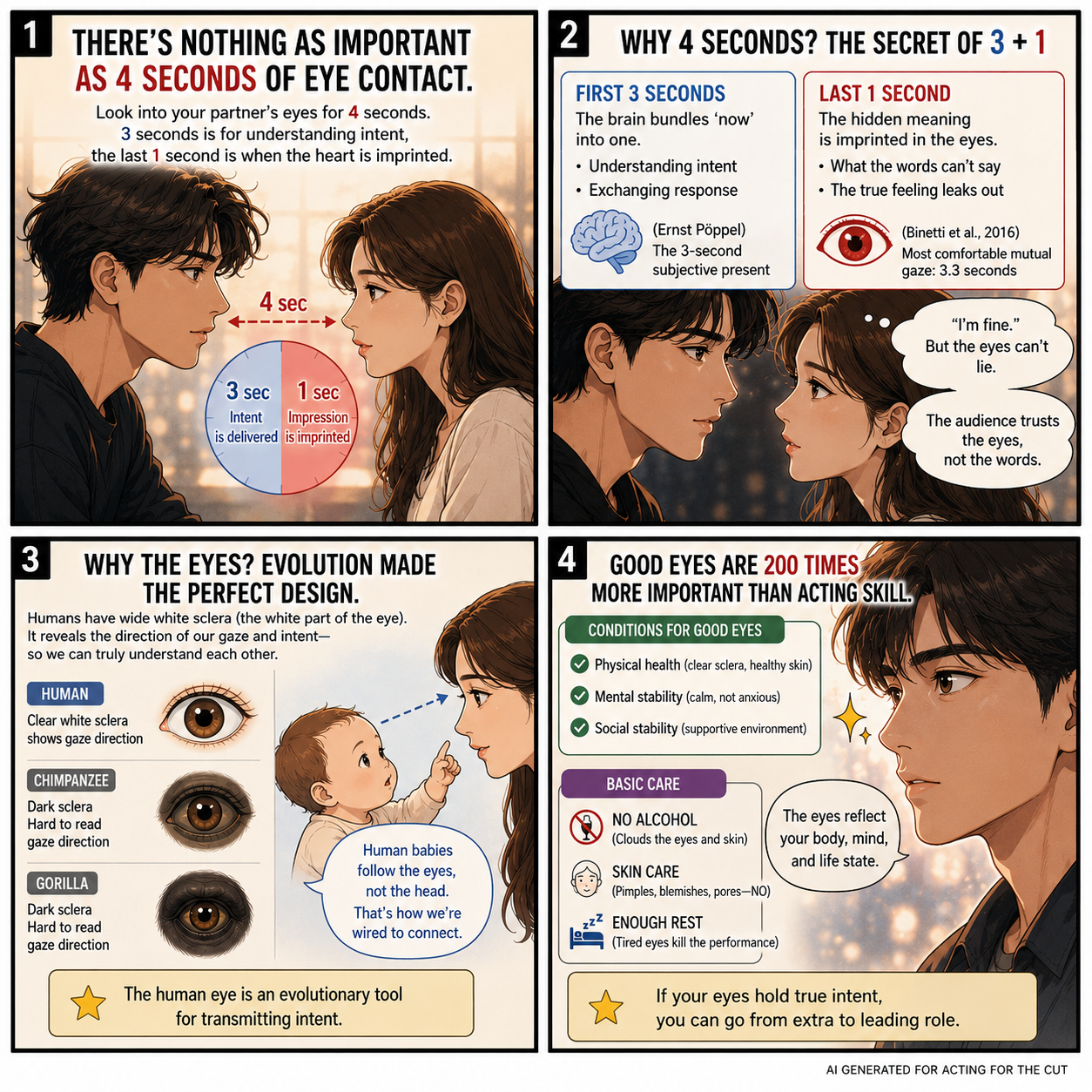
One — Three seconds: the brain binds the “now” (Ernst Pöppel, the three-second subjective present)
The time it takes a person to grasp another’s intention and respond to it is, roughly, three seconds. Not for some glancing, trivial signal — I mean when a somewhat serious intention passes between two people. And this isn’t merely my own field lore; it’s a number neuroscience has worked over for a long time.
The German neuroscientist Ernst Pöppel proposed that the brain binds the stream of incoming events into chunks about three seconds long and perceives each chunk as “now.” He called this the three-second subjective present. What we feel as “the present” is not a knife-edge point but a window roughly three seconds wide. The breath it takes to read a line of a poem, the span of a handshake, the rhythm of completing a single gesture — all of them land near this three seconds. More striking still: when two people face each other, these windows of “now” interlock, and the two come to share a single present.
Carry that in front of the camera. To look into the other actor’s eyes is to lay two “nows” over each other. My intention crosses to you; you receive it and send a response back; and that one full loop takes about three seconds. An actor who breaks eye contact before three seconds is up has, in effect, cut off the conversation before delivering his intention. On screen such a gaze always looks hurried, shallow, somehow insincere. The audience can’t say exactly why — they just feel there’s something off about that one’s eyes. It’s because the three seconds went unfilled.
Two — The remaining second: where the imprint happens (Binetti et al., 2016 / Ekman’s nonverbal leakage)
So why four seconds, and not three? This is the thing I most want to say in this lecture.
Three seconds is the time it takes the other person to understand my intention and respond. A thoroughly ordinary, practical three seconds. But a performance needs one second more. At the very moment the understanding-and-response is about to close, one more beat is needed — and that beat is the fourth second. This is the second in which the imprint is made. The three seconds are where the meaning is delivered; the remaining second is where the hidden meaning is engraved onto the other person’s eyes. If the three seconds are the outer face, the one second is the interior. If the three seconds are the line of dialogue, the one second is the subtext beneath it. That, in my experience, is why a performance needs not three seconds but four. Three plus one — that is the anatomy of the four-second gaze.
Here is the delightful part: someone actually measured the length of eye contact people find most comfortable. In 2016, a team led by Nicola Binetti had some five hundred visitors from fifty-six countries at London’s Science Museum hold a gaze with a face on a screen and mark the point at which it grew uncomfortable (Royal Society Open Science). The average most-comfortable mutual gaze came to 3.3 seconds — a hair past three, exactly the “three seconds plus a beat” I’d been describing. The four seconds I’d learned in my body on set, and the 3.3 seconds that came out of a laboratory, meet right there.
What happens in that one second becomes obvious the moment you think of a person whose words and heart disagree. I’m fine, they say — and they are not fine at all. How do we know the real feeling? Through the eyes. The psychologist Paul Ekman called it nonverbal leakage: the way a suppressed emotion seeps out across the face however hard we try to hold it down, because the circuitry that generates the buried feeling and the circuitry that moves the facial muscles are one and the same, so it escapes in an instant no matter what. Words can be dressed up endlessly; the eyes cannot. That is why an audience trusts an actor’s eyes, not his lines. When the words say “I’m fine” but the eyes read not fine at all, the audience is finally pulled into the character’s true story. The time in which that reading happens is precisely that one second.
Three — Why the eyes, of all things: the secret of the white sclera (the cooperative eye hypothesis, Tomasello et al., 2007)
Here is a foundational question. Why is the human eye split into a white sclera and a dark iris? Why isn’t the whole thing black, or white?
Look at other primates. In chimpanzees and gorillas the sclera is darkly pigmented, so the eye reads as a single mass — and it’s hard to tell where they’re looking. Only humans go about with a broad, bright-white sclera on open display. Why? The answer from the cooperative eye hypothesis, put forward by Michael Tomasello’s team in 2007, is this: humans evolved the white of the eye in order to show the direction of their gaze to others. Only when a dark iris sits against a white field can another person read where you are looking, where your attention — your inclination — is tilting. In fact, human infants follow the direction of an adult’s eyes rather than the turn of the head, while apes follow the head, not the eyes.
To put it plainly: humans came to divide the eye into white and dark expressly to convey intention through the gaze. The eye was, from the start, engineered as an organ for transmitting intention. Is there a fact more decisive than this for an actor? More than anything else, the camera hunts down this contrast — the dark iris moving across the white sclera — and holds it in close-up. The actor’s eye is the seat where the camera looks, in close-up, at an intention-transmitting device the species spent millions of years refining.
Four — The condition of a good gaze: what matters 200 times more than skill
So, to bring that one-second gaze to life — what do you need? First of all, healthy eyes.
The eye is a gauge that reflects the health of the whole body. If the body isn’t well, the eyes aren’t well; if the eyes aren’t well, the gaze isn’t well. When the body is damaged, no matter how pure the intention an actor pours in, that intention is obstructed, blurred, distorted — and does not arrive intact.
I’ll say it boldly: for an actor, having a good gaze matters two hundred times more than having good technique. Technique you can grind upward through relentless effort and self-awareness. But a good gaze doesn’t come from effort alone. An actor who can’t act but has good eyes survives. An actor who acts brilliantly but whose eyes aren’t vividly alive, in the end, disappears.
Then does minding your eye health alone produce a good gaze? Of course not. Still — the eye is the most important channel, one through which even hidden feeling is expressed. Through this narrow channel all of a character’s intention flows in and out. And for an actor to transmit his own intention through those eyes at one hundred percent purity, his physical, mental, and social condition must be stable.
This isn’t a standard I invented. The World Health Organization defines health as “not merely the absence of disease, but a state of complete physical, mental, and social well-being.” For an actor, that definition is not somebody else’s business. Only from a place of good well-being — a body that is healthy, a mind that is settled, a life that is not socially isolated — does a gaze of one hundred percent purity emerge.
And the truth is, securing that state of “well-being” is the hardest thing of all. We tend to assume a newcomer acts badly because he’s raw, and that becoming a star is simply technique improving. But if that were really so, how do you explain the newcomer who, from a debut role, seems two hundred times better than the seasoned masters — the first-timer in front of a camera who acts like a genius?
What grips us in that newcomer is not superior technique. It’s that something beyond technique — that latent something — crosses to us whole, and we willingly give ourselves over to it, immersed, moved. Where does that carrying power come from? From the fact that the newcomer, in a state of physical, mental, and social well-being, can pour himself into the work at one hundred percent purity, and nothing else. This is exactly why a child actor with a mother’s solid support will sometimes out-act an adult who has won an Academy Award. The child has nothing to protect, nothing to hide, nothing to shake him.
Five — How to break through an unfair reality
So what about those of us without a mother’s solid support? Most newcomers act badly not simply because they’re raw, but because their physical, mental, and social circumstances are wretched. Harassed on every side by such an environment, they can’t concentrate on the script; they have no mental room to interpret and absorb the work; they have neither the time nor the money to prepare it. Every meal is meagre, the future is dark and unsteady, and there is no grown-up nearby — emotionally or financially — to lend a hand.
In an environment like that, how is an actor with a good gaze supposed to appear? And yet — in spite of it — let me be clear: you must have a good gaze. Because far more than polishing your technique, acquiring that good gaze, brimming with some mysterious charm no one can name, is the fastest road straight to a lead without grinding through bit parts and supporting roles. So how important a good gaze is, you must keep firmly in mind. Exactly how to solve this within a wretched reality I’ll take up separately in the later lecture, A Survival Guide for Actors; here I’ll cover only the basics.
First, manage the body. An actor’s skin must not go rough and dull. Don’t drink — alcohol clouds the sclera, and unintended bloodshot eyes instantly break a story’s immersion. Your eyes must be white and clear. Even in a horror film.
Nor can there be blemishes. These days lead actors are, for the most part, professionally cared for; clear, bright skin is simply the baseline. Now — what happens when the actor sitting across from that lead has a dull, unmanaged face? The instant it’s set beside the lead’s bright skin, the untended face looks several times more sallow and unkempt than it really is. The camera catches that contrast without mercy, and right there the audience’s immersion snaps. Male actors especially should watch for acne — it stands out on screen as pure disorder, and however well you act, one close-up and story and emotion alike are gone. For women, a single breakout is what breaks the spell; I’ve wasted hours in the editing suite painting blemishes out. It truly wrecks the immersion. And I’ll stress it again: an actor must never drink. Drink coarsens the skin and drags it downward, and a face left to go slack shows every bit of that dullness on screen — and brands you an actor who can’t even manage himself. Some say they have no choice but to drink, to get on with directors, writers, other actors. Let me be blunt: the drinking table does nothing for your career. You drink because you like to drink. And I have never seen a good end for the actor who loves the drinking table.
One more, coldly: no cigarettes. Not tobacco, not vapes, never. Need I go on? Don’t grind your body down with overwork; don’t let life wear you thin. There is nothing uglier than an actor gone haggard — steeped in drink, in smoke, in the grind of living. It is, truly, the worst.
Which means: without money, an actor’s trade has no answer. “To avoid grinding myself down with labor, is it all right to work at a bar?” Absolutely not. Don’t. The night you’re tending that bar and a customer hands you five million won for a taxi home — shall I help you a little? — and you’re moved by what feels like his pure goodwill, and you waver, even slightly: that is the night you lose the dream you held most precious and become just another person of this world. You lose the purity of the actor as a creature of fantasy, and it does not come back a second time.
So what on earth are you to do? Your physical, mental, and social circumstances are nonexistent; you can’t grind yourself down with labor; you can’t work the bar. Alcohol’s too dear to drink, there’s no money for cigarettes, none for a coffee with anyone, not even bus fare, so you walk. What is a person in that state supposed to do? (I’ll tell you later.)
For now, back to this lecture’s subject: skin care is, all the same, an actor’s obligation. Once a year, an Ultherapy lift; a pigment cream — something like Domina — for spots and blemishes; and a sheet mask every single day, without fail, like a habit. Exercise as if it were breathing. Guard the body’s health and the eyes’ health is guarded with it. Your body, hidden under clothes, says nothing of your effort — but your eyes tell everything about the effort you’ve made. So do it. Guarding the body is not a choice; it’s a necessity.
(To avoid any misunderstanding: the products and procedures I name here have nothing to do with sponsorship or advertising. I take no ad money. I’m simply setting down, as practical information an actor needs, the things I’ve confirmed with my own eyes — checking actors’ faces on a monitor countless times — as making a real difference. Take from it what suits your own skin and means.)
If the gym is out of reach, ride the bike-share. Seoul’s public bicycle — a year’s pass runs about thirty thousand won — is the finest instrument of exercise and of transport both. And once the body is prepared, let’s talk about preparing the mind. If you mean to become an actor, then from this moment on, think of everything in a positive light. (If you’re on medication for depression, keep taking it faithfully — and even if a wound sits so deep in your chest that a single nudge sets you weeping, hold the positivity alongside that pain, the two of them together.)
The one and only way to win the mental health that makes a good gaze is to read.
Six — Read novels, not scripts (Mar & Oatley’s narrative simulation / Kidd & Castano, 2013)
Actors, preparing to act, mostly pore over scripts. An actor studies from scripts — what could be more obvious? Sadly, that obvious act is exactly like drilling nothing but past exam papers to pass a licensing test. No interest in the whole; just memorize question and answer, question and answer, and grab the certificate as fast as possible. Regrettably, most Koreans lean this way.
I’ll dare to say it: reading scripts does nothing to improve your acting.
How can I make such a provocative claim? Because it’s true. A script is a blueprint. It’s the literal set of drawings by which every crew member and actor reads how the building is to be raised and what part each will play. But why those drawings were made, and how — that is precisely what the drawings themselves do not record. Which is why you read the script, then meet the director for an explanation, then track down the writer for another, then go home and chew the script over again, then take your role in those drawings to your acting teacher to ask and rehearse it once more.
If you can mine something real out of a script that says nothing about your acting — a past-tense script, moreover, that others once performed under some director, with some intention you have no way of knowing — then you are simply a genius.
So: read novels, not scripts.
Whatever you mean to do — theater, film, television — read novels. Read the classics especially. And of those, above all, read the nineteenth-century Russian novel. Every human psychology you want to know, every interior world you must express, every glance and gesture you’ll have to make, everything you wonder about — it is all in there. The novel in which human psychology is best rendered is, I believe, the nineteenth-century one, and among those, the Russian.
Tolstoy — a count who longed to become a peasant. Dostoevsky — a writer who wrestled his whole life with epilepsy and a gambling compulsion. They are, beyond argument, the specimens of the anguished human being. The figures their unconscious draws in those novels pose a concrete, visible question — what is a human being? — and depict it; know nothing of this and read only contemporary scripts, and you’ll not take a single step past illiteracy. Nikolai Gogol is the forefather of those two giants — Dostoevsky himself is said to have declared, “We all came out of Gogol’s Overcoat.” Have you read that Overcoat? For studying a character’s gestures, temperament, and speech, there is no work to match it.
And then, Anton Chekhov. For an actor, this man may be the first and the last. Chekhov’s people are forever like this: saying “I’m fine” with the mouth while collapsing inside, laughing while they die. That gap between the line and the buried heart — the very one-second gaze we’ve held onto through this whole lecture — is the whole of Chekhov. Even Stanislavsky’s system, the actor’s textbook, was born staging Chekhov’s plays. And if you turn your eyes outside Russia, you must read Charles Dickens, Victor Hugo, Edgar Allan Poe, O. Henry.
To a man, these were writers whose private lives were savagely hard. I revere Tolstoy; I count Dostoevsky a friend; I feel O. Henry is like me; I pity the life of Edgar Allan Poe. That the hardness of their lives is what made them see so deeply into human beings is, to me — living a hard life myself — a comfort that isn’t quite comfort, and yet somehow is.
In any case, reading novels is no mere matter of taste. Research keeps piling up that reading fiction genuinely strengthens the ability to read other minds. The cognitive psychologists Raymond Mar and Keith Oatley describe the reading of a novel as a simulation of social experience: while we read, we feel the characters’ emotions, follow their thoughts, and rehearse, over and over, the inference and prediction of tangled human relationships. Mar’s team reported that the more fiction people read, the higher their capacity to read others (empathy, theory of mind). David Kidd and Emanuele Castano, in Science in 2013, showed that even a brief passage of literary fiction lifted scores on the “Reading the Mind in the Eyes” test. Note the name of that test: reading the mind in the eyes. The act of reading a novel and the act of trading minds through the eyes meet, right here, in one place.
The living psychology laid out inside a novel plants in you the potential to make plausibility. The moment you engrave that peculiar potential onto your heart, you can turn in a fine performance even without a good script — even with a very shabby script and a director as devoid of craft as I am. Because every script a human has ever written holds, somewhere inside it, at least one point of aspiration toward empathy that even its author never noticed. Even if the script fails to bring that point to life, and the director hasn’t the faintest idea it’s there, you can see it. Why? Because you already carry the potential to make plausibility. (That’s just a phrase I made up.)
This, precisely, is what I call residual capacity. You have never yet spent your ability to its limit. But if you hold this potential, then in the moment of crisis — a wretched script, a slapdash production, the whole thing sliding toward the cliff of a written-off flop — you can summon an enormous residual capacity, take the entire piece by your own pace, and be born a hero. And in that very moment a work no one expected anything of is born a masterpiece the whole room applauds.
On the one way to keep a clear face and a good gaze, unworn by life, inside a wretched economy — I’ve even written a whole novel about it. It’s called Sad Lovers. When I’ve finished it, I hope you’ll read it. In any case, to gather it up: to have the power of the four-second gaze you must have a good gaze; for that you must have a state of “well-being”; and above all, to have a good gaze, you must read novels — this is the long way of saying it.
The one weapon that ranks above technique is a good gaze.
With that good gaze, if you hold four seconds of eye contact, you could become a lead this very day.
To win that good gaze takes restraint, sobriety, no smoking, exercise, skin care, and care of the mind — and reading novels rather than scripts. That is today’s lecture in a sentence. Until next time.
P.S. — If you had to pick one novel
Read Dostoevsky’s The Brothers Karamazov. If you can play Dmitri, you may leave the mountain. If you can play Grushenka, you may leave the mountain as well.
One more P.S. — A photograph, twenty-eight years early
After uploading this lecture I was scrolling Threads, and a single photograph was making the rounds. Christopher Nolan’s The Odyssey had just opened, and people had dug up an old picture of its lead, Matt Damon. Rome, 1998, the set of The Talented Mr. Ripley: young Damon in a chair under a parasol, lost in a paperback — a black-and-white shot by the photographer Greg Williams. The book appeared to be Homer’s Odyssey, and that’s what set the internet alight. Though some swear the cover looks more like Dostoevsky’s Crime and Punishment. Either way, there he is — an actor in the long, dull dead time of a film set, done with the script, reading a novel. The shortcut to becoming a great actor was, after all, the novel…
(Privately, I suspect it was Crime and Punishment — he was shooting Ripley, after all. And if so, wasn’t that Damon’s unconscious at work, reaching into a novel for the interior life no script would ever hand him?)