
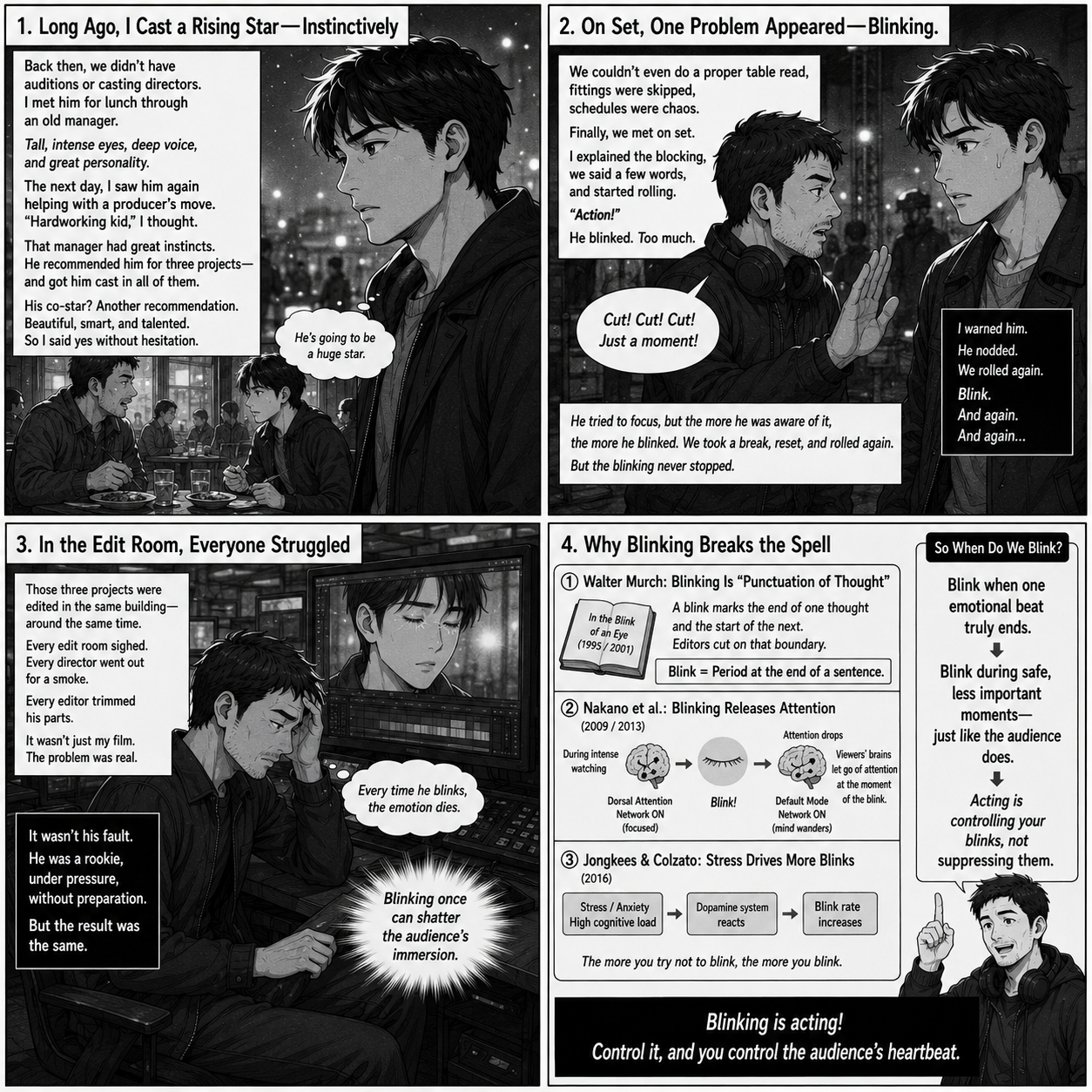
Don’t Blink
A long time ago, there was a young man I cast in a leading role after seeing his face exactly once.
This was before we selected actors through auditions — back when I was such an unknown director that it felt awkward even to call people in to read for me. No casting director, no assistant director in charge of talent. You’d thumb through the phone numbers of managers and actors you happened to know and cobble a cast together somehow. In those days you’d meet for no particular reason — lunch, dinner, whatever — and I honestly can’t remember now whether it was lunch or dinner, but over a meal a manager I was close with introduced me to this young man, and I cast him. If you tell me you shouldn’t cast that impulsively, I have no defense. But I was buried in a hundred other things, and I was told he’d appeared here and there and was about to become a rising star, so if I wanted him I’d have to move fast. That anxious little push was enough. I locked in the casting on the spot.
He had a wonderful presence in the eyes. A former model, they said — tall, a face both strong-boned and delicate, a voice like a low cave, and eyes that were deep and magnetic. A good personality, too. The day after I met him, I went to help a production company I knew with their office move — and there he was again, saying he’d come to lend a hand, bowing politely, then hauling boxes like his life depended on it. Watching this supposed actor-to-be carry furniture, I thought, Well now — for someone about to become an actor, he’s awfully diligent.
And the manager who looked after him was genuinely, impressively capable. He was pushing this young man not only on my project but on two others as well — and all three ended up casting him. The truth is, it was hard to say no to this manager. He was sincere, a good man. In those years there were a handful of managers who were diligent, sharp, and could see around corners; some of them went on to build publicly listed companies, to found production houses. A time when your relationship with the managers mattered enormously. So the manager recommended him, the meeting confirmed he had real appeal, and if he was unproven — well, he was a newcomer, of course he was unproven, and wasn’t it my job to discover exactly that kind of newcomer and raise him into a fine actor? With that little glow of pride, I made the casting official.
While I was at it, I took the female lead the same manager recommended, too. He suggested we go see a play, so we went — and she was lovely. And brilliant, apparently, a prodigy. Dazzled again, thinking this manager really does have all the good actors, I once more blurted out, Let’s do it!
This production, too, had to be shot at breakneck speed, so it was a brutal schedule — and the moment we moved toward shooting, the problems began, one after another. First, these two weren’t cast only in my project but in two others, so the scheduling tangled immediately. The table read couldn’t be arranged, the costume fitting was skipped as a matter of course, and even the shoot days couldn’t be properly pinned down. I began to worry — but the manager promised he’d send them to set fully prepared, and I talked myself into a kind of resignation: Fine. What can you do. It’s not some prestige production. He wants to work hard and become a rising star; I can’t demand he go all-in on this one thing. And so I just went on scouting locations and building props, preparing the piece.
Time slid by, and I met the actors on set with no rapport between us at all. I kindly walked them through the blocking, exchanged a few brief words, and went straight into shooting. And then the trouble started. The instant I called Action!, the young man blinked — hard, violently.
“Cut, cut, cut! One moment, please!”
I told him he was blinking too much. He nodded — understood. Blink a little less is not, after all, a difficult note, so I said it simply and we went again. He started his first line — and again, out of nowhere, blinked violently. I had no choice but to call cut.
I gave the note again and rolled. But once he’d started to tense, once he’d become aware of the blinking, he could not stop. We paused, took a break. We resumed. Steeling himself, he went in — hoping, I suppose, to get through it clean — and started blinking violently all over again.
There are things in this world that simply cannot be helped. That blinking was, I think, something neither he nor I could have foreseen — one of those unhelpable things. In what acting class does anyone teach, Please don’t blink so much? He was only trying, earnestly, to do his work; and I, if I may make my excuse, had only cast him because a manager told me he was good. Not that any of this covers the responsibility.
How we actually finished the shoot, I can’t now remember. What I do remember, vividly, is this: at that time my project and the other two happened to be editing in the very same suite, almost simultaneously — and from every editing room came sighs, every director’s face went the color of ash, they’d trudge out to smoke, and the editors, every last one of them, were quietly trimming down this young man’s footage. Which is to say: his problem hadn’t detonated on my set alone.
After that, he vanished from view. And looking back now, none of it was his fault. That a newcomer acts badly at first is simply the way of things. Your mind goes white and you forget every line; you tense up and walk with your left arm and left leg swinging together — all sorts of mistakes are possible.
Lee Jung-jae, a global star now, could barely deliver his lines when he appeared in Sandglass; as the story goes, director Kim Jong-hak’s one and only instruction to him was, in effect, Don’t say anything — just stand there. And so, saying nothing, simply gazing at Ko Hyun-jung, he became a sensation. Which is why it pains me that this young man was never seen again. What happened that day was no one’s fault — it might even have become a rite of passage he could have stood on and gone on to do well — and that it turned out the way it did still aches.
In any case, the editing suite was in an uproar. His part carried real weight in all three productions, so cutting his footage down to the point where the story still held together was the editors’ task — an unforeseen one. A difficulty no one had predicted. So — what exactly is the problem with a blink? Let’s start with the theory.
One — Walter Murch’s discovery: a blink is the period at the end of a thought (Walter Murch, In the Blink of an Eye, 1995 / 2001)
While editing The Conversation in 1974, Walter Murch noticed something strange. Agonizing over where to cut a shot of the lead, Gene Hackman, he would settle on a point — here — and find that the actor blinked at precisely that spot. Not once. Every time he marked a place to cut, the blink was already sitting there. From this Murch drew a conclusion: a person blinks at the exact moment one thought or feeling ends and gives way to the next. The rate at which we blink, he came to believe, is tied far more tightly to our emotional state and the movement of our thoughts than to whether the air is dry or the eyes are tired.
So Murch called the blink a “punctuation” of thought. Just as a period marks the end of a sentence, a blink is the body’s period, signaling that one whole unit of thinking has closed. And here comes the decisive conclusion. A cut is, in the end, the transition from one thought to the next — so if an actor is truly inside the character’s feeling, the blink will fall, naturally, at the very moment the real person would have blinked, and the editor will find himself matching the cut to that blink.
Isn’t that remarkable? The fact is, I too have wrestled with this blink in the editing room all my life. The actor’s gaze rests on something, the feeling in those eyes wound tight and full — and the instant the actor blinks, the emotion filling the frame is severed, just like that, as if by a lie. The immersion is over.
That the actor’s eyes, that gaze, the feeling held inside it, should hold an audience more powerfully than anything else — and then lose it all in a single blink. So at some point I began cutting just before the actor blinked. I wanted to hold that taut, feeling-filled gaze to the very end, and I cut before the period landed — before the blink could discharge the emotion. I thought this was merely my own editing instinct. It turns out it was a law Murch had already put his finger on half a century ago. Murch matched his cut to the blink; I cut just before it — and both are the same story. The blink is the boundary line of a single unit of emotion, and the editor always cuts along that line.
Two — Nakano’s neuroscience: in the instant of a blink, the brain lets go of attention (Nakano et al., 2009 / 2013)
Murch’s discovery was an insight born of an editor’s practiced eye. But is this really something that happens inside our brains — or just the intuition of a seasoned cutter? The answer came from a team led by the Japanese neuroscientist Tamami Nakano, who looked directly, with brain imaging, at the “identity of the blink” that a century of acting theory had never touched.
First, in 2009, Nakano’s team showed the same short film to a number of people and recorded when each of them blinked (Proceedings of the Royal Society B). The result was astonishing. Their blinks clustered at the same moments, as if by prior agreement. And when those shared moments fell is the heart of it: the point where an action wraps up, the point where the protagonist leaves the frame, a distant long shot that asks for no particular focus — in short, the passages that whisper nothing decisive is coming right now. There, everyone closed their eyes at once. By contrast, when subjects watched plotless background footage, or merely listened to a story read aloud, this synchronization of blinks did not appear. In other words, we place the timing of our blinks, unconsciously, in the “safe moments,” so as not to miss anything important. Murch’s “period at the end of a thought” was being stamped at the same spot in many viewers’ brains, simultaneously.
Going a step further, in 2013 Nakano’s team scanned people’s brains with fMRI as they watched (PNAS). And in that brief instant of a blink, two opposite movements happened at once inside the brain. Activity in the “dorsal attention network,” which pours attention onto the outside world, dropped for a moment — while the “default mode network,” which switches on when we turn inward, briefly lit up. Crucially, when the screen was artificially blacked out for the same length of time, this switch in the brain did not occur. Which means a blink is not merely a physical event in which vision is briefly occluded; it is a psychological switch by which the brain actively lets go of the attention it had trained on the outside.
Carry these two studies into the editing room and it comes to this. For an audience immersed in an actor’s gaze, their dorsal attention network is pulled taut against the screen. But the moment the actor on screen blinks, that signal is transmitted, intact, into the audience’s brains: Ah — this is where a thought ends. I can release my attention now. The audience’s brains let go, following the actor. What I used to feel in the suite — one blink and the whole immersion collapses — was no metaphor. It was a neural event, happening for real, inside the audience’s brains.
Three — why the newcomer couldn’t stop: the psychology of blink rate (Jongkees & Colzato, 2016)
Here let us return to that newcomer. If the story so far has been why a blink brings the frame down, the last question is this: why, in that way, so completely, could he not stop blinking? This is not to blame him. Quite the opposite. We now know it was a bodily response he could not have willed away.
The number of blinks a person produces on their own, at rest, is called the “spontaneous eye blink rate,” or EBR. And this rate is a fairly honest readout of a person’s inner state. According to a 2016 review by Jan Jongkees and Lorenza Colzato synthesizing many studies (Neuroscience & Biobehavioral Reviews), blink rate is linked to the brain’s dopamine system, rising and falling with states like attention, arousal, and cognitive load. And subsequent studies have confirmed, again and again, one thing: when stress and anxiety and an unmanageable cognitive load bear down, the blink rate visibly spikes.
Now picture that young man’s state of mind. Unable to make the table read, skipping the fitting, without a single moment of rapport with the director, shuttling among three productions in a fog of not-knowing, standing before the camera for the first time. At Action!, arousal and anxiety flood the whole body, and cognitive load climbs to its limit. What is the most natural response his brain can produce? The blink rate spikes. And the instant I gave the note — blink a little less — he began to be conscious of the blinking itself. On top of an already elevated load, one more monitoring load — I must not blink — was laid. The heavier the load, the worse the blinking. This vicious circle, worsening the harder he tried to stop, was not his weakness; it was the very way the human nervous system is built.
And so, having titled this lecture “Don’t Blink,” I want to say first that the single note don’t blink solves nothing at all. That note only adds to the load. The real solution is not to press the blink down by force, but to settle the arousal and the load at the bottom that drove the blinking up in the first place.
A blink is the “period” at the end of a unit of emotion (Murch); which is why, the instant the actor on screen blinks, the audience’s brains actually release their attention (Nakano); and the rate of that blinking spikes on its own with the actor’s tension and cognitive load (Jongkees & Colzato).
So — when should we blink? As Murch’s discovery shows, blink when the feeling feels finished. And when should the natural, resting blink come? As Nakano’s experiment showed, audiences closed their eyes in unison at the ease-filled passages that murmured nothing important is coming now — so if the actor blinks naturally in those same easeful passages, it will not fall out of step with the audience’s breathing.
In the stretch where the emotion carries on, you do not blink; at the point where the emotion resolves, you blink naturally. This, precisely, is the acting of the blink. Yes.
Blinking, too, is acting.