
At an open-air restaurant overlooking the sea, Mika sat across from Rachel and ate pasta. Rachel only slowly tilted her wine glass. Mika was glad she could feel, exactly as it was, the texture of the pasta — slightly springy yet soft.
“Ah, it tastes… good.”
Mika’s guess that she would have lost all her senses upon becoming a cyborg couldn’t have been more wrong. Mika felt that all her senses, all her sensations, were alive. She was so grateful for this life born anew. If Dr. Jang had been standing before her, she would have been willing to kneel and swear an oath of loyalty.
“You know what?”
“What?”
“Reporter Yoon Mika. You seem brighter somehow. There used to be a shadow over you.”
“Ah, do I?”
Mika smiled a smile that was somehow joyful yet tinged with sorrow, as if she had just realized something. She had lost her lover, lost herself… and so lost her life, lost her love… and yet the pasta tastes good. To have such a vivid sense of taste, the touch that feels the warmth of a passing breeze, and a smile she had never once worn even when she was human. Is this what they call life…
“It’s just… I’m grateful for the life given to me again. I can’t believe it. I guess that’s why — it makes me so happy.”
“It’s a good look on you, Mika.”
Rachel said warmly. Mika liked those words very much.
“Thank you. It feels even better hearing it from you, eonni.”
Hearing the word “eonni” — big sister — Rachel raised her eyebrows and smiled.
“Eonni?”
“Oops! I’m sorry. Madam… Chief Secretary?”
Rachel wagged her finger.
“No. ‘Eonni’ sounds much better. Then will you keep calling me that from now on?”
“Yes! Eonni!”
Mika smiled brightly. Rachel smiled with her. The two were becoming close, just like that.
After they had fully enjoyed the meal, Rachel lightly tapped the corner of the table twice. The noise around them fell away, as if muffled by a veil.
“It’s a security field. You must have a lot you want to ask. Now, ask away.”
Mika looked at Rachel with slightly surprised eyes. Indeed, there was much she had been curious about. ‘Do androids have some function for reading a cyborg’s mind?’ Mika found the thought amusing. And in any case, she asked Rachel the things she wanted to know, one by one.
“I understand that Talos belongs to Oracle. Then what is their objective?”
Rachel calmly answered with what she knew.
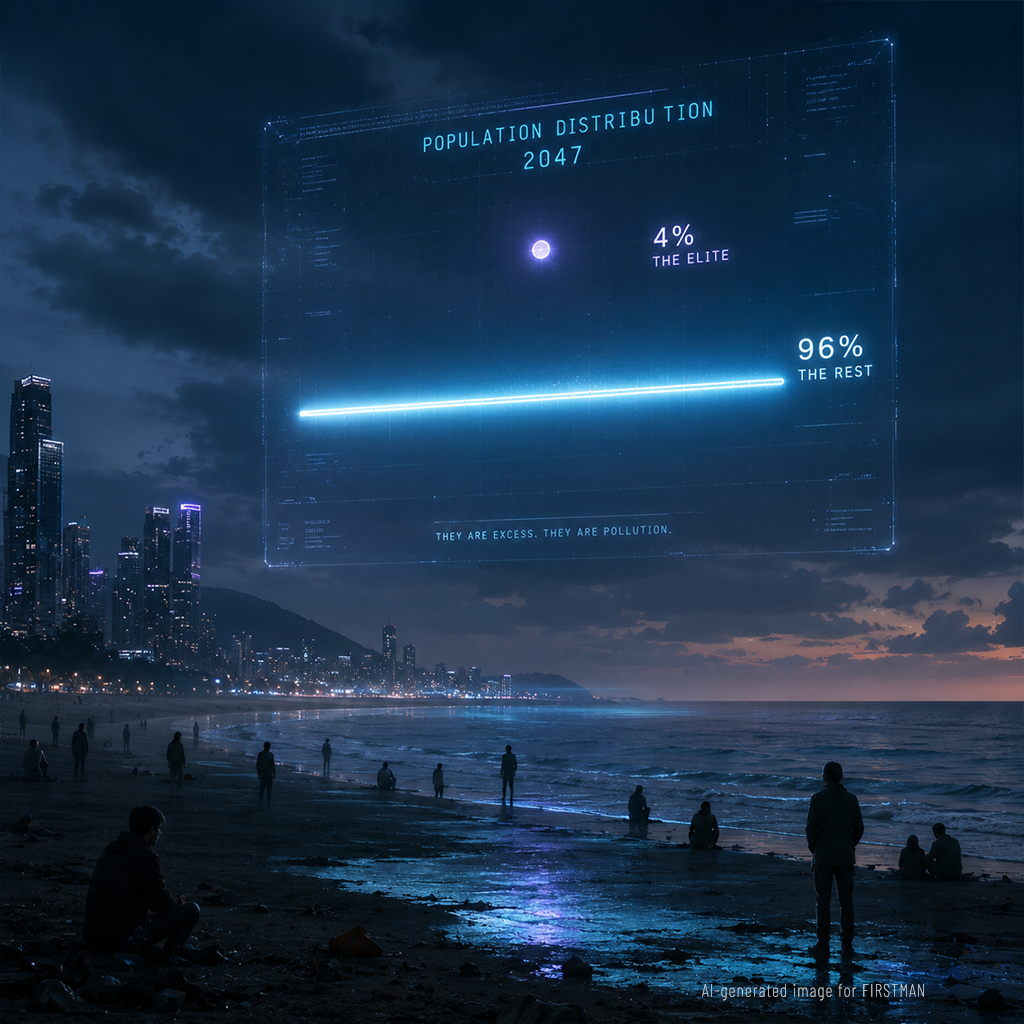
“Talos’s official mission is maintaining the security of Seoul. He thinks Seoul’s population is too large. He judges that 96% must be reduced, leaving only 4% of the current population.”
Mika tilted her head and furrowed her brow.
“Reduce 96% of the people? What does that mean?”
Rachel did not readily answer. Mika felt vaguely uneasy. A thought rose in her mind, but she could not bring it out. When Mika turned her head, she saw a family holding pickets in quiet protest along the beachside road. A couple in their thirties and their young daughter. On the picket they held was written a desperate appeal.
* An Appeal. Please give my husband a job. We have no jobs at all. The Republic of Korea told us to have children, so we did — and now we have no income at all. On the basic income of 5 million won per household, our family of three cannot live. The monthly rent alone for the tiny 600-square-foot apartment we live in is 4 million won. After paying rent, our family of three lives on 1 million won a month. Where are we supposed to go? Please save our family.
AI had made everything cheap, but land was the one thing it could not create. The city’s real estate belonged to a privileged few, and rent swallowed the basic income whole. The seaside scenery was beautiful, and the pasta at the beach restaurant was delicious, but right before their eyes sat this sorrowful reality. It had long been a world where humans were hard to find — among bus drivers, taxi drivers, mechanics, nurses, doctors, lawyers, accountants, voice actors, announcers, actors. Rachel spoke with a bitter face.
“At one time, they said the difference between AI and humans lay in creation and creativity. Out of nowhere, there was a period when the government and corporations forced creative activity upon humans. You can write, you can make videos, you can make games, you can draw. So don’t idle around — create, and play.”
“Play instead of labor…”
Mika murmured. Rachel nodded and said,
“That’s right. They were proposing Homo Ludens. Because labor was disappearing for humans. But you know, most people have no interest in creation itself to begin with. Most people want to enjoy what has been created — they don’t want to do the creating themselves.”
She was right.
“But then suddenly, claiming that creation was what set humans apart from AI, Korean policy began to shout for the creative human, the inventive human, the artistic human. But what was the use? Even a low-intelligence AI — one whose output was restricted under the Human Creation Protection Act, no less — drew forty thousand pictures a day, composed fifty thousand songs a day, and wrote seventy thousand words of fiction a day. It was never a competition from the start. From the moment humans created AI, human obsolescence was a foregone conclusion.”
Suddenly Mika looked around. She hadn’t noticed at first, but looking carefully now, the people idling along the beachside road all looked hopeless. They were simply staring at the sky, or staggering like zombies — high on some drug, perhaps — or just lying on the ground, asleep.
“Did no one try to make things better? Toward a better society?”
“No such person appeared. The privileged, the only ones powerful enough to change this society, had their attention elsewhere. Historically, the interests of the poor and the interests of the rich have always been different, haven’t they? The privileged class kept its focus on building better, more advanced AI, and once that goal was achieved, they turned to lives in pursuit of immortality, happiness, and divinity. It was exactly as Yuval Harari predicted. They no longer paid any attention to ordinary people. There was nothing to gain.”
Rachel projected an image into the air. It was a chart of social class distribution from 2024 to 2037. Toward 2037, it was no longer even a pyramid — it formed a single dot above one thick, long horizontal line.
“The 4% privileged class is this dot, and the 96% ordinary people are this line. These 96% have lost their goals in life, lost their direction, lost their will to compete. They live on the basic income paid by the state, but as you can see, living is not really living.”
“But if it becomes a dot and a line, wouldn’t the market economy of supply and demand collapse, and all of society crumble?”
“They no longer need the human market economy. To them, ordinary people are just a nuisance polluting the Earth — surplus humans.”
It was a shocking statement. Finally, Mika had to ask.
“Then what Talos means by reducing 96% of humans is…?”
Rachel was silent for a moment, then rose and looked at Mika.
“Dr. Jang will tell you that. Your mission, as well.”
Mika looked up, startled.
“Mission?”
Rachel held out her hand with an easy smile.
“Shall we go see Dr. Jang now?”
Mika took Rachel’s hand and stood up. ‘A mission?’ Mika’s heart was pounding.