
The Micro and the Macro
Every actor arrives on set holding every card in the deck. They have read the script; they know how it ends; they know what the whole thing means. The audience knows none of it. Park Sun-jae spent years watching that gap open up on his monitors before he understood what it was — and before a young actor who claimed to think about nothing at all handed him the answer without knowing he had.
What does it mean to act well?
Ask that in a room and you will sometimes get an answer — a brisk one-liner, a long meandering theory, a running account of what the speaker happens to be working on at the moment. Some people are glad to be asked.
But often nobody says anything at all. For a long time I assumed the silence meant nobody knew. It doesn’t. People have opinions. What they don’t want is to say something in front of everyone and be looked at for it — not the attention, not the praise, and certainly not the exposure of having got it wrong. Which is why the least polite-seeming move is often the kindest: to look someone in the eye, say their name, and ask what they think. Being called on gives a person cover. Now the answer isn’t a bid for attention; it’s just compliance.
Here, though, there’s no room. There is no one but you and me. So answer however you like. I’ll ask again.
What does it mean, to you, to act well?
“No idea.”
“None at all?”
“If I knew that, would I be here?”
That’s roughly what you’ll say, and honestly, so would I. How would I know? I don’t know what it means to act well either. I’m only putting the question on the table because it’s what I’d like us to talk about this time.
There was an actor.
He had been working since childhood, and it showed. His lines landed. He knew where the camera was. His face did what it needed to do. He was still when stillness was called for and he moved when movement was. Nothing excessive, nothing lacking. In a word: good.
What impressed me most was something else. Every one of his scene partners on that job was making their debut. When the experience gap is that wide it always shows on screen — except it didn’t. In his scenes, the newcomers’ inexperience simply failed to register. He was carrying them. And he was doing it so quietly that nobody, including them, ever knew they were being carried.
We worked together three times, and all three were good. On his jobs I could stop worrying about the acting and attend to everything else, which for me was not a small thing. I was a director who also produced. Always. Which meant that finishing on schedule and inside the budget outranked finishing well, and which meant, on average, that the work came in a notch below what it might have been. A shameful kind of director, in other words. That was the arrangement I lived in.
He was not, I should say, a leader. He didn’t gather the young actors around him and run rehearsals or dispense advice. He was as introverted as I am — quiet, off to one side between setups, muttering his lines under his breath.
He didn’t appear to read much. He didn’t do the endearing thing of colour-coding his sides and filling the margins with notes. His script was simply clean. And his head, as far as I could tell, was clean in the same way — empty. (I don’t mean he seemed vacant. I don’t mean innocent either. I mean it was, quite literally, empty, and I have never found a good way to describe it.)
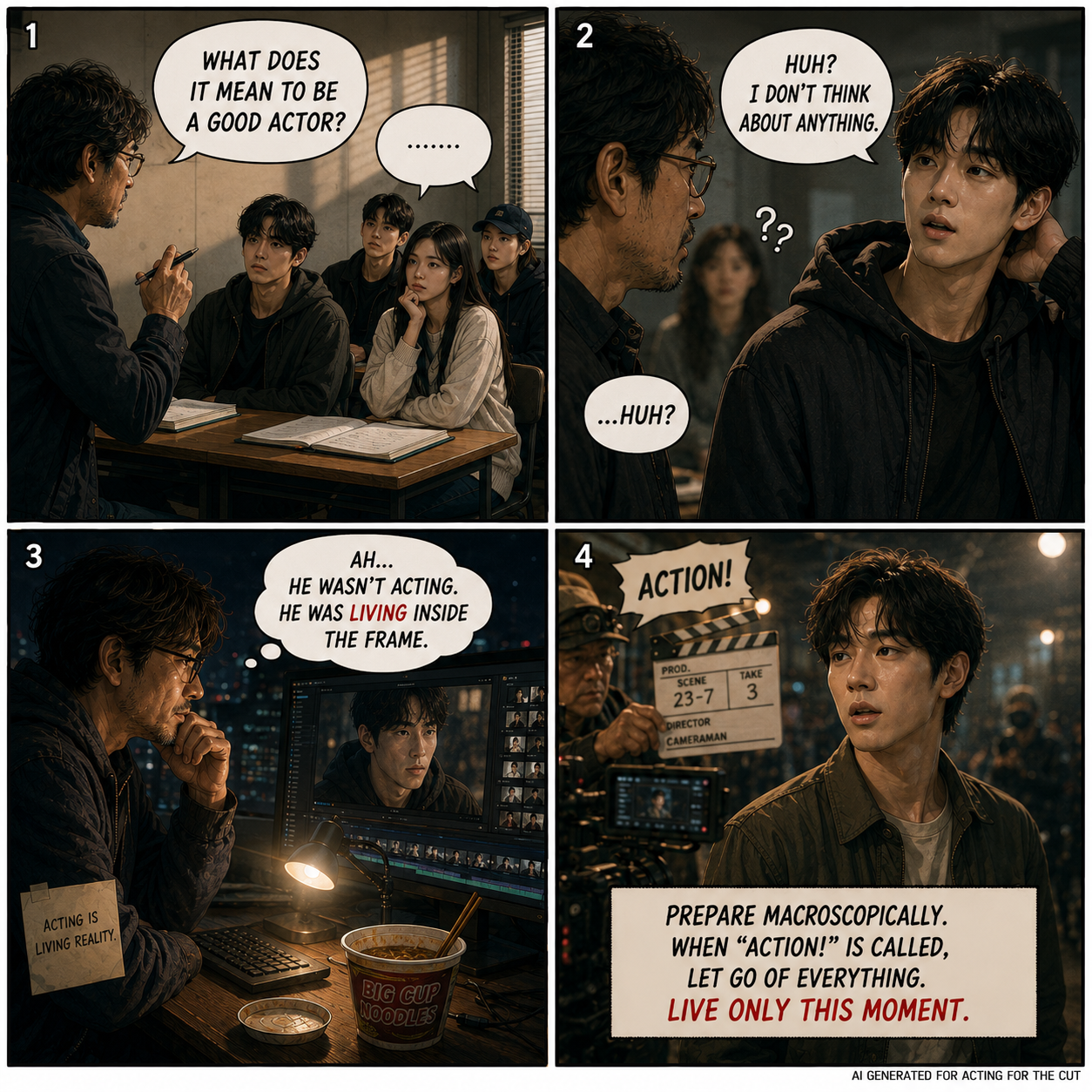
So I asked him once what he thought about.
“Sorry? I’m not thinking about anything.”
I have never been able to shake that answer. It was an entirely ordinary thing to say, and yet it circled in my head for a long time afterward. That’s right. Not thinking is right. That’s the correct answer. I had no idea why I believed that. I just did.
Then the camera would roll and I would sit and stare. There was no display of immersion, no emotion pumped up past its level, no voice pitched a little higher for effect. No visible effort to be good. He was not — and here is the thing I had seen a thousand times and never had a name for — he was not a young actor wanting to act well, standing where the character should have been. He wasn’t straining, and he wasn’t papering over not knowing how with obvious hard work. He was nothing like the ones I’d watched all those years.
He played fantasy, grief and rage the same way: easily, unhurriedly, as if none of it cost him anything. Watching him, I felt relief. I felt safe. And then I felt moved, which is not a thing a director on a tight schedule expects to feel.
What exactly was he doing?
There was nothing showy in it, so what had actually reached me? That night in the edit room, past two in the morning, pushing his cuts around and eating instant noodles out of the cup, I finally understood what I had been looking at.
What he had been doing was live.
“Live? Like a live broadcast?”
Not wrong, but not it either. A drama isn’t going out live; nothing about the situation is literally live. What I mean is closer to this:
He was simply living inside the frame. What he showed me was not a performance of reality. It was reality.
So: playing a filmed drama live. Feeling reality inside a fiction. What could that possibly mean?
Here is what we do. A script arrives and we read it end to end, over and over. We know every character. We know the plot. We know the beginning and we know exactly how it finishes. Between the writer and the director we have been fully briefed on what the thing is about, and we know precisely which part we are playing and how it is meant to be played.
Which is to say: we begin acting with every card in the deck already in our hand. If this were a contest, the position would be indecently favourable.
But consider what follows. The audience watching this film knows nothing. We, performing it, know everything that comes before and after. And there, in that asymmetry, an unexpected drift begins.
The time of someone who starts knowing everything and the time of someone sitting in the dark knowing nothing do not run at the same speed. The point where we stand and the point where the audience stands twist slightly out of true, and the twist widens, until the feeling we are transmitting and the feeling they are receiving stop arriving at the same instant. Our clock reads 1:20. Theirs still reads 1:19. We are a minute ahead. It sounds like nothing. It is fatal.
“Sorry? I’m not thinking about anything.”
That was the actor who had me leaning toward the monitor. He really was thinking about nothing. The camera rolled and he acted; someone called cut and he stopped. There were times between takes when his face was so occupied that I assumed something enormous was going on behind it. Nothing was. He was blank.
To live in the present. That is what it means to act well.
We do not know how our lives end. We don’t know what tomorrow brings; we don’t know what we’ll eat tonight. And yet, on the sole grounds of being an actor, on the sole grounds of having read the script, we know how our life concludes and what message we are meant to leave behind as we die. Is that fair to the audience?
Obviously not. We are supposed to not know. Not know that we read the script; not know the ending we’ve already been handed; not know who we are, what function we serve, what theme we carry, what task we’ve been assigned. That is the condition under which we ought to be acting. And that, I think, is where the honest answer to what does it mean to act well has been hiding all along.
Who am I? And where is this?
Korean readers will recognise the line. It comes from “We Are,” a 1993 song by the duo Deux, and it long ago escaped the song — it survives now as the phrase Koreans reach for when they have lost their bearings entirely. Which is the point: we go on living without knowing who we are or where this is. And because of that, we keep asking — is life like this? or like that? — in films, in dramas, in novels, in musicals, in music, in paintings. We ask because we want to know what our lives are, and because we never stop wanting something we can’t name.
So what is it, this acting that lives in the present, in the same time zone as the audience? It comes down to knowing the difference between micro acting and macro acting.
“Between what and what? I’ve never heard either term.”
You haven’t. I made them up, for want of anything better.
Micro acting is this: attending only to the line in front of you, the single stage direction, the single piece of dialogue — and not letting yourself be aware of what comes next. The words and actions you are performing right now are the entire sum of what you know. What follows, you do not know at all. That is micro acting.
“All right, I think I’ve got it. And macro?”
Macro acting is knowing where you are standing. Coordinates, if you like: we are in the solar system, on Earth, in the year 2026. More concretely: this set, the period accuracy of the production design (is this a straight historical or a fusion piece?), what is actually being made here — a film, a series, and to what end. It is taking in what is plainly in front of you and registering it. And if there’s preparation time, it is doing a little reading on the period, looking at the source material if there is one, talking to the writer and the director, and making an honest effort to understand where this production is trying to sail. That posture is macro acting.
“Forgive me, but you called it acting. Isn’t there any actual acting in macro acting?”
There is. In fact you’re already doing it. Arriving on set and taking in the flow of the day, the air of the place, the temperament of the director, the direction the room is drifting — that alone is already macro acting. Because when you are on that set you could not forget the script if you wanted to. You know what the next scene is and what it requires; you have every line memorised. Short of amnesia these things cannot be put down, and they are with you the entire time you are there.
And the version of you that exists on a set is not the version of you that exists in daily life. However convincingly you pretend otherwise, everything you present on set is performance — I know this, because I have watched it for thirty-one productions. You arrived keyed up, resolved to give the job everything. So the very posture you hold while standing by, the bearing itself, is already a prepared performance. (I don’t mean this as an accusation of phoniness. I mean the macro acting that makes micro acting possible has already begun.)
“Then concretely — how am I supposed to do both?”
It’s simple. Read the whole script, learn everything there is to learn, do all the study there is to do — that far is macro acting — and then forget all of it. From there it is micro acting. When you shoot the scene, live only inside that scene. When you play the line, live only inside that line. Exactly as our own lives give us no sight of what is one step ahead: throw out everything you know about the next scene and breathe only inside the reality of this moment.
“So — forget everything I’ve read and heard. That I can do.”
You can. Forgetting what we’ve heard and what we’ve read is the thing our species does best.
“Then what do I need the macro for?”
Because without that base you may turn out not to be an earthling at all, but an extraterrestrial, or a stone half-buried on Mars. Living only inside the words and actions of the present moment is not a licence to play some entirely unrelated life at some entirely unrelated set of coordinates. At minimum you need the baseline — that you live on Earth, in Korea, in the twenty-first century — and you need to know where the production is pointed. Micro acting laid on top of that macro foundation is what acting well looks like.
Macro acting is the acting you do up to the moment someone calls ready. Micro acting is the acting you do from the moment you hear action. Skip the first and you lose your coordinates. Skip the second and an error creeps into everything you transmit. Whether you manage both or fail to is the line that separates acting well from not.
Two things turned up while I was preparing this lecture.
The first is an essay written in 1915 by the American actor William Gillette, titled “The Illusion of the First Time in Acting.” Its argument is that an actor at the thousandth performance must appear to be saying the line for the very first time in his life. Correct, obviously.
But Gillette was a man of the stage. What, then, are those of us in front of a camera supposed to do? We shoot the same scene many times over and afterwards choose the take that cuts. So for us the question is not does it look like the first time but is it real in every single cut. The stage’s repeatable first time becomes, in front of a camera, a matter of which performance survives the edit room.
The second is an experiment published in 2019 by a team led by Steven Brown, who put trained actors inside an fMRI scanner and asked them questions. Once they answered as themselves; once they answered as Romeo or as Juliet. The finding was that answering in character produced a broad decrease in brain activity. The medial prefrontal cortex — the region that handles the question who am I — went conspicuously quiet. The researchers called it a “loss of self.”
Which means that acting well is not a state in which the head runs harder in pursuit of a good performance. It is a state in which the head is empty. The young man who told me “Sorry? I’m not thinking about anything” was not being modest. He genuinely wasn’t thinking about anything, and that condition of thinking about nothing was in fact the release that carries an actor across from macro acting into micro acting.
If micro acting is living with nothing in your possession but this moment’s stage direction, this moment’s line — and macro acting is arriving on set knowing every coordinate that line sits inside: the period, the writer, the character’s history, the place this scene occupies in the whole story, and what this production has to say to the time we are living in — then you must be able to move freely between the two before you can call yourself anything close to a master.
He simply didn’t have the words for it. He had been doing all of it already.
Sources: William Gillette, “The Illusion of the First Time in Acting” (Dramatic Museum of Columbia University, 1915); Steven Brown, Peter Cockett & Ye Yuan, “The neuroscience of Romeo and Juliet: an fMRI study of acting,” Royal Society Open Science 6(3), 2019.
Leave a Reply