
The brief sounded manageable. Five episodes, fifteen minutes each, for a YouTube drama platform — eighty minutes of total content including a teaser. The premise had real teeth: a twenty-something intern and a fifty-something intern competing for the last permanent position at a single company. Generational friction, office politics, the particular anxiety of precarious employment in contemporary Korea. Director Park Sunjae, with thirty-one drama productions behind him, took the assignment without hesitation.
What followed was a slow-motion lesson in how creative enthusiasm, when left to compound unchecked, builds quietly toward catastrophe.
The Script That Ate Itself
The writer on the project had been forged in variety television — a background that produces a very specific kind of professional: adaptable to the point of self-erasure, constitutionally incapable of defending a draft against a note. Every suggestion from the brand team found its way onto the page. Every producer’s comment landed. Director Park offered ideas freely, and those found their way in too. The script was, in the most literal sense, democratic — and democracy, in screenwriting, is not always a virtue.
By the time principal photography approached, the final episode had swelled past forty pages in its first draft. Forty pages for fifteen minutes. For context: that is enough material for a sixty-minute episode with room to spare. The producer came to Park with the question both of them had been quietly sitting with.
“Can we actually shoot all of this?”
Park said yes.
He knew it was a wager, not a plan. Two years earlier, he had made the same bet on a six-part drama originally designed at twenty-five minutes per episode. It finished at sixty minutes per episode. Eighteen shooting days to cover what should have taken forty. He’d made it across the line then — barely, expensively, and at considerable cost to his nerves. He told himself this project was shorter.
The cast came together well. Strong material draws good actors, and when good actors arrive on set, they do what good actors do: they inhabit the space completely. Every glance holds a beat longer than the script indicates. Every pause lands with precision. The supporting cast — mostly newcomers to the medium — brought the same commitment as the leads. Nobody had told them otherwise. Nobody could.
This is the part they don’t teach in acting school.
“If I had walked up to any of those actors mid-take and said, ‘Good, but can you play it at 1.2 times the speed?’ — I would have destroyed everything they’d built. Actors prepare a performance the way musicians prepare a piece. The timing isn’t ornamentation. It is the structure. The moment you touch it, the whole architecture falls. The eyes go empty. The lines vanish. You get a body standing in front of a camera, not a character.”
So he said nothing. He let every performance run to its natural length, collected the footage, and carried it into the edit room.
The assembly cut ran three hundred minutes.
Alone with the timeline, Park permitted himself the speech he couldn’t give on set:
“Do you know what audiences are like now? They decide in the first second whether they’re staying or swiping. All those carefully layered reactions, all those meaningful silences — gone. Cut. The edit doesn’t care how hard you worked on it.”
No one heard him. But the question that followed is one every working screen actor should sit with seriously: if performers understood what actually happens to their work in the edit room — if they could see, in advance, how a sustained breath becomes dead footage, how a built emotional arc becomes a cutaway to the master shot — would they approach the camera differently?
Four Theories That Explain What Just Happened
The relationship between editing and performance is not a recent discovery. It has been studied, mapped, and increasingly measured for over a century. What follows is not film-school atmosphere. These are the structural principles that determine whether a performance survives the edit — or gets replaced.
I. The Kuleshov Effect — Verified by Brain Scanner, a Hundred Years Later
Lev Kuleshov, c. 1920 → Mobbs et al., 2006; Barratt et al., 2016; fMRI studies, 2023–24
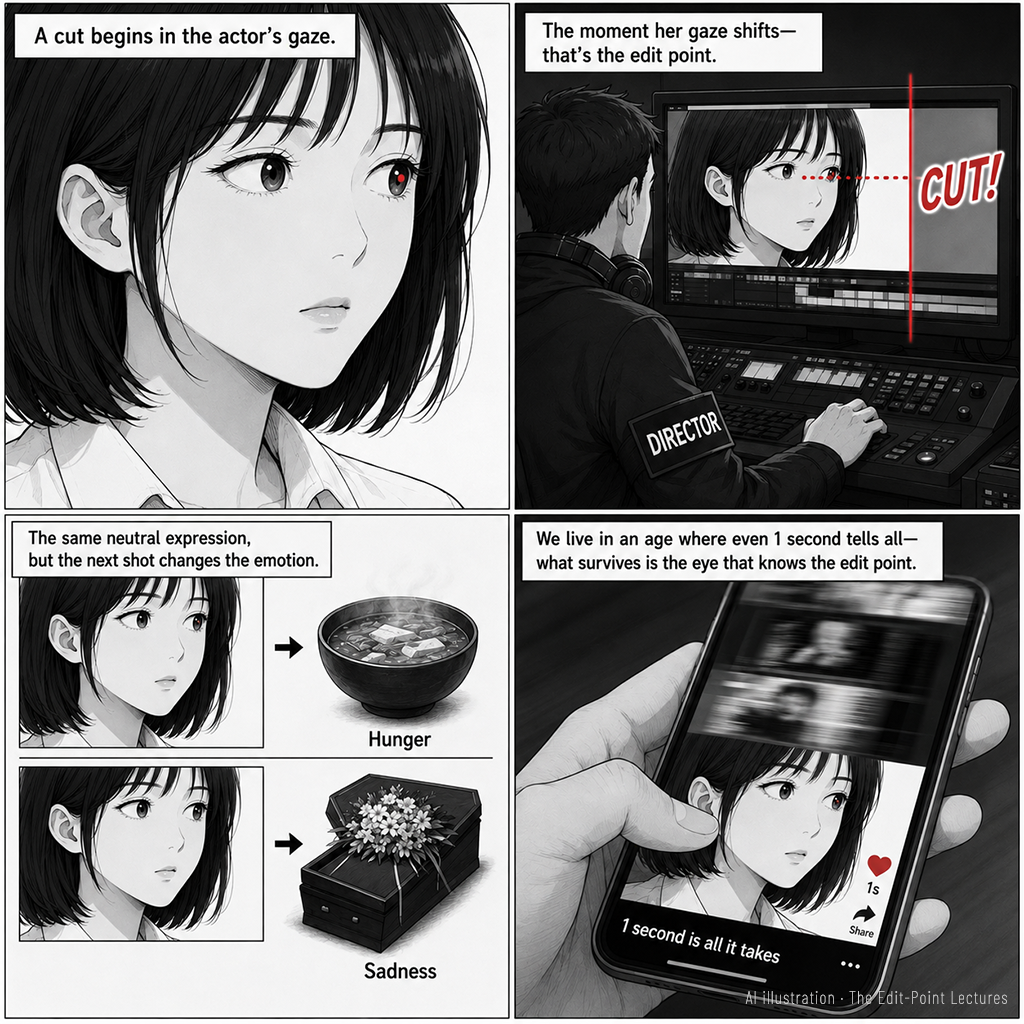
Soviet film theorist Lev Kuleshov ran what may be cinema’s most consequential experiment sometime around 1920. He took a single close-up of actor Ivan Mozzhukhin — a deliberately neutral, expressionless face — and cut that identical shot in sequence with three different images: a bowl of steaming soup, a woman lying in a coffin, a child playing on a sofa. Audiences watching each version reported different emotions in the actor’s face: hunger, grief, paternal warmth.
Mozzhukhin had done nothing. The edit had done everything.
The original film has since been lost; what survives are written accounts by colleagues who witnessed the screenings. For most of the twentieth century, the Kuleshov Effect occupied an awkward position in film theory — universally cited, impossible to verify in any scientific sense, potentially exaggerated in the retelling.
Then neuroscience caught up.
In 2006, a research team led by Dean Mobbs at University College London reproduced Kuleshov’s exact structure inside an fMRI scanner. Participants viewed the same neutral face edited against different contextual shots. The finding held: not only did viewers report different emotional readings depending on what followed, but their brains — specifically the amygdala and surrounding emotion-processing regions — showed measurably different patterns of neural activation. The effect was not a cultural convention or an artifact of suggestion. It was visible in the brain. A more refined replication by Barratt and colleagues followed in 2016. By 2023 and 2024, researchers were running the same tests using actual film sequences.
The conclusion is no longer intuition. It is neuroscience on record.
A screen performance does not exist as the actor created it. It exists as the editor assembles it. The emotion an audience perceives belongs not to the actor alone — it belongs to the cut that follows. For anyone working in front of a camera, this is the most important sentence in this lecture.
II. Tim J. Smith’s Attentional Theory — Where, Exactly, Does the Cut Go?
Attentional Theory of Cinematic Continuity (AToCC), 2012
Kuleshov demonstrated that editing creates meaning. British cognitive scientist Tim J. Smith, working at Birkbeck, University of London, pursued the next question: where should the edit actually happen? What separates a cut that feels invisible from one that feels like a collision?
For most of cinema’s history, editors knew the answer as embodied knowledge — something felt in the rhythm of the footage, not derived from principle. Smith decided to measure it.
Using eye-tracking technology — cameras that record precisely where viewers are looking, frame by frame — he traced what happens to audience attention in the seconds just before and after a cut. His 2012 paper introduced what he called the Attentional Theory of Cinematic Continuity (AToCC). The finding: effective editing mimics the way human attention moves in real life. In daily experience, we are constantly jumping our gaze from one point to another; we simply don’t register ourselves doing it. When a film cut falls at the precise moment a viewer’s attention is already in motion — already seeking the next beat — it registers as no cut at all. Smith named this edit blindness.
MATCH-ACTION cuts, shot/reverse-shot structure, the 180-degree rule, POV editing — all of it rests on this principle.
The implication for actors is specific and frequently overlooked. Editing does not occur at random. It occurs at the moments when audience attention is already moving. And what moves audience attention, in almost every case, is the actor. A glance. A turned head. An inhaled breath before a line. A hand rising from a table. These are not incidental physical behaviors. They are, by the logic of AToCC, the moments where the editor will cut.
An actor who understands this is, without necessarily knowing it, sending the editor a continuous stream of navigation signals: cut here, not there, here. An actor who doesn’t understand it generates those signals anyway — but without intention, and often at the wrong moments.
There is a corollary Park noticed across years of production. First takes, he found, tend to produce unusually cuttable performances — even when they’re called NG for technical reasons. “I’d get to the edit room and keep coming back to the first take,” he recalled. “The second take would be technically cleaner. But the first take had something alive. The eyes were tracking correctly. The breath was landing where it should. The whole thing was generating cut points naturally.”
Smith’s framework explains why. On a first take, the actor’s attention hasn’t yet been filtered through self-correction and repetition. The eyes are genuinely seeking. The breath is genuinely arriving. And genuine, unmediated attention — it turns out — creates natural edit points.
III. James Cutting’s Research — The Shrinking Window
Attention and the Evolution of Hollywood Film, 2010
Smith located where cuts happen. Cornell psychologist James Cutting addressed a different question: how long can a single shot actually hold an audience’s attention before the edit must arrive?
Cutting and his team analyzed 150 commercially successful Hollywood films spanning seventy years, from 1935 to 2005. The results moved well past the familiar observation that contemporary films cut faster. Average Shot Length (ASL) — the mean time a single image stays on screen — fell from roughly ten seconds in the 1930s and ‘40s to under four seconds by the 2000s. But the more significant finding concerned the structure of that compression.
The distribution of shot lengths in modern films has converged toward what physicists call a 1/f structure — known informally as pink noise — the same mathematical pattern found in human attentional rhythms. Films produced after 1980 conform to this pattern more precisely than earlier films. Contemporary editing has not simply become faster. It has evolved to synchronize with the cadence at which human attention naturally rises, sustains, and releases.
The practical implication for screen performers is direct: the window in which a performance must fully arrive has contracted. Not because audiences have grown less intelligent or less capable of depth, but because the editing rhythm that holds their attention has been calibrated to something more immediate. A setup that once had ten seconds to establish itself now has three or four.
Park’s monologue to an empty edit room — “Do you know how impatient audiences are these days?” — was not a frustrated opinion. It was a statistical observation that had already been made, measured, and published.
IV. Gloria Mark’s Forty-Seven Seconds
Attention Span, 2023
A 2015 statistic once traveled very far on the internet: human attention had shrunk to eight seconds, shorter than a goldfish. The comparison was vivid enough to generate considerable media coverage. It has since been largely discredited; the underlying sourcing does not survive scrutiny, and the academic community has set it aside.
What replaced it is more carefully documented and, if anything, more consequential.
Gloria Mark, an informatics researcher at the University of California, Irvine, spent roughly twenty years tracking how people actually distribute their attention when seated in front of screens. Her research, synthesized in a 2023 study, found that the average time a person spends on a single screen before shifting focus has dropped from approximately two and a half minutes in 2004 to around forty-seven seconds today. Once that attention is interrupted, full return to the original task takes an average of over twenty minutes.
When this finding is read alongside behavioral data from TikTok, YouTube Shorts, and Instagram Reels — platforms where, by most industry analyses, a viewer decides within the first one to two seconds whether to continue watching or swipe away — the actual parameters of screen performance become visible.
The era when one second tells you everything is not a rhetorical posture. It is a measurable condition, documented in peer-reviewed research.
Audiences no longer wait for a scene to develop. They read the first frame, the first breath, the first look — and decide. A performer who moves toward their emotional truth through a visible process, whose preparation shows as runway, has already lost the viewer before arriving. Screen performance in this environment is not a journey the audience observes. It is a state they enter, or they don’t, in the opening seconds.
What This Actually Means at the Camera
None of the above argues that preparation shortens. If anything, it argues the opposite. The craft required to deliver a fully inhabited moment immediately — without visible warm-up, without on-screen runway — is more demanding, not less, than a slow build. It requires that the emotional work be complete before the camera rolls, not during.
Anticipating specific edit points in rehearsal is genuinely difficult and not always possible. Final cut decisions are made in the edit room, after the shoot — sometimes weeks later — and a detailed storyboard with pre-distributed floor plans and multiple read-throughs helps considerably, but is not guaranteed. What a performer can develop is something more durable: an instinct for the logic of the cut. An understanding of what cameras are positioned to capture at a given moment. A read of what the director’s coverage plan implies about where audience attention will be directed. A sense of what in a given scene is likely to compress versus sustain.
Human attentional rhythms have shortened. Platforms have multiplied. Production schedules have compressed to match. The edit room is effectively present on set now — in the decisions made during coverage, in the brevity of the schedule, in the implicit arithmetic of what can and cannot survive post-production. For a performer who understands this, that is not a constraint. It is information.
Three hundred minutes became five episodes. The project made it out. But the gap between what those actors prepared and what the audience finally saw — that gap is the subject of this series.
Over the next fifteen lectures, we will close it.