
Park Sunjae is a Korean film and drama director. He has written, directed, and edited 31 works across film, drama, short-form, and music video, including Color Rush, First Love, And So I Live Today, and Crazy Love. He is pursuing a master’s degree in Cultural Content at Konkuk University and works as a freelance director.
His sets have rarely been gatherings of established stars. They have been festivals — newcomer actors, idol-trained actors, and a handful of veterans, all arriving with their own preparations, their own languages of performance, their own ideas about what a take should look like. Editing was the only place where this Babel could be reconciled. Not by selecting the best performance, but by selecting the one that fit, the one that did not stick out, the one that survived alongside the others.
In that editing room he came to a truth most actors never see. Takes that drew applause on set get cut. Takes the actor dismissed as failures live on. He could never find a clean way to tell them why. This column is his attempt — to lift “the edit point” out of the editor’s private vocabulary and into the center of screen-acting practice.
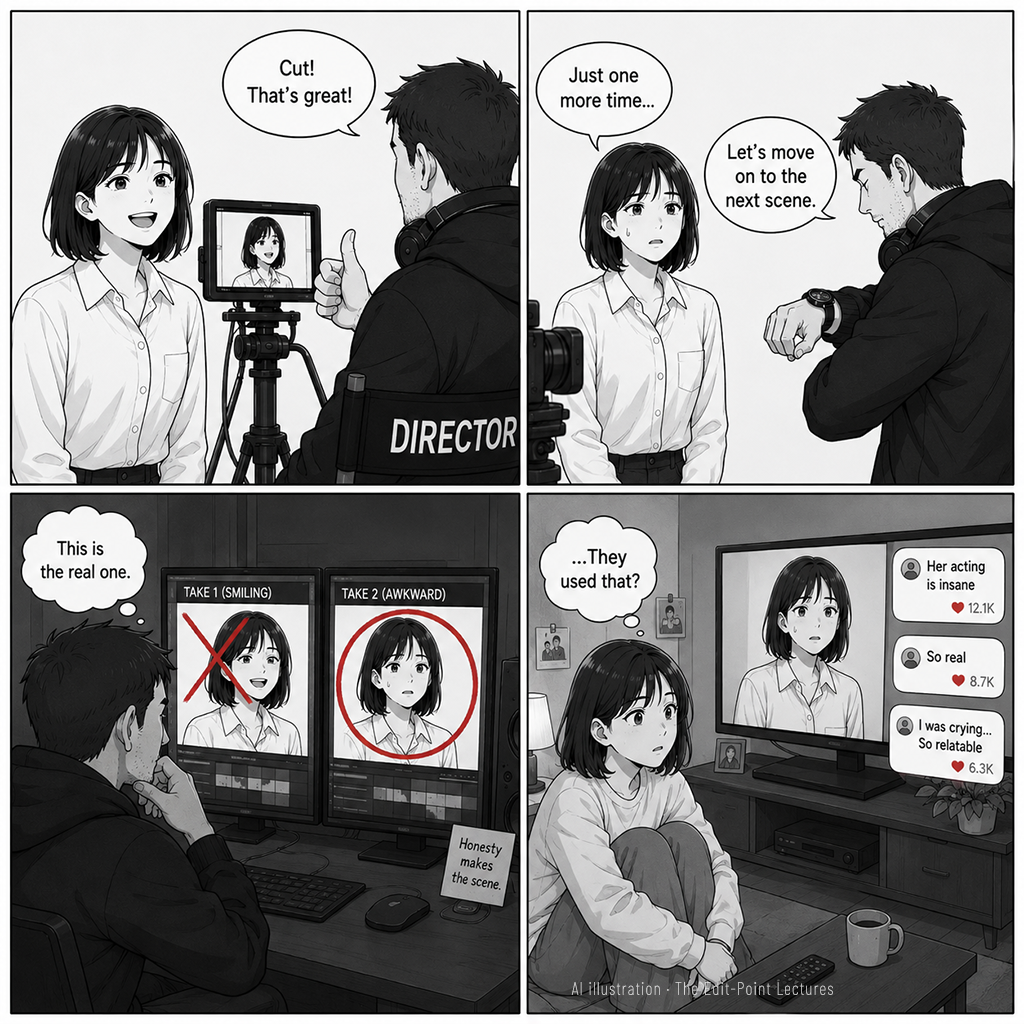
It was past 11 p.m. on a soundstage in Paju when the actress finished what she was sure was the take. A newcomer in her late twenties, this was her first major drama. She had been on set since seven that morning. She smiled at her scene partner. From behind the monitor came the call: “Cut. Good.” A thumbs-up from the director.
For the first time that day, she allowed herself to feel that the work was going well.
Two hours later, on the same scene, a second take. Her timing felt off — barely, but enough. Her eyes, she thought, betrayed her. “Director, one more. That was awkward.” He looked at his watch.
“Next scene.”
She went home certain that the second take would be cut.
It wasn’t.
Three months later, when the drama aired, the take that survived was the one she had asked to redo. Comments scrolled across her phone in real time. Real. This performance is insane. Look at her eyes. She watched alone, knees pulled to her chest, scrolling.
That one made it?
This is the gap I have spent thirty-one productions inside.
I am a Korean film and drama director, and over the past decade I have written, directed, and edited 31 works — films, dramas, short-form series, music videos. I have not, for the most part, directed established stars. The performers on my sets have been mostly newcomers and idol-trained actors, learning on the job, often meeting me for the first time on the morning of their first scene.
It is in editing those 31 works that I have come to believe the central proposition of this column: in screen acting, real acting is what survives the cut.
What an actor judges in the moment — that was good, that felt right, that was the one — is the wrong question. The right question is the one only the editor can answer, weeks later, in a dark room, switching between takes on twin monitors: which one belongs in the final cut?
This column will spend sixteen weeks unpacking that gap. But before any of the analysis, a description of the conditions that have made the gap unbridgeable.
The minute hand has shortened
The Korean broadcast era is gone. Where there were once three networks scheduling drama production around decade-old norms, there is now a fractured market — Netflix, Disney+, Wavve, TVING, YouTube, web-drama platforms, short-form vertical-video apps, and AI-generated content circling on the edges. Korean visual storytelling, as a global product, has expanded enormously. We have entered the multi-medium era, and we are about ten years in.
One thing has not changed: there is never enough money.
New formats arrive carrying a constant companion — the budget shortage. And the budget shortage has a peculiar, almost mystical, ability to make the impossible possible. It compresses what cannot be compressed. It performs the magic trick of producing a finished drama for a fraction of what it should cost. Inside that magic trick are a series of small surrenders, most of them invisible to viewers.
Here is one.
In a production I directed recently, I met my cast for the first time at a full table read. It lasted three hours. That was all the time I had with my actors before stepping onto set. The idol-trained leads were already booked into other schedules — concerts, variety appearances, training. The newcomers, paid at the low end of the rate sheet, could not afford to give the production their full attention; they were auditioning elsewhere, working part-time. There was no rehearsal week. There was no character workshop. There was the read, and then there was the shoot.
The first time I really met them was on set, often minutes before the camera rolled.
The legal frame around Korean production is now a 52-hour work week, with mandatory one-hour lunch and dinner breaks. A shooting day cannot exceed twelve hours. Inside those twelve hours, the crew must accommodate costume changes, makeup touch-ups, travel between locations, set dressing for the next scene, the director’s blocking walk-through, and the lighting setup.
What remains for actual acting and shooting — for the actor to be in the scene, with the camera, doing the thing they came to do — is shockingly little.
Multiple takes are a luxury. Most scenes get one. “Cut and try again” is a phrase that belongs to a different era.
The era of fourteen takes
When I was a production assistant on Korean film sets in the early 2000s, I watched a different industry at work. The director would walk slowly through a setup, talking with the actor — what if you held that look longer? what if she crossed first? He would discuss it with the DP. He would do fourteen takes of one scene, then fourteen more from a different angle.
If a prop felt wrong, the production designer’s runner would be dispatched to find a new one, and the entire crew would wait — quietly, without complaint — until the right object arrived. The director was making art. Nobody questioned the pace.
That era is over.
Today, when a location is locked, the call sheet arrives first. Hours allocated. Hard out. Who arrives at what time, which scene runs from what minute to what minute, when everyone breaks, when the trucks roll. The schedule has become the gravity of the production.
To produce that schedule requires preparation — and preparation, too, has been compressed. Pre-production used to take six months. Then three. Now I am routinely given two weeks. One month if I am lucky. Inside that window I have to lock the script, the cast, the crew, the locations, the production design, the costumes, the budget, the camera-and-lighting plan, the music conversation, the editor relationship, and the schedule itself. Then we shoot.
A daily call sheet I saw in 2005 listed five scenes. The call sheets I carry onto set now run twenty-five scenes — sometimes more. A 110-minute drama I shot recently was completed in three shooting days. The math suggests thirty scenes a day.
There is no time to talk through performance choices. There is barely time to find the actor’s mark.
“Look at his eyes for four seconds”
Imagine this. You are a young actress. You have prepared the scene for a month — you have worked out the character’s history, her interior monologue, the choices she might make. You arrive on set at dawn. You meet the director for the first time, briefly, between the makeup chair and the first slate.
You stand on your mark. You ask, sincerely: “Director, how would you like me to play this?”
It is a reasonable question. It is, in fact, the only question you can ask, because nobody told you anything before today. And the director — me — does not have time to answer. The next scene is in twenty minutes. The light is changing. The location turns into a pumpkin at 6 p.m.
So I give you the only direction I have time for.
“Look at his eyes for four seconds. Don’t move until I call cut.”
Can you make that work? Can you, on the basis of that instruction, generate the inner state that will read as truthful on camera? With what emotion? What facial register? Concerned? Hopeful? Trying-not-to-cry? You would like to ask. There is no time to ask.
I have stood across from many young actors and seen the question hover in their eyes, unasked. We did not have time for the conversation. We did not have time for the rehearsal. The set has become a place where each professional is expected to bring their own competence and merge it with the others’ on the fly — actors act, directors direct, and the assumption is that everyone has come prepared to do their job without instruction.
For better or worse, this is the working condition. And the kind of acting that thrives inside it is a particular kind. It is not the acting that survives in the workshop, or in the rehearsal hall, or in the carefully prepared production. It is the kind that survives in the editing room — three weeks later, at 2 a.m., as the editor flips between takes and decides which one tells the truth.
That is what I want to name. That is what this column is about.
A medium that has fractured, an acting style that hasn’t caught up
Screen acting and stage acting have always been different disciplines. But the screen itself is no longer a single medium. A scene that lives at 24 frames per second in a feature film does not work the same way at 30 fps on a streaming drama, or in nine-second vertical clips, or in the cold open of a short-form web series watched on a subway commute. The pacing is different. The rhythm of attention is different. What the camera asks of the eyes is different. What the editor cuts to is different.
Has screen acting kept pace?
Are actors trained for the editing logic of a feature film, a 16-episode K-drama, a web-drama, a six-minute short-form episode? Are they trained for the moment-to-moment shape that the editor of each of those formats is looking for?
In my experience, rarely. Acting pedagogy in Korea has not, on the whole, caught up to what each medium now requires. Most schools still teach as if the actor’s job ends when “cut” is called. It does not. The actor’s performance enters a second life in the editing room, where it is judged by criteria the actor was never told about.
A field survival guide is overdue.
If directors have had to evolve to survive — and we have, sometimes painfully — actors need their own evolution. To find the takes that survive. To know which moments the editor will reach for. To shape a take, in the seconds the production gives you, in a way that the editing room recognizes.
I have come to believe there is a name for the skill at the center of that survival.
I call it acting for the cut.
Each of the next sixteen weeks, this column will take one aspect of that practice and look at it closely. Some weeks will begin with a review of what acting theorists have already said, and where the gaps are. Some will move into theory — how the editor’s logic actually works, and why. All of them will end at the same place: in a specific scene, from a specific production, in a specific edit suite, where I had to decide what to cut and what to keep, and why.
The promise of this column is simple. Editing rooms differ — film, drama, short-form, every cut bench has its own pressures. But the rule is the same.
In screen acting, real acting is what survives the cut.
I would like to spend the next sixteen weeks telling you what that means, with the stories from the field that taught me.