
“Don’t overdo it.”
“That was too exaggerated.”
“You’re over the top. Way over the top.”
Every actor hears this at some point. You gave everything you had, and that is the response you get. The confidence drops, the posture tightens. And beneath the embarrassment, a worse thought: I must have done something wrong.
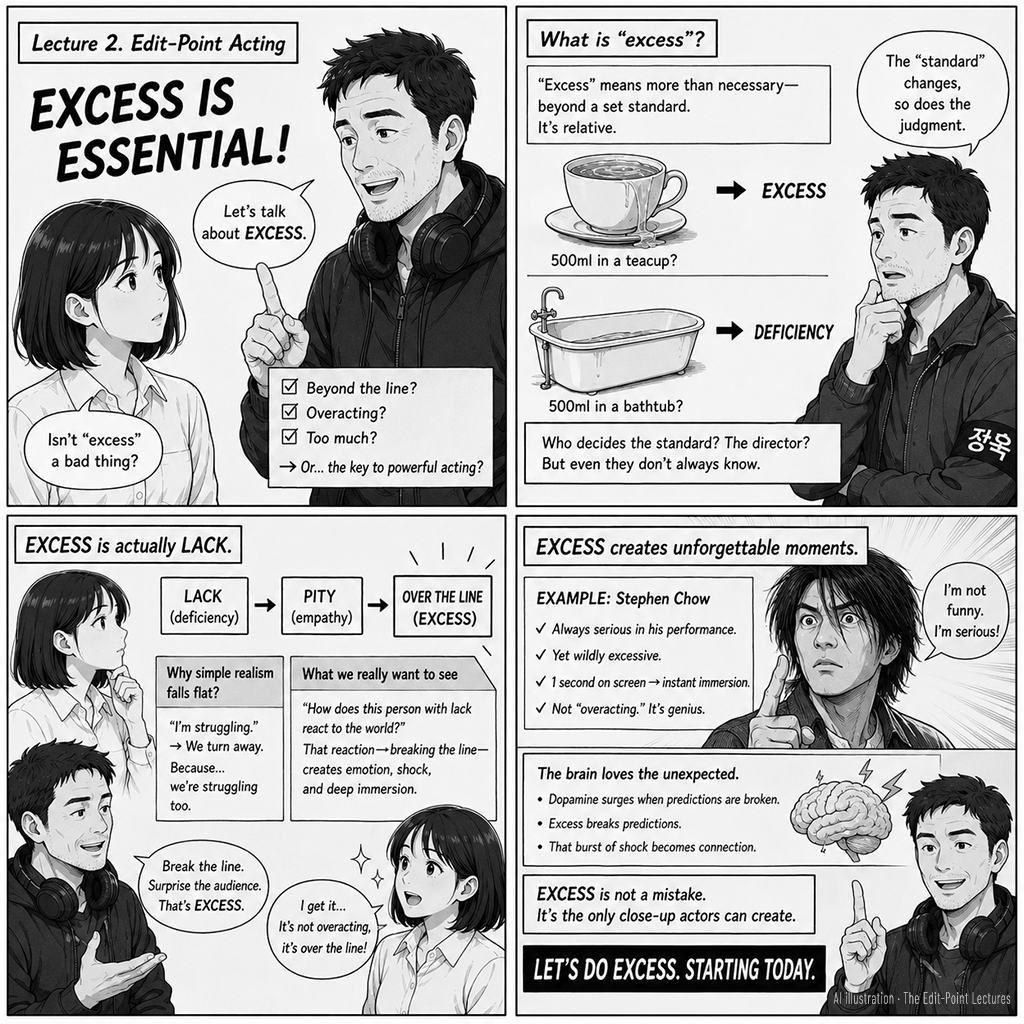
The Korean word gwaing — excess — is defined, with characteristic economy, by the crowd-sourced Korean encyclopedia Namu Wiki as “a Sino-Korean term meaning that something remains beyond what was planned or necessary; its synonym is going too far, its antonym is deficiency.” In other words: excess means crossing some established line.
A brave actor will immediately ask: who drew that line?
Where was the boundary set, and by whom? Is the instruction to pour five hundred milliliters of water, or two liters? It matters, because pour five hundred milliliters into a teacup and it overflows. Pour the same amount into a bathtub and you’ve barely wet the bottom. By the teacup’s measure, five hundred milliliters is excess. By the bathtub’s, it’s a shortage.
“So excess is relative?” the actor says. “There’s no fixed standard — it’s just whatever the director decides?” In a sense, yes. Which is precisely what makes the concept so interesting.
This confusion plays out on set in a specific way. An actor who has moved past the first stage — simply throwing themselves at the material — and reached the third, where they read the room, track the other actors, sense the scene’s whole shape — that actor will constantly interrogate their own register. Am I crossing a line? Am I going too far? They’ll glance at the monitor between takes. (“God, I look terrible from that angle.”)
But no one tells you how large the container is. Even if you summoned the nerve to ask — “Director, is this scene a teacup or a bathtub, a river or the ocean?” — the director probably doesn’t know either. They are navigating by feel, just as lost in the open water as everyone else.
An orchestra has a conductor. With a single finger, in real time, the conductor signals when to enter, which beat to follow, how much force to bring. The drama director calls “Action!” — or, depending on their background, “Hi, cue!” (A brief digression: Korean directors who came up through cinema invariably call “Ready, action!”; those who trained in television always call “Hi, cue!” It is a small tell about where a person’s instincts were formed. Oddly, everyone ends the take the same way: “Cut!” But I’ve strayed from the subject. This is the kind of digression that gets called excessive. It is not. It is simply digression.)
Excess is something rarer. Nobler, even.
The director controls emphasis through the lens — zoom into a face, and the audience follows. But the actor is on the other side of that lens, always the object rather than the subject. So how does an actor make the audience look? A furrowed brow, a comic gesture, a shift in vocal color — these are techniques. They are craft. They are not excess.
To understand what excess actually is, consider the theoretical foundation laid by film scholar Linda Williams.
In her 1991 Film Quarterly essay “Film Bodies: Gender, Genre, and Excess,” Williams grouped melodrama, horror, and pornography under what she called “body genres” — forms of cinema whose shared characteristic is excess: specifically, the kind of excess that causes an audience’s body to involuntarily mimic what it sees on screen. When audiences weep together, shudder together, that mimicry is produced by excess. Williams’s argument was not that excess represents a failure of cinematic language. Excess is cinematic language’s central norm. Excess is not acting’s failure. It is the signal that emotion has been transmitted.
From thirty-one dramas, I have reached the same conclusion from the opposite direction: excess is the only close-up effect available to the actor.
A director, mindful of the ensemble, will sand down anything that protrudes. The Korean proverb is direct about it — “The stone that sticks out gets chiseled.” Bring it level and it becomes just another stone, indistinguishable from the rest. Try to stand apart and you hear it: “Can you bring it down a notch?” The other actors watch you with cool eyes and think, without saying: Who do you think you are?
This is the drama set — not a solo recital, but an ensemble production where the work depends on every element cohering. The performer who breaks the plane gets chiseled.
“So, Director,” the imaginary student says, “you’re saying excess is the only tool available to an actor — but also that we should never use it? Could you say one clear thing, please?” Fair enough. I’ve been building the foundation. Here is the road.
When excess creates immersion, it becomes brilliant acting.
That is how Cho Jung-seok does it. How Song Kang-ho does it. How, as of this writing, Koo Kyo-hwan does it.
The Korean drama Everyone Is Fighting Their Own Worthlessness swept the country when it aired. My friend Lee Sun-joo’s reaction captured the consensus: “Koo Kyo-hwan is a genuine jewel.” The writing, the direction, the performances — all exceptional. But what the audience carried home was one sentence: Koo Kyo-hwan can act.
That verdict was not produced by Koo alone. The moment screenwriter Park Hae-young’s script reached the cast, the reaction was reportedly electric — once-in-a-career material, the kind that makes every collaborator give a hundred percent, then twenty more. All of that accumulated and made the verdict on Koo possible.
Could any sufficiently prepared actor have produced the same result in that role?
“Of course I could have done it,” the imaginary student protests. “Why are you shutting the door before I’ve even knocked?”
No. Because you are not Koo Kyo-hwan at that particular moment in time.
For the role of Hwang Dong-man to find Koo Kyo-hwan, every condition had to align simultaneously: the right script, the right actor, the right stage of readiness, the right moment in a career. The probability of that convergence is roughly that of winning the lottery or being struck by lightning. The opportunity rarely arrives when you are prepared, and preparation rarely peaks when the opportunity comes.
“Opportunity flies like an arrow,” as the saying goes — except the arrow never comes when you are standing ready with the bow drawn. It passes overhead while you are still lacing up your shoes, or it simply does not arrive. Koo Kyo-hwan built his craft through years of independent film, growing invisibly, and still needed everything to align before his moment arrived. Readiness is necessary. It is not sufficient.
There is one secret weapon for manufacturing that alignment.
It is excess.
“What is Koo doing that others aren’t?” the student asks. “He’s doing the same thing Cho Jung-seok does, that Song Kang-ho does — but they’re so different from each other.”
My counter-question: different how? Is Choi Min-sik’s acting the Shaolin school and Han Suk-kyu’s the Wudang school? Is Koo, having come up through independent cinema rather than the mainstream, a renegade who trained outside both traditions — a Yang Guo who forged his own path?
(For those unfamiliar: Yang Guo is the protagonist of Jin Yong’s martial arts novel The Return of the Condor Heroes — expelled from both the orthodox and heterodox schools, he becomes the era’s greatest martial artist precisely because he was forced to discover his own method.)
What does it mean to reach that level? And why, despite being ready, does the defining role refuse to arrive?
Because you are not doing excess.
Excess means breaking the expectation by a small margin. They tell you to do it this way; do it that way instead. The line says stop here; step over it, slightly. They expect this; give them that. They predicted that; give them something else entirely. That is excess.
When a prediction is broken, people feel pleasure. That is instinct. When an unconscious expectation shatters, the brain receives a jolt and releases dopamine.
Wolfram Schultz, neuroscientist at the University of Cambridge, proved this experimentally in his 2016 paper “Dopamine Reward Prediction Error Coding,” published in Dialogues in Clinical Neuroscience. Dopamine neurons do not fire when an expected outcome occurs. They fire — explosively — when something outside the prediction happens. Schultz named this the “reward prediction error.” The brain is indifferent to what it expected. It responds to deviation. An actor who moves exactly as predicted leaves the brain undisturbed. An actor who breaks the prediction causes dopamine to detonate.
“Fine,” the imaginary student says. “But the script has stage directions. If it says: turns left, winks — are you telling me to turn right and frown? Isn’t that just ignoring the text?”
I don’t have a clean answer to this. Excess is as hard to describe as enlightenment. On the page it resists me — but there is one example that requires no description.
The actor I respect most in the world arrived at his career in the following way.
He grew up desperately poor and worked every menial job available. He tagged along with a friend to an audition and was rejected — his friend got in. He ended up hosting a children’s television program, and approached it with the resigned energy of someone who had run out of things to lose: fine, I’ll just do whatever I want. The bit went viral. He took a background role in a film where his friends were the leads. A director noticed him and gave him a supporting part. Then a lead. Then he wrote his own scripts. Then he directed. Then he became a god of his craft.
That name is Stephen Chow.
Stephen Chow is, without qualification, the ground of excess, the substance of excess, the universe of excess made visible. Ask me what excess is and I will say: excess is Stephen Chow, and Stephen Chow is excess.
“But isn’t that just comedy?” the imaginary student says. “Isn’t he just exaggerating for laughs?”
Stop and reconsider.
Stephen Chow has never overacted in his life. His performances are, at every moment, entirely sincere. That sincerity is precisely what makes them excess. No academic paper, no study, has come close to capturing what he demonstrated. His performances hold you from the first second — there is a compelling quality in the smallest line reading, an attention that builds, a pull that grows stronger the longer you watch. Why? What is the source of that energy?
It is the thing you can practice starting today. The thing you already have, if your spirit carries any hunger. The conclusion toward which this whole lecture has been building.
Excess is deficiency.
Recall: the antonym of excess, by definition, is deficiency. How, then, can deficiency be excess?
The most powerful emotion an audience can feel for a character is pity — what the Greeks called eleos, what we might call compassion. The root of compassion is lack. We feel most intensely for the character who is missing something.
But the moment a character announces their lack directly — “I am suffering,” “I am broken” — we look away. Because we are suffering too. We came to the screen to be somewhere other than inside our own exhaustion. We do not want a mirror held up to our own pain.
This is where many actors misunderstand realism. “It’s a realistic story, so shouldn’t I play it realistically? Otherwise it’s overacting, right?” That frame is, in the current moment, definitively wrong.
Film philosopher Murray Smith, in his 1995 book Engaging Characters: Fiction, Emotion, and the Cinema, described audience identification with characters as a three-stage process: recognition, alignment, and allegiance. The most powerful stage — allegiance — is triggered specifically by a character’s deficiency and vulnerability. The perfect character pushes the audience away. The deficient character, struggling against their deficiency, pulls them in.
What we want to watch is not the deficiency itself. We want to watch how the deficient being responds to the world. The story is fixed — the script is fixed. What we want to see is how the person writhes within it.
When that response is well-expressed, the audience feels a surge — an involuntary catch in the chest, a softening in the throat — and their defenses drop. They are pulled toward the character without resistance. That pull is excess. Excess is made of deficiency.
Here is the mechanism: the deficient being, responding to a world that constrains them, cannot help but cross some line that world has drawn. When we see that line crossed, we snap to attention. We lean forward. The deviation electrifies us. Electrification produces immersion. Immersion merges us with the character. That merger is excess.
One condition applies: the immersion must flow toward affinity, not aversion. If it generates repulsion rather than connection, the attempt has failed.
I have explained, at best, a tenth of what excess actually is. Perhaps, when we reach the end of all sixteen sessions, we will be able to go deeper.
Until then: go excessive. Starting today.