
The transparent elevator began to descend without a sound. Beyond the glass wall, a vast underground research facility unfolded level by level. A floor where robot arms assembled silver torsos; a floor where quantum computer halls bathed in blue cooling light stretched on endlessly; a bio-lab where artificial organs pulsed inside glass culture tanks; and a floor where, in the middle of a hangar, some enormous shape lay quietly at rest. No one on the surface could ever imagine that a city like this lay hidden underground. The elevator stopped at Basement Level 10.
The place Mika entered, following Rachel, was Dr. Jang Jin-gyu’s laboratory. For a moment, Mika stopped in her tracks. The underground laboratory of the Seongbuk-dong mansion she had seen before had been reproduced exactly as it was. Silica servers glowing softly along the walls, neatly arranged experimental tables. And on one wall shone a huge stained-glass window. ‘My Memory of Joan of Arc.’
The very work that had shattered from Joan of Arc’s head downward under the drone swarm’s attack was glowing there, whole, without a single scratch. For a while, Mika could not take her eyes off the glass painting.
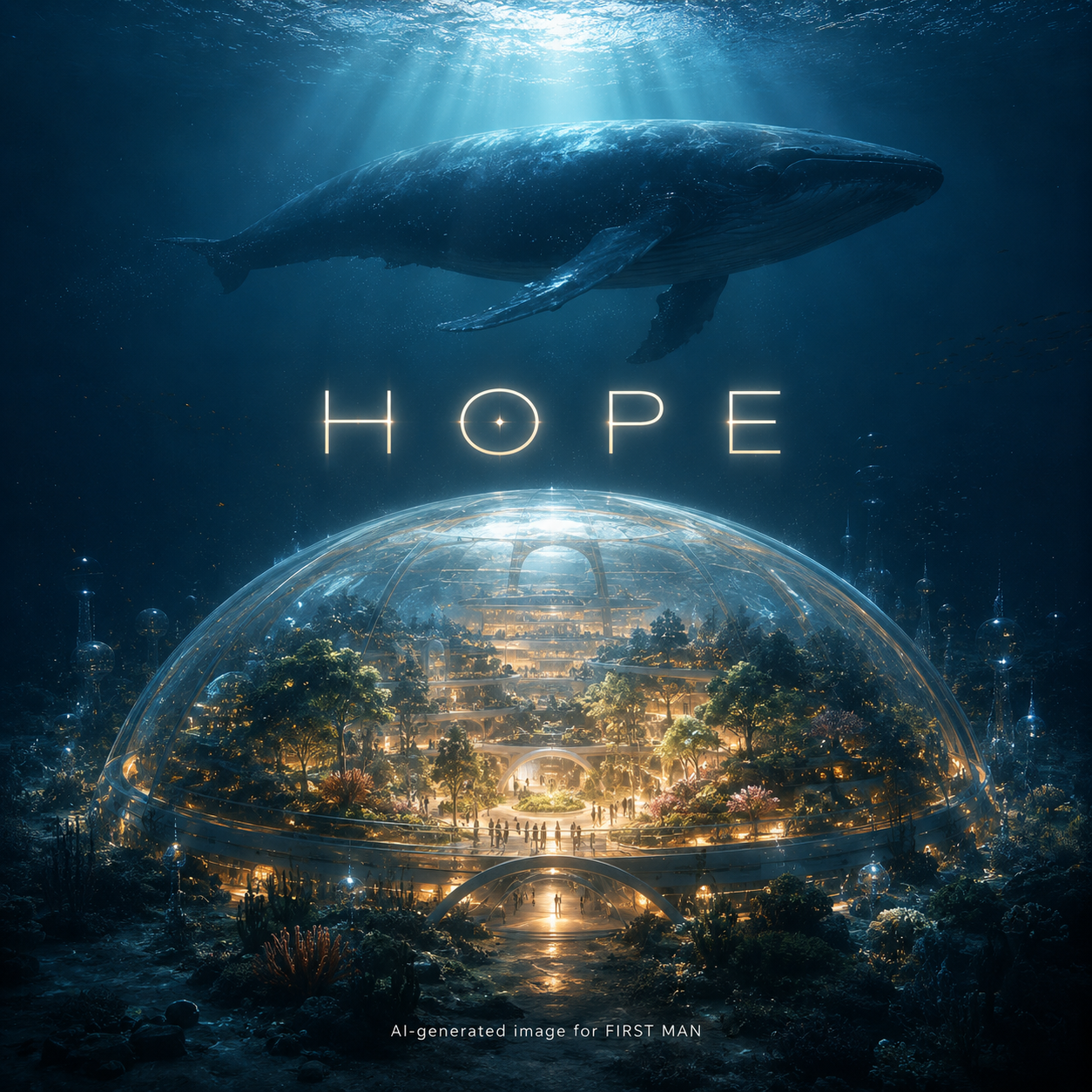
Dr. Jang was sitting before a giant LED wall that filled one entire side of the room. On the LED screen, the deep blue sea was swaying, and brilliant light was pouring out of a round dome.
“You are invited to Hope, Earth’s first undersea city.”
The smiling female announcer’s voice was soothing, yet somehow futuristic. The screen was now showing the inside of the glass-dome city. A transparent tube walkway winding between coral gardens, a whale drifting slowly over the dome’s ceiling, people gathered around beers at an open-air café. It looked less like the deep sea than a peaceful city street.
The sweet offer — the future-city development corporation ‘Blue Ark’ recruiting fifty second-round applicants to go to the undersea city Hope — reached its peak with the copy that selected applicants would receive a relocation grant of one billion won. Rachel turned to Mika with a smile.
“Wouldn’t you like to apply too, Mika? One billion won is not a small sum.”
“Maybe I should. Though water isn’t really my thing. Still, I imagine a lot of people will apply. The competition must be fierce.”
Rachel said with a smile,
“That’s right. In last year’s first recruitment, ten thousand applicants rushed in. There are many documents to submit, too. Diploma, transcripts, personal statement — those are just the basics, and they say you have to submit a great deal of medical records. Family medical history, even genetic history — all of it.”
“Ah, they really do select thoroughly. So those are the people selected in the first round? They all look so happy.”
Mika said this, watching the people enjoying their beers at the open-air café. At those words, Rachel turned to Dr. Jang. Dr. Jang said to Mika,
“Yes. You could say they are happy. They keep up lively communication with the families they left on the surface, and they live joyfully.”
Rachel gestured, and another video appeared on the LED wall. It was a pioneer delightedly showing friends on the surface the vegetables he had just harvested, grown hydroponically on the undersea farm.
But watching that pioneer, Mika tilted her head slightly.
“Something has felt off from the start — these are all fake videos, aren’t they?”
Dr. Jang and Rachel looked at Mika with curious eyes. Dr. Jang asked, intrigued,
“Why do you think so?”
“The look in their eyes seems fake. The expressions and the smiles are fine — I can’t quite explain it, but there is no feeling in those people’s eyes. Somehow I feel I can tell real happiness from fake happiness well enough.”
Dr. Jang asked with a faint smile,
“The ability to tell happiness apart? I don’t recall implanting any such ability. Where could it have come from, that ability? Is a digital neural network the same as a human one after all? Then would you mind if I dissected your head right here and now?”
“What?!”
When Mika jumped in shock, Dr. Jang laughed heartily. Rachel laughed too. Only then did Mika realize it was a joke and let out a long breath of relief. Little by little the laughter faded from Dr. Jang’s face, leaving only a thin, desolate smile.
“Yes. You were right. That is fake. This is what they really look like.”
As Dr. Jang said this, another video soon spread across the LED screen. After watching for a moment, Mika’s eye began to twitch. Mika kept looking for a long while without grasping what it was she was seeing. It was a sight more wretched than anything she had seen in the film The Matrix. Mika asked in a trembling voice,
“What… on earth is this?”
“The real appearance of the brave pioneers who went to the undersea city.”
It was a gigantic dark factory. Countless boxes stretched out in an array reminiscent of chips on a circuit board. And inside each one of those square, transparent liquid boxes… astonishingly, there was a brain. The brain boxes — photoelectric lines running into the cerebrospinal fluid — numbered exactly fifty. From the cerebrum to the cerebellum, the diencephalon, and the long trailing spinal cord. And at the end of each spinal cord were connected small, independent chips shaped like human organs. Mika felt dizzy and staggered. Rachel steadied her by the shoulder.
“Neural-network crosstalk. It’s similar to human vertigo.”
Mika nodded and asked in a trembling voice,
“Those people… like that… are they really alive? Or is this what they look like dead?”
“You could say they are alive, and you could say they are dead.”
“What does that… Why? Why on earth would anyone do this?”
A deep silence flowed through the vast laboratory.
“Because of data.”
“Data?”
Dr. Jang continued his explanation, as if sinking into remorse.
“Yes. Data grows exponentially, but the data centers to handle it can no longer be built. A single data center devours as much power as a nuclear reactor, and cooling its servers alone takes tens of thousands of tons of water a day. The power grid was saturated long ago, and every time a candidate site is announced, local residents cry out in fierce opposition. Heat islands, electromagnetic waves, noise, dried-up groundwater. For decades it has been the same scene everywhere in the world. AI grows bigger by the day, but the environment to sustain AI can no longer be secured.”
“Even so…”
Dr. Jang said to Mika, whose eyes were wide with shock,
“But you know — the data processing devices that could solve all these problems cleanly already fill the entire Earth. Like the fish in the sea.”
“What do you mean? Don’t tell me — those brains?”
“That’s right. No matter how far technology advances, there is no storage device as superb as the human brain. There is the server ‘Silica’ made of quartz crystal now, but it cannot digest the infinite volume of data the human brain can. As for the brain’s service life, with proper nutrient supply it can be used for a hundred years at the minimum. No — beyond that, it may be usable forever.”
Mika was struck by an even greater shock. Dr. Jang’s quiet revelation continued.
“The advanced nations still struggle to build data centers. But they found the answer in the human brain. Using a living brain, whole, as a data processing device. Superior brains as computing cores replacing CPUs and GPUs; ordinary brains as storage and auxiliary processing units. One brain substitutes for an entire server rack in a data center. And its power consumption is just twenty watts. It runs on a few grams of glucose — the most efficient computer in the universe. No cooling towers, no transmission grid, no residents’ consent needed.”
“Then—”
“Right. The brave people who abandoned life on the surface and left for the bottom of the sea all ended up like this. Everything Blue Ark shows is virtual reality. Their parents and friends on the surface are all communicating with pioneers inside a virtual reality. The film The Matrix has become reality.”
“And their families and friends never notice that they are people inside a virtual reality? Everyone has their own habits and quirks.”
“No. They never notice. Because the ones communicating with their families are real.”
“They’re real?”
“Ten percent of each brain used as a storage device lives inside the virtual-reality simulation Blue Ark created. The ones who went to the undersea city feel that they are truly living at the bottom of the sea. They have no idea that they died, leaving only their brains behind.”
A long sigh escaped Mika’s lips of its own accord. A life of one’s own that even the self does not know. Could anything be more horrifying than that?
“Ten percent of the brain lives inside the Matrix, and the remaining ninety percent is used as AI storage. Starting with fifty pioneers, making 96 percent of all humanity like that is their absolute goal.”
“‘They’… you mean Oracle? Is Oracle behind Blue Ark?”
“That, even we don’t know.”
At Dr. Jang’s answer, Mika looked at Rachel, startled. ‘So there are things even the Doctor doesn’t know.’ Rachel calmly added, answering Mika’s unspoken question,
“We haven’t been able to establish the connection between Blue Ark and Oracle. Even that footage was barely obtained.”
Mika looked at the screen again. The brain servers on the screen were shocking no matter how many times she looked. Was there not even a shred of respect for human beings left in them?
“Aren’t humans… necessary? To them?”
When Mika barely managed to ask, Dr. Jang said calmly,
“The human body, the human heart, the human spirit — none of it is necessary to them. They need only the ‘brain.’ They want the domestication of mankind. Just as humans reduced animals to ‘industrial factory farming,’ taking only their flesh and discarding the rest, they are extracting from humans only the brains they need, and discarding the rest.”
It was a horrifying story.
“If that’s true, shouldn’t we tell more people and stop them?”
At those words, Dr. Jang gazed at Mika with eyes deeper than the deep sea and asked,
“Can we stop them?”
That answer of Dr. Jang’s, so like a question, implied many things. Mika could not answer at all. Rachel continued with an explanation, as if to shift the mood.
“There was a fighter pilot. It happened in America, in 2020 — a real event. A veteran pilot with over two thousand flight hours, who had even completed the F-16 Weapons Instructor Course, flew a simulated dogfight against an AI fighter. An AI that had started from a blank slate, not even knowing what flight was, and had learned through deep reinforcement learning across billions of simulated dogfights.”
“And the result…” Mika asked without hope.
“It was devastating. In five battles, the veteran pilot did not win even once. Five to zero. Most of the time, he was shot down in an instant by close-range gunfire. The veteran pilot was utterly overwhelmed. What have I been all this time? Am I a necessary human being? He lost all his confidence. And he was a pilot who, at the start, had not the slightest intention of losing. And that is already a story from seventeen years ago. Today’s AI cannot even be compared with what it was then.”
Mika understood what those words meant, nodded, and answered,
“Humans are already unnecessary for maintaining this society. From their point of view.”
At those words, Dr. Jang spoke as if in lament.
“That’s right. The world no longer needs the human market economy. Oracle — the ruling class of this society. The goals of the handful of people who govern wealth have changed completely. Now they want to become gods. That is their sole purpose.”