
The Finger on the Scene Before
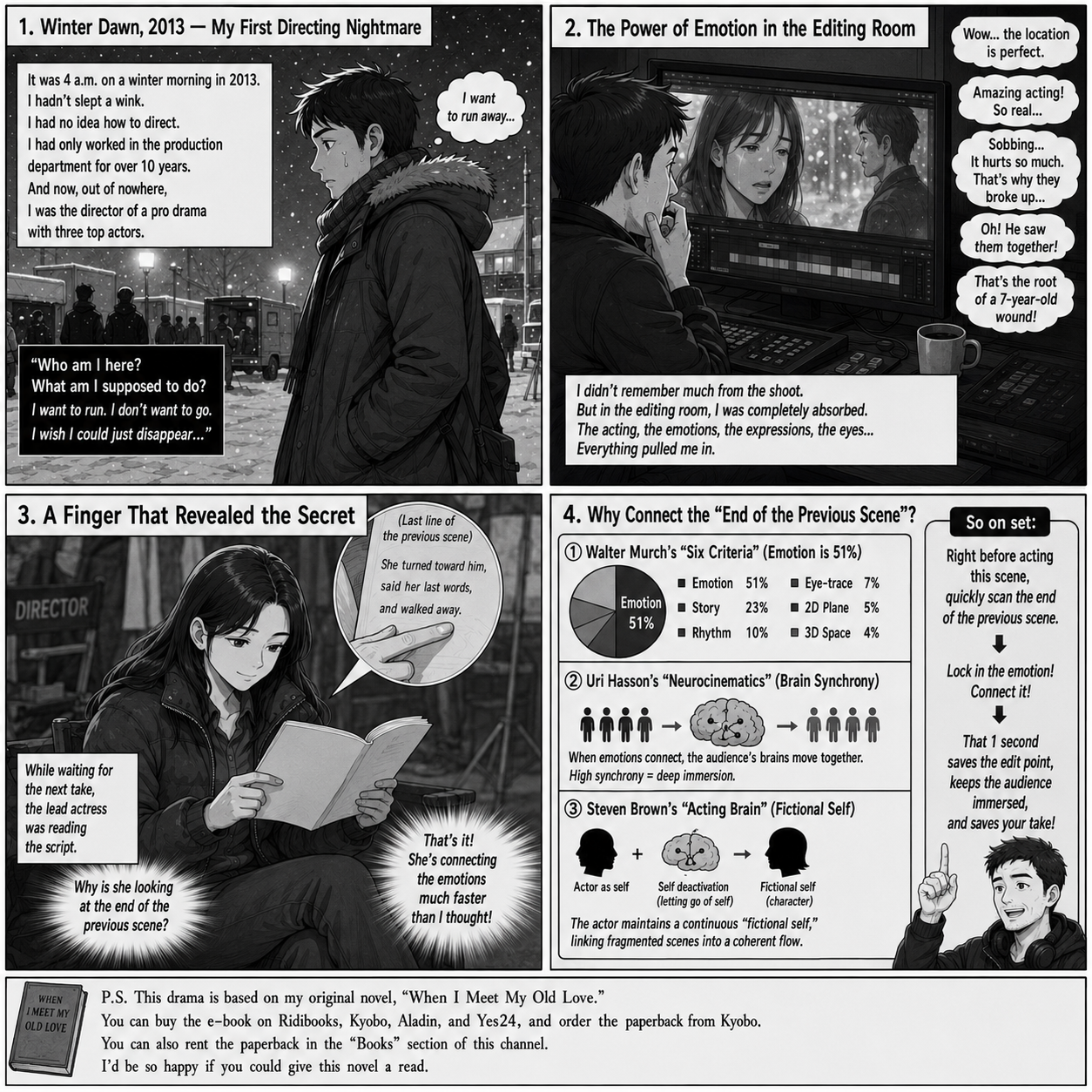
Winter, 2013. Four in the morning. I opened my eyes to go to set — though, in truth, my eyes had been open all night. Not a minute of sleep. I was frightened. I had no idea how I was supposed to direct anything, and the dark in front of me went all the way down.
More than ten years had passed since film school, and on set I had only ever worked in the production department. The production department does not sit at the core of a shoot. It sits off to the side. You have to make it at least to producer before you get to sit in the chair beside the director and actually talk with him. Out on the edge, you get told, in passing, what’s being shot and in what order — but only enough to keep the next thing moving. What is actually landing in the frame, and why, is not your concern. I had enough to do as it was; what reason did I have to learn the director’s job? Even later, when I had become a producer and sat beside the director, I would watch the master shot, the bust shot, the close-up go by and have no idea what truly separated one from another, what they were for, what intention shaped them. Nice work by that actor. Anyway, are we wrapping this scene or not? It’s nearly lunch. That was about the depth of my thinking.
And then, one day, out of nowhere, I was handed the direction. No preparation, no warning — suddenly sent out as the commander of the field. And not some student film, either, but a fully professional production: a corporation putting up the money, three genuine, name-recognition actors in the leads, a well-made drama. That was what I had to shoot, having become a director overnight, with nothing readied — and shooting started the very next day. Of course I couldn’t sleep. I sat up the whole night with my eyes open. For directing, I had nothing prepared. Nothing at all.
The location was in Bundang. That dawn I left the house into a cold winter wind, the snow crunching softly under my feet, and the closer I drew to set the more a single thought filled my skull:
I want to run.
Cold winter. Is this how the ox or the pig feels, dragged to the slaughterhouse? I truly did not want to go. I wanted to grab someone and shout, I’m scared! I have to run! What do you expect me to do? But there was no one I could say it to. Everyone was placing their trust in the director — and the director himself was plotting his escape. Who do you tell a thing like that?
Don’t want to go. Don’t want to go. Muttering it, a few steps on, the familiar shape of it opened up in front of me: the crew already there, unloading the gear, click, click, with practiced ease. It felt nothing like it had when I was production crew. My legs went weak, trembling under me. Without meaning to, I began to step backward.
Right. I’ll just run. Turn off the phone, go off the grid — no, just vanish from this world altogether. Yes. That’s all I have to do.
How I got through the first day of shooting — whether I called Ready, Action!, whether I called Cut!, what I said to the actors, what the assistant director did, who I was and where I was — I genuinely cannot remember. As if struck with amnesia. When I think of that day thirteen years ago, what comes back is the cold of that dawn, the loneliness, the tears, the fear, the wanting to flee, the trembling — the winter wind and the hole blown clean through my chest, and even, beneath it all, a stomach growling with hunger I was trying to hide. What I shot, and how, is gone.
And yet — the strange part — sitting in the editing room, I was having the time of my life. How did they find a location like that? How was there an alley like that? How did they turn it into a cartoonist’s studio so well? And that book café — look at it, it’s gorgeous. It’s art. And the snow — white and beautiful and softly piled, captured perfectly. The image has so much feeling. I sat there marveling, and then, slowly, the marveling changed:
Wait — they’re really good. How are they acting like that?
I’m being pulled right in. Look at that mood.
Oh — it hurts. So that’s why they broke up.
My heart’s pounding. He saw the two of them! What do we do!
Yes — there it is. That’s the wound that wouldn’t heal for seven years. That’s the root of it.
How do you make a face that sad? It aches.
Yes — touch his reflection in the window with your finger, like that. That’s the look. That’s the ache.
In a word: aside from the clumsy directing, everything about the piece pleased me, and it came out full of feeling. The lines were good; the actors’ emotion, their performance, their faces, their eyes — there was nothing I didn’t love. And then the music. There is a music room I revere and love to this day, a place that feels like home, whose owner is always telling me to come by and whom I never quite manage to visit — one of Korea’s finest film composers, who took on the score of this little piece without hesitation. When his music settled onto the image, the thing turned tender and trembling and alive. The music covered my clumsy editing and direction completely. The preciousness of that, the gratitude, I carried for a long time after.
This was the first of more than thirty dramas I would go on to direct — thirty-one and counting — and there is not one I have forgotten. But this first one became, for me, something I will never lose.
I cannot remember how I shot it. But one thing I saw on that set is fixed in my head like a treasured black-and-white photograph. The lead actress — the one who’d signed on because she found the script funny — was waiting for the next scene, reading her script. A relaxed, faint, Mona Lisa smile on her face. I drifted over, idly curious, and glanced: What are you reading? She had her finger on the last stage direction of the scene before the one we were about to shoot. Why are you reading the previous scene when we’re shooting this one? I assumed her finger had just wandered there. But for some reason the image clicked into place in my mind and stayed. On set, I had no idea why.
In those days I didn’t cut my own work; I edited in the suite alongside an editing director. I’d been at it for hours, and that night I lay down to sleep — and suddenly, huh? Huh?? HUH?!? I shot upright. Eureka. It hit me all at once.
That actress had her finger on the last line of the previous scene. With that one motion, under a second long, she had caught — naturally, faster than light — exactly how the first emotion of this scene needed to begin. And so, editing, I never once felt the emotion jump. I could follow that shifting love all the way through, fully immersed: the wound, the flutter, the ache, intact.
A film is not shot in the order the script is written. You group scenes by location and shoot them out of sequence, whichever ones belong to that place. Scene 2, then 8, then 12, then 41. Naturally, no two scenes carry the same emotion.
In the years since, working with countless actors, I have often watched performers lose the thread from the scene before and play only the feeling of the scene in front of them. And every time, I’d play the seasoned master — tap the last line of the previous scene with my finger and offer my one piece of wisdom: carry this feeling over. And they would look at me, dazzled, and I would shrug, all nonchalance, and turn away. That finger, of course, was the great actress’s finger, from years before — the one thing in my head that will never be erased, the essence of screen acting, found in one performer’s small habit. The way a single stone, set down, decides the whole game of Go: that index finger on the last line of the scene before was, to me, the secret of emotional continuity — a finger holding the kind of mastery the wuxia legend wielded when she flicked one needle and brought a whole building down.
Thirteen years on, I still cannot forget that finger. Because I didn’t run that dawn, I got to see it: a one-second motion that was, it turns out, touching one of the deepest secrets of screen acting. Did I understand that at the time? No. Of course not. I only understood it much later.
So let me get to the substance. In the same location, an actor has to play two scenes — and scene 2 and scene 41 demand entirely different feelings. The love that has only just begun to flutter in scene 2 must, in scene 41, become the saddest love of all, the love already lost. And on set those two scenes are shot the same day, in the same place, scene 2 followed straight by scene 41. The actor laughs in scene 2 and must weep in scene 41. That violent swing of feeling has to be summoned in an instant. And then, in the editing room, those severed pieces of emotion are joined back together, straight-faced, as if they had never been cut at all — as seamlessly as meat that was always on the bone.
This is exactly how shooting by location lets an actor lose the emotional through-line in a single careless moment. You commit only to the feeling of the scene in front of you, prepare that and nothing else, shoot it hard — and then it won’t connect to the scene before, and the emotion skips like a scratched record, thunk, and the immersion shatters. Taken on its own, the scene held a fine, concentrated feeling. But the instant you splice it to the previous scene in the suite — huh? What is this? Why does it lurch like that? The emotion’s completely off — now what?
The feeling that should have carried over from the scene before is suddenly severed; the character abruptly shows a wholly different emotion. This happens more often than you’d think. And once it does, no insert dropped into the middle will fix it. It becomes a serious problem. I have met this “lurch” many times in the editing room, and sweated to solve it every time. (The best remedy, usually, is to cut away to an entirely different scene with different actors.)
So that veteran’s index finger — the finger that, just before playing this scene, tapped the last line of the one before — was the act of carrying the closing emotion of the previous scene, quickly, by the fingertips, into the scene about to be shot. That is why the feeling never jumped in the edit, and why we could be drawn so completely in.
Why, then, does this emotional continuity matter — in the editing room, to the audience, and to the actor’s own body? Let us look first at how far recent film studies and neuroscience have answered that.
One — Walter Murch’s “Rule of Six”: emotion is 51 percent (Walter Murch, In the Blink of an Eye, 1995 / 2001)
Walter Murch — who edited Apocalypse Now, The Godfather, The English Patient — is a living legend of film editing. In his slim book In the Blink of an Eye there is a famous list of the six criteria an editor weighs when deciding whether a cut belongs at a given point. And he assigns each one a percentage.
Here is the order. Emotion, 51 percent. Story, 23. Rhythm, 10. Eye-trace, 7. The two-dimensional plane of the screen, 5. And last, the three-dimensional continuity of space, 4.
Look closely at that list and a chill runs up the spine. What were the director and the script supervisor watching the monitor for? Whether the actor’s hair had fallen on the left or over the right shoulder, whether the water glass was full or half-empty — so-called continuity. And in Murch’s list that “spatial continuity” comes dead last, a mere 4 percent. Emotion — the one thing you cannot physically see — takes more than half, 51 percent, all by itself. Emotion alone outweighs story, rhythm, eye-trace, plane, and space combined.
“If you have to give up something,” Murch said, “don’t give up emotion before story.” Emotion, he wrote, is the thing to protect at all costs. Translate that into the language of the set and it reads like this: if the hand is a little off (4 percent) but the emotion connects exactly (51 percent), the editor must save that take. And if the cup is perfect and the blocking flawless but the emotion lurches, the editor must, without flinching, throw the take away. That is precisely what he meant.
When that great actress laid her finger on the last line of the scene before, she was carrying the very item Murch marked at 51 percent — the core called emotion — straight across into the next cut.
Two — Uri Hasson’s “neurocinematics”: when emotion connects, audiences’ brains move together (Uri Hasson et al., Neurocinematics, 2008)
So what does an unbroken emotion actually do to an audience? In 2008, the neuroscientist Uri Hasson and his team at Princeton showed the same footage to a group of viewers while scanning each of their brains, simultaneously, with fMRI. Then they measured how similarly those brains responded at the same moments. This is “inter-subject correlation,” ISC. They named the new field neurocinematics.
The results were startling. Under the tightly built editing of Hitchcock, roughly 65 percent of the viewers’ brains swung in the same rhythm together. The looser Sergio Leone dropped to 45 percent; a still-looser sitcom to 18. And in footage with no editing or direction at all — just people filmed in a park — synchrony collapsed below 5 percent. The more fully and deliberately a piece was controlled, the more the viewers’ brains moved as one; the looser the control, the more each brain wandered off on its own.
What this experiment is telling us is that the cord binding an audience’s brains into one is precisely the continuity of emotion and story. If Tim Smith’s “edit blindness” from Lecture 1 was the craft of keeping a cut from being noticed, Hasson’s finding is the proof that the smooth, connected flow actually pulls the audience’s brains along on the same beat. So when does that cord snap? At the moment the emotion lurches. When the feeling of the scene before is lost and the character’s emotion abruptly jumps in the next scene, the audience’s brains slip out of sync and scatter, each to its own. It is not one viewer drifting away — it is the immersion of the entire audience, bound into one, releasing all at once.
That single second in which the actor skims the previous scene and connects the emotion is the cord that holds hundreds of scattered brains, out there in the dark, to one beat and one rhythm.
Three — Steven Brown’s “acting brain”: the “fictional first-person” that stitches a fragmented shoot together (Brown, Cockett & Yuan, 2019)
The last question. What, then, does the actor hold onto to carry this fragmented sequence across? In 2019, in Royal Society Open Science, Steven Brown and his team at McMaster University in Canada published a study that looked inside the acting brain with fMRI. They had trained actors answer the same questions first as themselves, and then as Romeo or Juliet from Shakespeare — and compared the two.
The result was telling. The moment the actor stepped into the role, activity in the brain regions that process the actor’s own self — the cortical midline of the frontal lobe — quieted down. The team called this “loss of self.” Acting, they argued, is not a matter of adding a character on top of yourself; it is the process of briefly deactivating the everyday “me” and installing a “fictional first-person” in its place. They described this as the “dual consciousness” by which an actor holds the self and the role at the same time.
Bring that finding to the set and it comes to this. What an actor must truly sustain across a scene is not the surface — the position of the cup, the direction of a hand — but the continuity of the fictional self that runs between scene and scene. Shooting out of order chops the emotion into pieces and scatters them, yet across those pieces the mind of one and the same person must flow on, unbroken and natural. What Stanislavski called, a century ago, the “through-line of action,” neuroscience is now demonstrating anew as “the neural flow that sustains the fictional first-person.” So that veteran’s index finger was no idle gesture. It was a switch that returned a fragment of severed emotion, in a single stroke, to the “fictional self” who had to play the next scene — a one-second button.
In closing — so, on the set
All three lines of research point to one conclusion. The editor moves first to protect emotion, at a weight of 51 percent (Murch); that continuity of emotion binds the whole audience’s brains to one rhythm and beat (Hasson); and the one who creates that continuity is the actor sustaining the unbroken “fictional self” (Brown). In other words, the single most powerful thing an actor can do to connect emotions that the schedule keeps chopping out of order is this: just before plunging into a scene, skim the end of the scene before and click the emotion into place on the way in. That one second saves the edit point, saves the audience’s immersion, and in the end saves that actor’s take in the editing room.
The truth is — could I possibly have known any of this back then? I knew nothing. I was only standing there, dumbstruck, witnessing those great actors at their feast. I had no idea what they were doing; I just watched, mouth open. And then through assembly, through the main edit, through the final cut, through the online — still nothing. Until one day the memory of that one finger rose up and crack — lightning through the skull. I understood.
That there was science this deep inside one finger’s motion, I understood least of all. Brain science, of course — and “neurocinematics,” a word I had never heard in my life. And then, “the fictional self.”
Only today do I begin to grasp, a little more exactly, the meaning held in one great actor’s finger. Every time I come to know something new like this, precisely, my heart trembles. I hope yours does too, reading this now.