
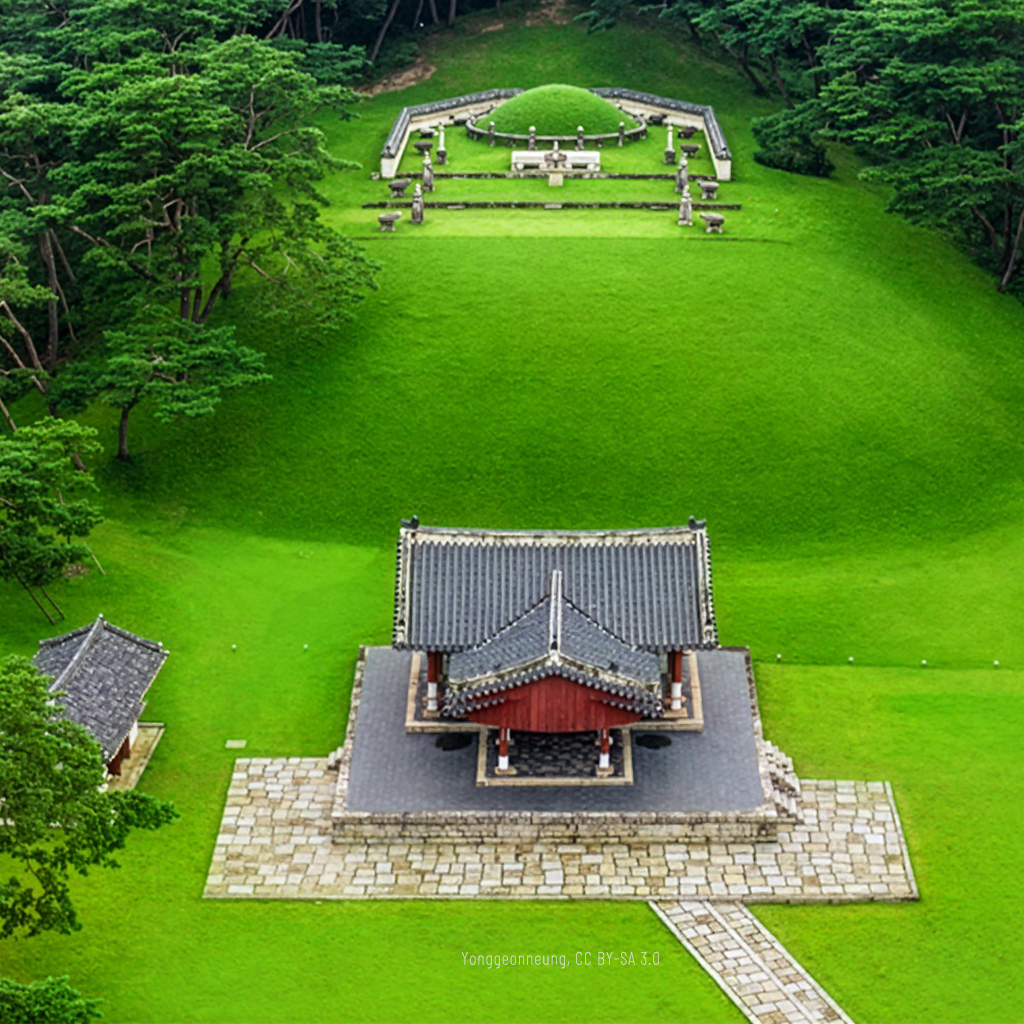
On Saturday, May 9, 2026, the courtyard in front of Yeongneung — the tomb of King Sejong in Yeoju, Gyeonggi Province — was thick with the scent of ink. The Sejong National Hangeul Calligraphy Contest was underway, an annual celebration of the beauty of the Korean alphabet. In an age when digital keyboards have become routine, the sight of so many people steadying their brushes upright and laying stroke after stroke onto traditional hanji paper felt almost otherworldly. From elderly men in white durumagi coats to dignified middle-aged women and young schoolchildren, dozens knelt before sheets of hanji, brushes in hand, pouring themselves into each character.
As the hanji rustled in the breeze, I was struck by how varied each writer’s hand was. From the prim Goongche (the courtly palace style) to the bold, muscular Minche (the people’s style), to flowing cursive variations, I had never realized that Hangeul could wear so many faces. The same consonants and vowels, depending on whose hand held the brush, could be neat and reserved or sweeping and unrestrained. I found myself standing in front of the calligraphers for a long while, captivated.
Then, in the middle of the courtyard, a beautiful woman in a white jeogori and chima, holding a long white silk scarf, began to dance. The scarf, trailing from one hand, sliced through the air as though alive — it was a salpuri-chum, literally a dance to drive out misfortune. Originating in the shamanic rites where a mudang would dance to release evil from a household, it has long since been refined into a stage art. Like the seungmu, the monk’s dance, its lines were elegant and gentle, yet each movement pulsed with vitality. Here, in front of King Sejong’s tomb, the ‘art of letters’ that is Hangeul and the ‘art of the body’ that is salpuri were meeting in quiet harmony.
I had come here as part of a field-study group led by Professor Yoo Dong-hwan of Konkuk University’s Digital Heritage Research Circle, intending only to see the tomb itself; happening upon the calligraphy contest first felt like a small gift. “It’s a good thing I came,” I caught myself thinking. On any ordinary weekend at that hour, I would have been at home munching on snacks.
After taking in the festivities, our group made its way into the tomb grounds. Professor Yoo wore a microphone and narrated like a seasoned heritage guide, his stories landing with that ‘aha’ clarity that makes everything stick. “It’s a shame we’re keeping this all to ourselves,” I thought to myself. What follows is my own attempt to capture what he shared, lightly supplemented with my own follow-up reading.
Climbing up near the burial mound, I looked out below. A landscape unfolded like a painting in every direction. Directly ahead stood Mount Bukseong, the main protective peak (jusan), facing the tomb with quiet dignity; behind, Mount Aengbong and the Namhan River cradled the site. The ranges flanking the tomb — the ‘blue dragon’ to the left and the ‘white tiger’ to the right of Korean geomantic theory — reached around the mound like two encircling arms. Even I, completely color-blind when it comes to pungsu (feng shui), found myself nodding: ah, so this is what a myeongdang, an auspicious site, feels like.
Yeongneung is counted, alongside Geonwolleung (King Taejo’s tomb) and Jangneung (King Danjong’s tomb), as one of the three greatest auspicious sites among the Joseon royal tombs. Geomancers have a saying for it: Yeongneung-ga-baengnyeon, ‘Yeongneung adds a hundred years.’ Because a sage-king like Sejong was laid to rest in such a powerful site, the saying goes, the Joseon dynasty’s life was extended by a full century. The whole reason the tomb was moved from its original location west of Heolleung to Yeoju in 1469 — a full 200 ri (about 80 km) from the capital — was to draw on the energy of this remarkable land. After one slow look around the horizon, I felt almost smug, as if I had become a master of geomancy myself. From now on, if anyone asks, “What do you know about pungsu?”, I think I might just say, “Quite a bit, actually. I’ve seen the greatest of all auspicious lands with my own eyes.”
The proper tour of Yeongneung begins at the Hongsalmun, the ‘red arrow gate.’ Two round columns are set up, and across the top run rows of red, arrow-shaped wooden spikes — no roof, just the spikes — with a triple-taegeuk (samtaegeuk) symbol set in the center. The red is meant to repel evil spirits and misfortune, in the same auspicious-yang spirit as the red bean porridge eaten on the winter solstice; the arrows above, symbolically, shoot down any malevolent spirit that approaches. Unlike an ordinary gate, the Hongsalmun does not divide an inside from an outside; rather, it announces, ‘From here on, this is sacred ground.’ It’s the reason your posture quietly straightens as you walk through.
Beyond the Hongsalmun, two parallel stone-paved paths run all the way to the Jeongjagak, the T-shaped shrine. The slightly higher path on the left is the hyangno (incense path); the slightly lower path on the right is the eoro (royal path). The hyangno is the ‘spirits’ path,’ along which incense, written invocations, and the soul of the deceased king pass; the eoro is the path walked by the living king. The difference in height is only about ten centimeters, but contained within those ten centimeters is the Confucian principle that the soul of the departed king ranks above the living king. Even a reigning monarch, in the presence of his predecessor’s spirit, willingly accepts the lower place.
The same logic governs the steps up to the Jeongjagak. The eastern staircase splits into two: the one with ornately carved stone railings (somaetdol) is the singye, climbed by spirits; the plainer one beside it, without carved railings, is the eogye, used by the king. After the rite, the king descends by the western stair, while the spirit passes back through the simun (spirit gate) at the rear of the Jeongjagak and returns to the burial mound. To see, within a single building, the paths of the living and the dead so carefully separated and yet so carefully woven together — it left me genuinely moved.
The Jeongjagak, where ancestral rites are performed, takes its name from the fact that its floor plan resembles the Chinese character ‘丁’ (jeong) — essentially a T-shaped hall. On the wall facing the tomb, at the rear, a large slatted window-door opens toward the mound, so that the spirit of the king can pass through, descend, and partake of (heumhyang) the food laid out on the altar. Standing inside the Jeongjagak and looking through that spirit gate toward the burial mound, I could almost see, for a moment, the smoke of incense rising and the chanted invocations of 600 years ago.
If you turn around at the Jeongjagak and look back toward the Hongsalmun, broad open courtyards stretch out on either side of the stone path. In times past, on days of state ritual (jehyang), this yard would have been filled with court officials, royal kin, queens and ladies-in-waiting, and musicians lined up in formation, with brilliantly colored ceremonial banners planted on either side of the Jeongjagak. Imagine, too, the solemn court music ringing through the space — it is itself a spectacle to picture. Beyond the Hongsalmun, throngs of ordinary people are said to have gathered to watch the unfolding scene with great interest. I found myself wanting, more than anything, to drop a pair of augmented reality glasses onto this empty yard and bring the whole tableau back to life.
Another fascinating thing I learned during the visit was the concept of hon and baek — the spirit of the mind and the spirit of the body. According to the Confucian Book of Rites (Liji), when a person dies, the hon, the spirit that animated the mind, ascends to heaven, while the baek, the spirit of the body, returns to the earth. That is why the body is buried with such care, and why ancestral rites are held at the appointed times. When incense is lit and bows are offered before the altar, the hon descends from heaven to meet the baek that lingers in the earth, and the spirit that comes together in that union is the josangshin, the ancestral spirit. Once the spirit has partaken of the food, blessed its descendants, and the written invocation has been burned in the bunchuk rite, the hon and the baek return separately to their proper places. “Ah,” I thought to myself, “so that is why we hold jesa.”
I had vaguely heard the word honbaek before, but I had never really understood it. Until that moment, my mental picture of the soul had been more like the spirit in the film Ghost — just the hon, floating around. The fact that there was also a baek hit me like a small revelation. “Then what happens if you’re cremated? I’m planning to be cremated. Does the baek just disappear? Forever?” My head was suddenly busy with new questions.
Yeongneung is a hapjangneung — a joint royal tomb — where King Sejong rests together with his queen, Soheon Queen Shim. In form, it is what is called dongbun-ishil, literally ‘one mound, two chambers’: a single burial mound containing two separate stone chambers. It is also the first joint royal tomb in Joseon history.
The way the joint burial was managed is itself fascinating. When Queen Soheon passed away first in 1446, King Sejong ordered that his own future resting place be prepared in advance. Two chambers were built side by side beneath the mound — one for the queen, the other left empty. Four years later, when Sejong himself passed, there was no need to dig up the whole mound. Instead, only a small rectangular section of earth at the entrance to the reserved chamber was carefully removed; cloth screens and reed mats shielded the work site; the great royal coffin (jaegung) was lowered by pulleys; and beneath it, rolling timbers — called yunyeo or yunmok, laid out like railway sleepers — allowed the coffin to glide directly into its waiting chamber. The whole mound never had to be opened. This is the precise civil engineering of six hundred years ago.
I had been picturing the kind of shovel-and-dirt work you see in the Korean film Exhuma (Pamyo), so to discover this much thought and method hidden beneath the surface was a genuine lesson. Royal tomb construction was managed by a temporary office known as the Salleung-dogam, and every step of the process is preserved in a record called the Salleung-dogam Uigwe. The Joseon dynasty really was, in every sense, a scientific state.
The Sejong Royal History & Culture Hall (better known locally as the Sejong Royal Museum), set near the entrance to the tomb grounds, quickly dispels any tidy equation of ‘Sejong = inventor of Hangeul.’ The creation of Hunminjeongeum alone would have been enough to immortalize him. But what he left behind goes far beyond that.
On the military front, in 1419 Sejong dispatched General Yi Jong-mu to subjugate Tsushima (Daemado), the base of marauding pirates that had long harried Korea’s southern coast. To the north, he sent Choe Yun-deok and Kim Jong-seo to establish the Four Counties and Six Garrisons (4 Gun, 6 Jin), extending Joseon’s frontier to the Amnok (Yalu) and Duman (Tumen) Rivers. The familiar outline of the Korean peninsula on today’s map was effectively settled during his reign.
In music, he commissioned the scholar Bak Yeon to recast the standard pitch pipes (yulgwan) and to refine the court instruments — the pyeongyeong and the pyeonjong, racks of chime stones and bronze bells. Sejong himself composed pieces such as Jeongdaeeop, Botaepyeong, and Bongnaeui, which were performed at state rituals. The fact that music composed by a king six hundred years ago is still performed today as Jongmyo Jeryeak — the ancestral rites music of the royal shrine — is genuinely without parallel among the world’s dynasties. King Sejong, the GOAT.
In science, he gathered talents like Jang Yeong-sil, Yi Cheon, Yi Sun-ji, and Kim Jo, and through them produced an astonishing line of astronomical and time-keeping instruments: the honcheonui (an armillary sphere) and the gani (a simplified observational instrument) for tracking the heavens; the jagyeongnu, an automatic striking water clock; the cheugugi, the world’s first standardized rain gauge; and the angbuilgu, the famous concave sundial. That all of these emerged from a single reign is hard to believe; that they were so precise is harder still.
Of all of them, the one that stayed with me was the angbuilgu. Western and Chinese sundials typically project a shadow onto a flat plate, but doing so means that when the sun hangs low — early in the morning and late in the afternoon — the shadow stretches and the hour marks become uneven. The scientists of Sejong’s court simply hollowed out the dial into a hemisphere. The name itself, angbu, means ‘an upturned cauldron’ or ‘a bowl looked up at,’ and that is exactly the shape.
Inside the concave dial, the shadow of the gnomon (yeongchim) follows the sun’s path along a smooth curve, falling precisely on the hour marks at every moment of the day, whether the sun is just rising or about to set. Even more remarkable are the horizontal seasonal lines (jeolgiseon). Because the sun’s altitude changes with the seasons, the shadow’s length changes too — and those differences are inscribed onto the curved surface so precisely that one can read both the time of day and the season at a single glance. Time, space, and season — all held inside a single bowl-shaped instrument.
The Joseon dynasty divided the day into 96 gak, each one equivalent to fifteen minutes by today’s reckoning. The angbuilgu further subdivided each gak into four parts, meaning that during the day one could read time down to about the four-minute mark — six centuries ago, in an open public square. Some sources go so far as to say that compared with modern timekeeping the angbuilgu’s accuracy is ‘barely off at all.’ It is hard to suppress a small gasp. And Sejong did not hoard this marvelous device inside his palace. He had it installed in busy public places — at Hyejeong Bridge on the main Jongno avenue in Hanyang (today’s Seoul), and in front of Jongmyo Shrine — and, so that even those who could not read could tell the time, he had the twelve zodiac animals carved beside each hour. Compressed into this single instrument is the whole of Sejong’s aemin, his deep love for the common people.
Just behind Sejong’s Yeongneung lies another Yeongneung — this one the tomb of the seventeenth king of Joseon, Hyojong, and his queen, Queen Inseon. The Chinese characters are different (英陵 versus 寧陵), but the pronunciations are identical, and the two tombs together are often known collectively as Yeongnyeongneung.
Hyojong was the second son of King Injo. Following the Manchu invasion of 1636, he was taken as a hostage to Qing China together with his elder brother, Crown Prince Sohyeon. When the Crown Prince was allowed to return home and then died under mysterious circumstances, Hyojong was elevated to the throne. After ascending, he gathered hardliners like the scholar Song Si-yeol around him and quietly planned a Bukbeol, a campaign to march north against Qing. He restructured the military, improved firearms, and built up his armed forces. He expanded the Daedongbeop tax reform to ease the burden on the common people, minted the Sangpyeong-tongbo coinage, and adopted the new Siheonryeok calendar — reaching even into the basics of livelihood and time. The Bukbeol dream never came to pass, but its determination seems to have followed him all the way to his resting place.
Hyojong’s tomb was originally placed within the Donggureung tomb cluster in Guri, just east of Seoul, but when the stonework began to develop persistent problems, the tomb was relocated here to Yeoju in 1673, in the 14th year of King Hyeonjong’s reign. At the end of this corner of Yeoju lies the auspicious land where Sejong rests; one cannot help feeling that the descendant simply gravitated toward a place beside his ancestor. So if you ever come to Yeoju, I would urge you to make time for both Yeongneungs in a single visit. To stand in one place and see, side by side, the king who laid the foundations of a nation and the king who tried to defend them — that itself is a deep cross-section of Joseon history.
Six centuries ago, a single king made an alphabet for his people, measured time, composed music, and gauged the rains. And the place where that king now sleeps forever is still, even today, celebrated by geomancers as the finest auspicious land in all of Korea. There today, people still lift brushes to write the letters he created, dance the salpuri to release misfortune, and stroll the pine forests of the tomb grounds.
There is a saying that, because Sejong was laid to rest in such a fine spot, the life of the Joseon dynasty was extended by another hundred years. There is no way to verify the truth of that saying. But one thing seemed plain. The Hangeul, the science, the music, the national defense, and the love of the people that Sejong left behind have all become the bedrock on which today’s Republic of Korea stands. Perhaps that, in the end, is what ‘the finest land under heaven’ really means. As I walked back down from the tomb, looking out over the rice paddies that, the story goes, were laid out in a king’s care for his people, that thought lingered in my mind.
—
By Sunjae Park
Editor, Korea Insight Weekly