
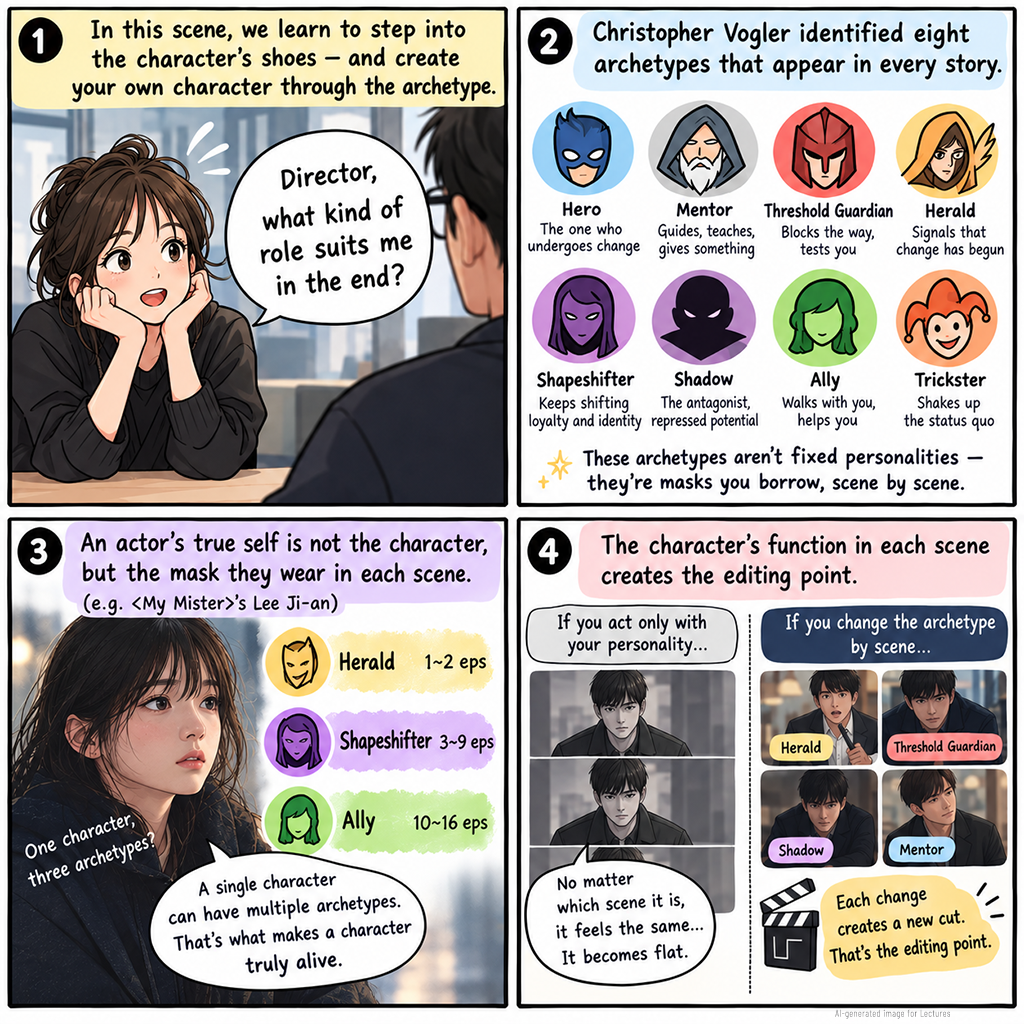
There was an actress who once put a question to me. It was a simple question. I failed to answer it properly, and it has stayed with me ever since.
She was one of the funniest people I have worked with. She had been turning it over for a while before she asked, and when it came out it came out like this:
“Director — in the end, what sort of role am I suited to?”
It was the in the end that got me.
She was, by the industry’s reckoning, the friend of the friend. Not the lead’s best friend — one further out than that, the loud one in the group who says the ridiculous thing. That was the shape people saw when they looked at her.
What people did not see was that she read constantly, that her work was full of fine detail, and that behind the brightness and the relentless clowning she was inward, quiet and serious. On the inside alone she would have been perfectly credible as Lee Ji-an in My Mister. What she was actually being cast as, over and over, was the silly one. Because her face was distinctive.
Most actors who have not yet found their footing are asking some version of her question. They want confirmation of who they are. Good roles or bad ones, light or dark, lead or support — tell me which, and I will forget everything else and dig in that direction for the rest of my life. The resolve is real. It is the premise underneath it that is the problem.
I have watched that premise cost people in two directions. Actors with conventionally good faces, quietly convinced that they are headed for leads, take no interest in any other kind of character and receive no training in one, and over the years they thin out into something bland. Actors with distinctive faces specialise into supporting work, harden into a single shape, and eventually give up on the rest of the map. Neither is safe. Having the face is no protection, and having an unusual one is no reason to draw your own boundary in advance.
Life is not only the story of beautiful people, and neither is film. What matters is what a particular director is trying to make at a particular moment in history, what that work is trying to say, and who can carry it.
I think I can now give that actress a small piece of an answer. Not the single-sentence definition a wiser man would offer — I will need several months of these lectures to get it out. Compressed, it goes like this:
“You can play anything. Provided you can play all of the following.”
Rather appetising, isn’t it. Reasonably concrete, too. So all I have to do is manage the following, and then any part is open to me? Show me the list.
All right. But first, the idea the list rests on.
There is no role that suits you. There is only the function you are required to perform in this scene.
If that is opaque, let me make it worse before I make it better. We should start with the theory.
There is a man named Christopher Vogler who spent many years in Hollywood as a story consultant. While working as a story analyst at Disney he wrote a short internal memo, which began circulating around the industry rather like a set of commandments, and which — on the strength of that circulation — became a book in 1992: The Writer’s Journey. Anyone who writes screenplays has probably passed through it at least once.
In it Vogler set out the eight character archetypes that recur across all stories.
- Hero — the central figure, the one who changes
- Mentor — the one who guides, teaches, and hands something over
- Threshold Guardian — the one who blocks the decisive passage and tests you at it
- Herald — the one who announces that change has begun; may be a person, may be an event
- Shapeshifter — the one whose identity and loyalty keep wavering, generating doubt and tension
- Shadow — the antagonist; the suppressed and disowned possibility
- Ally — the one who walks alongside and helps
- Trickster — the one who shakes a hardened situation loose with laughter and disorder
Read straight through, it looks easy enough. The Lord of the Rings comes to mind immediately. So does The Lion King, so does Game of Thrones. Most works built on heroic narrative can be broken down into characters based on those archetypes.
Too easy, then? Let me ask you something. In that list, which one is Lee Ji-an?
My Mister ran on tvN in 2018. Park Dong-hoon is a middle-aged structural engineer in a construction firm, losing ground in an internal power struggle, his marriage hollowed out. Lee Ji-an is a young woman working as a temp in his office, buried in debt, caring for a deaf grandmother, and she is nobody’s idea of a mythic figure. The show is about the two of them recovering some part of their humanity through each other. Nothing in it resembles a quest.
“Sorry, Director — what are you talking about? That’s the Hollywood system. That’s the hero-narrative pattern. Star Wars. Marvel. Superhero pictures.”
You’re right, and you’re wrong. Absurdly enough, Vogler’s archetypes apply to My Mister exactly as they stand. They do because the hero in Vogler’s sense is not the superhero we all picture. The hero is whoever is standing at the starting line of a life. Which is to say: us.
A study published this spring — in Journal of Culture Industry, by Rim Hoon of Catholic Kwandong University — reads the whole drama through Vogler’s model, and calls Park Dong-hoon an involuntary hero: a man who did not set out on any adventure, but was pushed by external events into an interior one.
And Ji-an? In that reading, Lee Ji-an is a Herald, and a Shapeshifter, and an Ally.
Three archetypes in one character. I found that startling myself.
There is a further detail, and it is the one that matters most to me. The study does not simply say that Ji-an occupies three functions. It says when she changes. Episodes 1 to 2: Herald. Episodes 3 to 9: Shapeshifter. Episodes 10 to 16: Ally.
Look at what that means. Across one sixteen-episode drama, a single character’s function changes exactly twice. At the end of episode 2 and at the end of episode 9. And those two points are precisely where Lee Ji-an is most violently unsettled in the whole series. That is not a coincidence.
It also gives away the ending of this lecture rather early. An archetype is not a fixed personality; it is a mask that gets changed. And the point at which the mask changes is where the story is jointed. I will come back to that.
So: in a film like The Lion King, a character — Timon and Pumbaa, say — may carry the Trickster archetype and nothing else. In contemporary drama, archetypes overlap and stack, and a complex modern character can hold several of them at once.
Vogler defines each archetype along two axes: its psychological function and its dramatic function. The Shadow, psychologically, is “the energy of the unexpressed, unrealised or rejected aspects of the self”; dramatically, it is the force that stands in the hero’s way. The Mentor is psychologically the wiser and nobler part of us; dramatically, the one who teaches and hands something over.
Which tells you what these labels actually are. They are not descriptions of what sort of person you are. They are descriptions of what you are doing right now. Vogler’s archetypes are masks a character swaps between from scene to scene, and this is the thing to hold onto, because it is where the combinations become infinite.
A Mentor is later revealed to be a false teacher. A Trickster becomes, at some point, an Ally. A Shadow turns out to be the part of himself the hero will not acknowledge. One character wears four or five masks inside a single work. That is the centre of Vogler’s system.
Which means the question — what sort of role am I suited to — needs rewriting.
“Director, which mask am I wearing this time?”
At which point someone will object.
“Isn’t that a rather old theory? Isn’t that the Hollywood formula, the same film stamped out over and over?”
I have affection for the reader who, even after the My Mister detour, still finds this too familiar. Archetypes, myth, Jung, Campbell — men from a hundred years ago. Give me something newer. Fine. Here it is.
First: the My Mister study I just cited was published this March. Research testing a hundred-year-old schema against a Korean drama from 2018 is still being produced, right now.
And there is something more decisive. In 2023 a team led by the American psychologist Benjamin A. Rogers published a paper in the Journal of Personality and Social Psychology titled “Seeing your life story as a Hero’s Journey increases meaning in life.” They reduced the hero’s journey to seven measurable elements: recognising yourself as the protagonist, encountering a pivotal shift, setting out on a quest, gaining allies, facing trials, being transformed, and leaving something behind for the community.
Then they had people rewrite their own lives against those seven headings. The results were remarkable. Participants who restructured their personal narrative in that shape reported significantly higher meaning in life and greater flourishing, and showed improved reappraisal of their own problems and better coping.
What does that tell us? That the hero’s journey is not a convenient formula invented by storytellers. It is a description of how the human mind actually moves. A hundred-year-old theory, empirically confirmed once again.
For an actor this is not merely interesting. It means that when you identify a character’s archetype correctly, you are connecting directly to a circuit already installed in the audience. Why does a viewer lean towards certain characters from their first entrance, while others never quite land no matter how well they are played? The difference lives there.
We have talked about the mask. Now look at the face beneath it — the actor’s own personality.
Someone has actually measured it. In 2006 the British psychologist Daniel Nettle compared the personalities of professional actors against the general population. Actors scored significantly higher on extraversion, openness, agreeableness and empathy. The effect sizes ran between roughly 0.4 and 0.7 — in plain terms, the average actor sits somewhere around the top quarter of the general population.
All of that is more or less expected. The interesting result is the one that came back flat.
Conscientiousness showed no difference at all.
A follow-up study in 2020 pushed further. A team led by Denis Dumas, publishing in PLOS ONE, compared professional actors, acting students and non-actors. Actors were clearly higher on openness and assertiveness, and best of all at generating ideas quickly. Conscientiousness, meanwhile, was actually higher among the non-actors, and working professionals scored higher on neuroticism. A model using psychological measures alone separated actors from non-actors with 92 per cent accuracy.
Reading that, I felt a great many things I had watched on set for thirty years line up at once.
Actors are open to the new. They move towards people. They read other people’s feelings well. But at meticulous management and patient repetition they are not especially strong. And they carry a great deal of anxiety. I would not call that a defect so much as a difference in where the attention points — which is, after all, why the whole apparatus of management exists around them. Actors who also handle their own lives flawlessly are genuinely rare. Most of the ones I have worked with were glass-hearted, unmoored from the practical world, deeply emotional, and wide in their emotional swings. That is simply the native disposition of people who pursue this work.
Two conclusions follow.
First: all eight archetypes are already inside you. Your job, scene by scene, is only to call the right one up. If you are an anxious person, that anxiety is not the weakness that will break you; it is evidence that you register things other people miss. If you want to be petty with a friend, that is entirely normal — and if some other part of you is holding it back, that Mentor is you as well. There is a Hero in you, and a Shadow, and a Mentor, and a Shapeshifter. You may not have noticed, but there are already eight people living in there.
Second: none of that determines your casting. This is the heart of today’s lecture. You cannot play villains because you are kind — no. You cannot play leads because you are quiet — no. Because a role is not a personality; it is a function. Playing the Shadow does not mean becoming a bad person. It means doing the work of standing in the protagonist’s way in this scene. Kind people block other people all the time.
At which point the reasonable question is: fine, but what has any of this to do with editing?
A great deal. Readers who have come this far will remember Lecture 6. If you act a scene already knowing how it ends, the emotional temperature stays identical from the first frame to the last, and when the material reaches the edit room there is nowhere to join it.
Exactly the same thing happens to an actor who has fixed the character as a personality.
My character is cold and calculating. Arrive on set holding that, and what follows? You play cold and calculating in every scene. In episode 1 and in episode 8. In the scene where you block someone, in the scene where you help them, in the scene where you come running in with news. Identically. And you will feel you did well, because you were consistent.
In the edit room that character is flat. No dynamics. No swell, no weather. Whatever is being said, the face is the same face. The audience gives up on them somewhere around episode 3.
Now take an actor who has fixed the archetype scene by scene instead.
Same character. In episode 3, scene 5, she is the Herald: she arrives carrying news and the ground shifts. In episode 4, scene 2, she is the Threshold Guardian: she stands in the protagonist’s path and sets a riddle he cannot solve. In episode 6, scene 11, she is the Shadow: she makes him look at the cowardice he has spent the whole story refusing to see. And in the final scene of episode 8 she is the Mentor: she appears at the worst moment, hands over the thing that matters, and goes.
The performance did not change. The function changed four times — and so what lands on screen changes four times with it.
And the point where it changes is the edit point.
Do you know what an editor is actually looking at when joining one scene to the next? What is this character doing in this scene. That has to strike against the scene before it for the cut to live, for one shot to collide with another and roll the story forward. If the character’s function never changes, the editor cannot find a point at which to make the join, and the scene shrinks or disappears altogether.
When their lines get cut, actors blame their own performance. But this is the reason certain cuts survive despite mediocre acting. If the function that character performed in that scene is alive on screen, that cut does not die.
Which is where we go from here. One archetype a week, until we have taken the whole field.
Sources: Christopher Vogler, “The Writer’s Journey: Mythic Structure for Writers” (Michael Wiese Productions, 1992; 3rd ed. 2007); Rim Hoon, “Vogler’s Hero’s Journey and Internalized Ethical Narrative in Korean Drama: My Mister,” Journal of Culture Industry 26(1), March 2026, pp. 175–182; Benjamin A. Rogers et al., “Seeing your life story as a Hero’s Journey increases meaning in life,” Journal of Personality and Social Psychology, 2023; Daniel Nettle, “Psychological profiles of professional actors,” Personality and Individual Differences 40(5), 2006, pp. 375–383; Denis Dumas, Marie Doherty & Peter Organisciak, “The psychology of professional and student actors: Creativity, personality, and motivation,” PLOS ONE 15(10): e0240728, 2020.
Leave a Reply