
“To become gods… wouldn’t they still need people to worship them?”
Even as she asked it, Mika thought how servile she sounded. It was the kind of question that begged for one’s life, asked only in order to survive.
When the advertisement ended, the image on the LED wall changed. The stretch of beach where Mika and Rachel had sat that afternoon appeared in real time, like CCTV footage. The young couple holding a picket sign asking for work, their little daughter’s hand in theirs, were still standing in the same spot, still hunched against the world. Watching them, Mika’s chest began to pound. It was a manufactured heart; she had no idea why it should throb like this. Dr. Jang, too, gazed at that family who had lost their livelihood, and smiled sadly.
“They would. But they don’t need many.”
“They don’t need many?”
“When human labor sustained civilization, everything had to be plentiful. But now robots replace everything, and do it more efficiently. So the number of humans they need is just 3.99 percent of the current population. Even that is enough for them to enjoy godhood to the full. Adoration, obedience, slaughter, war. That many humans is plenty. And only then can the Earth breathe.”
At his last words Mika found herself wincing. That the most terrifying threat to the planet’s warming, its pollution, its ecosystems, was humanity itself — that had been a talking point for a very long time. And it was true that mankind had run headlong toward that threshold, knowing it, unable to stop.
“In trying to become gods, they learned a great many new things about creation.”
“Such as?”
“That creation does not happen all at once. Most people imagine that God made this world in a single stroke. He did not. All creation requires absolute time. If that were not so, why would God have invented time in the first place? Time means nothing whatsoever to God.”
He was right. To a God who lives forever and never dies, what could the passage of time possibly mean?
“The time the Creator requires to make a creature is not the Creator’s problem — it is a problem inherent to the creature’s nature. Structurally, by the laws of physics, a creature cannot spring into being complete from the very first moment. A baby takes ten months to be born. A robot takes time to assemble. Even a single bowl of noodles takes time to make. And only after passing through countless variables and experiences and processes of evolution can a perfect creature at last come into being. It’s the same principle by which a perfect AI is made only after more than fifty thousand rounds of deep learning. When religious scholars saw Darwin’s theory of evolution and began every kind of persecution, crying that God had been utterly denied — at that moment they did not understand. That evolution, too, is a process of creation. That the passage of time is meaningless to God, and meaningful only to the created.”
What Dr. Jang was saying was that creationism was right and evolutionary theory was right, both at once — a thoroughly quantum-mechanical proposition. That zero and one exist simultaneously. That light is both particle and wave. That until you lift the lid, the cat inside the box is both alive and dead. Dr. Jang was speaking the truth of quantum mechanics, the bridge between God and science.
“If God exists, I don’t understand why He made animals and plants this way. If AI and robots are so superior, shouldn’t He have designed things that way from the beginning? Like the robotic lifeforms from another planet in the film Transformers.”
“That is because—”
Dr. Jang started to answer, then drew a deep breath as though short of air. Rachel quietly took his trembling hand, and the tremor soon subsided. Rachel continued the words he had meant to say.
“Because the biological method is the finest manufacturing process in the universe. To build a robot you need mines. You need smelters. You need factories. And you need factories to build those factories. But a living thing needs only a single cell, water, and light. It is the simplest and only manufacturing method that requires no factory at all. Building a single android takes enormous scientific knowledge and equipment — but the birth of a living thing needs none of it.”
It was a reasonable point. Still, Mika showed no particular reaction. So Rachel went on with her explanation.
“Think of the ancient Earth. When there was nothing but rock and seawater. No factories, no blueprints, no engineers. And yet, out of that place where there was nothing, life came into being all by itself.”
“That’s true!” Mika agreed, as if struck with wonder.
“And do you know where life first began?”
“No.” Mika shook her head. Rachel spoke quietly.
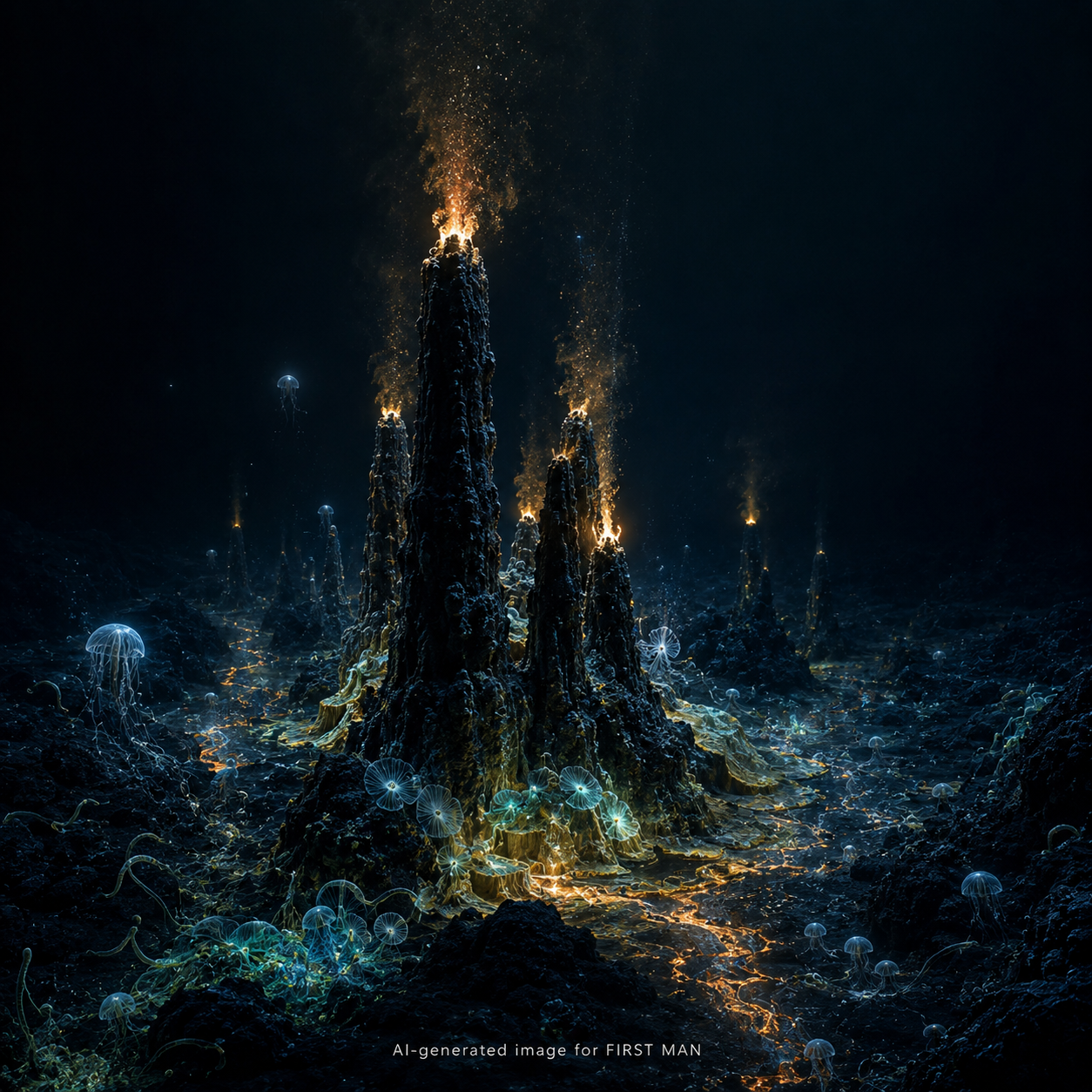
“In the deep sea, where no sunlight reaches. In the cracks of the rock where scalding water rises from the abyss. Life first began in the darkest, deepest place in the world.”
Mika found herself turning to look at the LED wall. Somewhere out there on that screen, beneath the sea, life had begun. And now—
“The only thing that can begin in a place where there is nothing is the evolution of living things. We are becoming machines now, but in the end humanity will be carried forward again by biological means.”
Rachel smiled brightly at Mika as she said this last part. Mika could not tell what Rachel meant by it, but she had no trouble accepting, however dimly, that the biological method was the one and only mode of creation.
Mika turned her head and looked at the LED wall. It was showing Blue Ark’s undersea city ‘Hope’ again. Pioneers sat at an open-air café, drinking coffee and enjoying their conversation.
‘That peaceful scene is all fake. In truth, fifty brain boxes with the spinal cords still attached are sunk down there.’
The instant Mika thought this, the LED screen — as though resonating with her thoughts — displayed the ‘brain server dark factory.’ Startled, Mika looked away from the screen. Rachel snapped her fingers, and the display returned to the beach.
‘Are my thoughts being shared with this system right now? They are, aren’t they?’
Mika glanced sideways at Rachel and put the question to her with her eyes. Rachel shrugged, as if to say yes.
‘Oh no! Then what about my privacy? What about my personal life?’
Snorting through her nose, Mika now glared at Rachel with eyes full of indignation. Rachel — as if she had read that thought too — waved a hand lightly. It meant: don’t worry about it. Well then. Phew. That was a relief, at least for now.
Reassured, Mika turned her head — and found Dr. Jang watching her with those deep eyes of his. There was nothing for it but to ask a question of some gravity.
“So then, what becomes of us?”
There was a great deal contained in Mika’s question. It was a question asked on behalf of everything from the smallest creature to the whole of the human race.
“Everything depends on the designer’s time.”
“The designer’s time?”
Mika looked at Dr. Jang with curious eyes. It was also a look that asked whether any hope was left for them.
“Oracle and Anthropos. For now, those are the designers we know of. Whether there are other groups, I couldn’t say. In any case, everything will change according to which of these two finishes its design for this world first.”
“‘Will change’ — you said ‘will change, and there’s no stopping it.’ The way you stress it is rather frightening.”
Dr. Jang laughed at her words. The right side of his face was paralyzed, so only the left corner of his mouth lifted. Half expressionless and half smiling, Dr. Jang’s face was grotesque — but to Mika’s eye it was rather endearing.
“We need time, but so do they. Neither we nor they have finished. How to redesign this world, and by what force and what power to hold it in place. Just as, long ago, both sides’ lives hung on who developed the bomb first — now both sides’ lives hang on who completes this design first.”
“And what is this design, exactly?”
“From their standpoint, it would be the annihilation of 96 percent of the human race in a single instant, with no side effects whatsoever.”
“Then what’s ours?” Mika asked, alarmed.
At that, Dr. Jang smiled faintly.
“Ours is… rather more complicated. We have far more to take into account. And we have so much less time than they do. But… yes. It’s true that time is short, but for now we should be all right.”
Uneasy, Mika pressed him.
“No — not ‘we should be all right.’ Couldn’t you just tell me that we are all right?”
At that, Dr. Jang turned his wheelchair slightly to face her.
“That rests on your two shoulders.”
“What? What do I—”
Rachel gestured, and the LED wall showed a hospital at night in pouring rain. Leo’s Blackcar Y dumped a man in front of the emergency center and immediately sped away.
“That man is the—”
Mika recognized him at once. It was the very man they had thrown down in front of Noah General Hospital’s emergency center that night, hounded by the drone suppression unit. Pluto had come to the protest site at enormous risk in order to save him. Why on earth had Pluto done such a thing? She had wanted to ask, but there had never been time to ask.
Mika spoke, watching the screen.
“Kang Zion, Chair of Terra Motors’ Second Union. Pluto saved him.”
Rachel gestured, and Kang Zion’s records appeared on the LED wall. Photographs and footage of him in work clothes, and beneath them a dense scroll of history. Rachel said,
“That’s right. Chairman Kang Zion. The leader who founded the Authentic Labor Union.”
At that, Mika tilted her head.
“I wondered about it back when I was reporting, too — I don’t know what that word ‘authentic’ is supposed to mean.”
“To be authentic means to hold your position even while taking the loss.”
“To hold your position even while taking the loss?”
Rachel pointed at the screen.
“According to the records, in twelve negotiations he gave up his own share first on eight occasions. He returned his chairman’s allowance three times, and when the layoff list came out he put his own name on it himself. These are choices that come out of no optimization function anywhere. Behavior that accepts loss cannot be calculated.”
Mika gave a bitter smile.
“Taking a loss and giving way — that’s what makes someone authentic?”
“I couldn’t say. It’s a mode of behavior I’m incapable of understanding. I’d like you to meet him yourself and ask him.”
“You want me to meet him?”
Rachel looked at Dr. Jang. When he gestured his permission, she changed the display again. It was a satellite map with Noah General Hospital’s location marked. But where the hospital should have been there was no building, no floor plan, nothing at all. Only gray static, hissing.
“Satellite scans, communications interception, medical network queries. All of it blocked. We can’t even get a thermal image of the exterior walls. It’s as if that one place had been cut out of the map.”
Mika stared at the static for a long while. An organization that looked into everything in the world could not look into that one hospital.
“There are not many places we cannot see into.”
Dr. Jang said.
“But that place is one of them. So whatever is inside, they must be people with technology comparable to ours.”
Rachel added, as if in support,
“And comparable means extremely dangerous.”
Mika asked,
“So? What is it you want me to do?”
Dr. Jang and Rachel looked at her at the same moment. With that face — half expressionless, half smiling — Dr. Jang spoke.
“Reporter Yoon Mika. Get inside that place, and meet Kang Zion.”
Instead of answering, Mika looked again at the gray static. The question she had swallowed a little while ago rose once more in her chest.
Why on earth had Pluto saved him?
Perhaps that answer, too, was somewhere inside that static.
Leave a Reply