
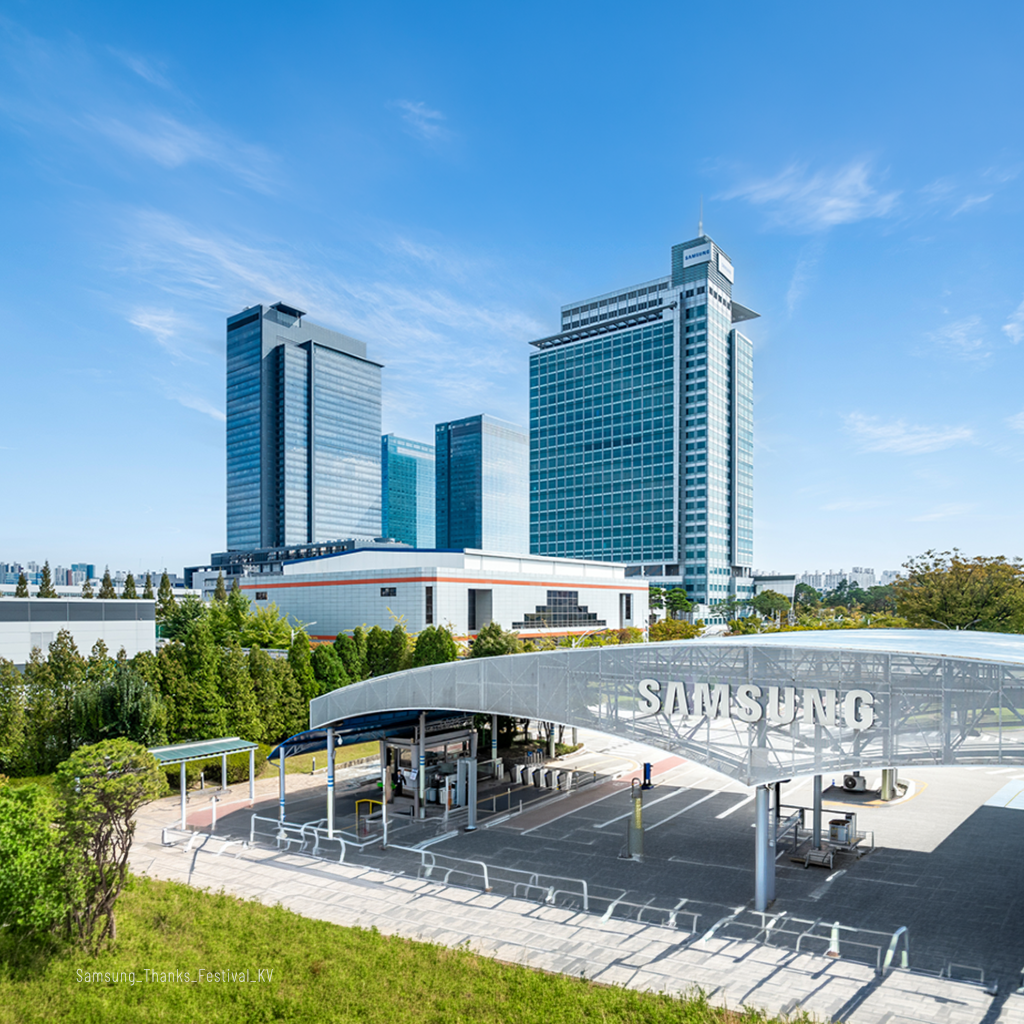
On June 5, 2026, Samsung Electronics announced its “Together with the People, Gratitude Festival.” For four weeks, from June 8 to July 5, every customer who purchases a Samsung product will receive Onuri vouchers — government-issued local commerce certificates — worth 20% of their purchase price. Uniformed public servants including soldiers, police officers, firefighters, and corrections officers will receive an additional 10%, bringing their total benefit to 30%. The total value of vouchers to be distributed is estimated at approximately 400 billion won. Buy a home appliance worth one million won, and you walk away with 200,000 won in Onuri vouchers. These vouchers, originally issued by the government to stimulate local economies, are accepted not only at traditional markets but at neighborhood eateries, convenience stores, grocery stores, and all manner of small local businesses — anywhere in your daily life.
When I read this press release, I was genuinely taken aback. This is not your typical sales promotion. The standard playbook for these events is to offer a percentage off the retail price, or bundle in another product at a discount — anything to drive more purchases of the company’s own goods. Yet here is Samsung, handing out vouchers worth 20% of each purchase and telling customers to go spend them somewhere else entirely. What on earth is going on?
Distributing support payments to stimulate the local economy has always been the government’s job. When COVID-19 brought the world to a halt in 2020, the government scrambled to issue emergency disaster relief payments. The first round targeted households in the bottom 70% of the income scale, giving families of four or more up to one million won. In 2021, 25,000 won per person was distributed to 88% of the population. When fuel prices surged, the government reached for energy subsidy packages under names like “livelihood recovery consumption vouchers,” opening the public purse. But now a private company — Samsung Electronics — has mounted a nationwide support payment program funded entirely from its own revenues. Can this still be called a marketing promotion?
“Samsung Electronics’ achievements in semiconductors and other areas in this era of AI have been made possible by the support and encouragement of the Korean people. This special event was created to give back in return.”
Since the founding of the Republic of Korea, I have never seen a corporate statement like this. A company earned money, says it was thanks to the people, and wants to give back. Has any company ever said this before?
“We will ensure that Samsung’s growth and achievements create a virtuous cycle not only for our employees but for our society as a whole. To that end, we will invest five trillion won over the next five years in ‘building a mutually beneficial and healthy ecosystem’ and ‘nurturing future talent.’”
Samsung’s decision to issue Onuri vouchers — redeemable at traditional markets and local small businesses — rather than simply discount its own products, the company says, is precisely because it wants to contribute to local economic revitalization beyond its own customer base.
Is this not exactly the kind of company we have always wanted to see? It is impossible not to applaud.
“Samsung Electronics will continue to ask fundamental questions about what role a company should play in our society, always mindful of the expectations and standards of the Korean people, and will faithfully fulfill its responsibilities as a company that grows together with society.”
The message Samsung is sending in the wake of its dramatic labor settlement on May 27 is one of genuine, positive influence. This, economists would say, is the social model they always dreamed of.
Harvard Business School professors Michael Porter and Mark Kramer introduced the concept of “Creating Shared Value” (CSV) in 2011. Their core argument: a company’s competitiveness and the health of the society it belongs to are inseparable. Rather than simply donating a share of profits to good causes — what is known as Corporate Social Responsibility, or CSR — businesses should design their operating models so that the act of doing business itself creates social value.
Samsung’s festival looks very much like that theory brought to life. Samsung is attempting to build a virtuous cycle in which selling its own products simultaneously revives the local economy. A consumer buys a product; the benefit flows to the traditional market; neighborhood commerce picks up; that energy flows back to sustain the broader consumer economy. The very act of buying and selling becomes a force for social good. This is precisely the model Porter and Kramer described.
It is simply true that we stand today at the center of the most dramatic productivity revolution in human history. NVIDIA CEO Jensen Huang has declared that “the agentic AI inflection point has arrived,” envisioning a world where every person has a personal AI assistant as capable as R2-D2 from Star Wars. Elon Musk goes further still, predicting that by 2030, AI will surpass the combined intelligence of all humanity.
And yet we cannot help but feel a creeping unease. If AI generates such enormous wealth, who gets to keep it? Where do the people who lose their jobs to AI end up? Can we prevent a future in which only the top 10% hold meaningful employment while the remaining 90% are reduced to a precarious underclass — the precariat? If human beings lose the right to work, if they can no longer pay taxes, will governments still be able to pursue policies of the people, by the people, for the people?
The future brought by technological progress seems breathtakingly beautiful — and yet it may also be profoundly dark. We stand before a future unlike anything the Industrial Revolution of the 18th century presented, a future in which no one can see even one step ahead.
And yet, one company is showing us a small light. The message is this: our profits exist because of the people; we want to share those profits; and we want that sharing to create a virtuous cycle for society. The gains from the AI boom, channeled toward traditional market vendors and neighborhood shops. The fruits of technological growth, shared with society as a whole. This is as good an example as any of where humanity ought to be heading in the age of AI.
In 2018, Samsung Electronics executed a 50-for-1 stock split. In the immediate aftermath, shares traded around 53,000 won. Rallying from the COVID shock, the stock surged to 96,800 won in early 2021, coming tantalizingly close to the “100,000-won stock” milestone. After a long lull, it finally crossed that threshold in October 2025. By May 2026, it had blown through 250,000 won. As of June 5, 2026, the stock trades above 330,000 won. Market capitalization has surpassed 2,000 trillion won, placing Samsung in the two-trillion-dollar club — 13th among all global assets.
Samsung Electronics is no longer just a stock for Korean investors. American retail investors can now trade Korean stocks freely through their own brokerage accounts. The Korean stock market has, in a real sense, become a genuinely global marketplace accessible to retail investors everywhere. And for ordinary individual investors around the world looking at Korean equities, Samsung Electronics is the obvious first pick. Samsung’s operating profit for the first quarter of 2026 alone came in at 57.2 trillion won. Securities firms project that full-year 2026 revenue will comfortably exceed 500 trillion won, with operating profit ranging from 200 to 370 trillion won depending on the analyst. The pie itself has simply become a different size. Samsung is no longer the Samsung we knew — it has become a whole new Samsung.
The direction of a whole new global company is set by the philosophy of the person at the top. NVIDIA’s Jensen Huang publicly declares his intention to transform humanity’s intellectual tools through AI chips. The world’s leading CEO, he was spotted during his recent visit to Korea at a local barbecue joint — soju in one hand, beer in the other, utterly unpretentious — showing us by example how to live. Elon Musk is deep into concrete development plans for Mars, intent on making humanity a multi-planetary species. Their visions are grand in scale and yet deeply human and intuitive.
Samsung Electronics Chairman Lee Jae-yong attended the Ho-Am Prize ceremony in June for the fifth consecutive year, reaffirming the company’s founding philosophy of “people first.” He has pledged to hire 12,000 new employees per year — 60,000 over five years. Plans have been announced to support small and mid-sized suppliers, establish a fund for industrial accident victims, expand financial access for vulnerable groups, and develop AI talent. And now, through the very concrete and immediate mechanism of traditional market gift vouchers, he has put that philosophy into practice.
The vision of sharing profits with the people. The vision of designing growth so that its fruits reach into every corner of society. This goes beyond “growing our company” — it is a declaration that reads: “we intend to grow the society we belong to, together.”
Many people, I hear, are sitting with the anxious feeling that Samsung has risen so much it must be time to sell. Just as many others are nervously wondering if they should be buying Samsung right now before it goes higher. There are those who say that with foreign retail investors now able to freely buy Korean stocks, Samsung is the prime beneficiary, and the right move is to buy a little bit each month, steadily, going forward. All of this is reasonable. Everyone is free to buy or sell Samsung stock as they see fit. I know someone who bought in at around 53,000 won and, sitting on considerable unrealized gains, says this is only the beginning and has no intention of selling. Watching all of this unfold, I find myself feeling genuinely warm about it.
So what does it mean to buy Samsung Electronics stock? It is, of course, an investment — a bet on the AI semiconductor boom, the explosion in HBM memory demand, and an expanding global footprint. But now there is more to it than that. To buy Samsung stock is to say that you agree with and stand behind the philosophy that corporate growth should go hand in hand with social growth. It is to add your weight to the movement that says the enormous wealth created by the AI revolution must not be monopolized by a few, but should flow to all the people.
To buy Samsung is to buy our future. The fact that this future seems to be pointing somewhere warmer — that is what moved me most when I encountered this press release today.
—
By Sunjae Park
Editor, Korea Insight Weekly