
On the morning of May 18, 2026, a small promotional poster appeared on Starbucks Korea’s official app and online store. It was advertising the Tank tumbler series as part of a “Buddy Week” event — and stamped across that poster, targeting May 18th specifically, was the phrase “Tank Day.” Below it, one more line: “Bang on the desk!”
May 18th. The anniversary of the May 18th Gwangju Democratic Uprising. Forty-six years ago, military tanks and armored vehicles rolled through the streets of Gwangju. To those who survived that massacre, and to anyone who has learned that history, the word “tank” is not simply a military vehicle. And “Bang on the desk”? In 1987, when pro-democracy activist Park Jong-chul died under police torture, the authorities explained his death by saying, “We hit the desk — bang — and he went ‘ugh’ and died.” Both phrases have long been used by far-right online communities — most notoriously Ilbe (Ilgan Best), Korea’s equivalent of extremist internet troll forums — as a way to mock and demean the pro-democracy movement.
Could this be coincidence?
The moment the poster went public, social media and online communities erupted. A new term, “Ilbe-bucks,” spread instantly. Posts flooded in of people deleting the Starbucks app — a movement dubbed “quitting Starbucks.” Videos appeared of people smashing Starbucks tumblers and mugs with hammers. As the backlash spiraled out of control, President Lee Jae-myung took to social media, writing that he was “furious at the inhuman behavior of these lowlife merchants who deny the values of our democratic community,” and warned that “appropriate moral, administrative, legal, and political consequences must follow.”
On May 21st, the Ministry of the Interior and Safety declared an institutional boycott of Starbucks. The mayor of Gwangju banned Starbucks gift certificates as prizes at city events. The Seoul Metropolitan Police Agency opened an investigation into Shinsegae Group Chairman Jung Yong-jin and former Starbucks Korea CEO Sohn Jung-hyun on charges of defamation and insult.
As the crisis spun beyond control, Shinsegae Group Chairman Jung Yong-jin abruptly dismissed Starbucks Korea (SCK Company) CEO Sohn Jung-hyun. The company explained that the promotional materials had been created by a staff member, and insisted there had been “no intent.” A simple mistake by one marketing employee, they said.
But wait. At a company like Starbucks, where brand image is everything, a “single person’s mistake” is structurally almost impossible.
As the Kyunghyang Shinmun reported, these promotional materials passed through a five-stage approval process: drafted by a junior staffer, reviewed by a team member, approved by a team leader, checked by a senior executive, and finally signed off by the CEO. And in typical big-brand marketing, the process goes even further — an advertiser’s internal team of roughly ten people, plus an external agency team of ten or more, handles everything from concept to deployment, with at least two executives and two team leaders running multiple rounds of revision and review.
The only person who has ever handled the entire process — concept, production, and release — entirely alone was “Chungju Man,” the viral one-man PR force behind a small city government’s social media channel. And he has since resigned. For a company like Starbucks Korea, with annual revenue of 3 trillion won and more than 1,900 stores nationwide, to claim that one staff member’s concept went out nationwide without any filter? It’s a defense that simply doesn’t hold up.
There’s a reason the anger refused to die down. The deeper people dug into this incident, the more evidence accumulated that “Tank Day on May 18th” was not an isolated mistake.
April 16th — the anniversary of the Sewol ferry disaster. It emerged online that Starbucks had run a “Mini Tank” promotional event on that very day. Too uncomfortable to dismiss as mere coincidence.
503ml. That was the volume of the “Colorful Tank Tumbler Set” featured in the May 18th promotion. Online, users pointed out that the number 503 evokes former President Park Geun-hye’s prison inmate number.
May 3rd (503). April 16th (416). May 18th (518). The dates most seared into the wounds of modern Korean history align, with uncanny precision, with Starbucks Korea’s marketing calendar. Asking people to believe all of this is coincidence is asking too much.
This pattern is precisely what makes it impossible to dismiss the scandal as a single employee’s “Ilbe-style tendencies and personal error.”
There is another reason — perhaps the more fundamental one — why the anger hasn’t cooled: Chairman Jung Yong-jin himself.
He is a man who has long stirred controversy by posting slogans like “I hate communism” and the hashtag “멸공” (meolgong, meaning “destroy communism”) on his personal Instagram. Allegations have also been raised that he donated to organizations with far-right political and religious orientations. OhmyNews and other outlets reported years ago that “Jung Yong-jin’s Ilbe-style conduct was bound to blow up eventually.” The Kyunghyang Shinmun’s editorial went straight for the jugular: “Is the shocking Starbucks mockery of 5.18 really not Jung Yong-jin’s fault?”
An owner’s political leanings permeate the entire organization. This is common knowledge in the marketing industry. When an owner openly embraces a particular ideology, the marketing team below — and the agencies beyond — naturally internalize that orientation. Even without explicit directives, a corporate culture forms in which content that suits the owner’s tastes passes through unchallenged. Some observers have suggested that the Tank Day incident may be the result of a culture of blind deference to the owner’s tastes. If the sequence of 416, 503, and 518 promotions truly reflects choices made somewhere within the organization, one cannot help but ask: what kind of culture allowed those choices to clear a five-stage approval process?
Starbucks Korea opened its first store in front of Ewha Womans University in July 1999, making its debut in the Korean market. Initially structured as a 50-50 joint venture between Shinsegae’s Emart and the U.S. Starbucks Corporation, the ownership balance shifted in 2021 when Emart acquired an additional 17.5% stake, bringing its share to 67.5%, while the remaining 32.5% went to the Government of Singapore Investment Corporation (GIC). The Korean entity was also renamed from “Starbucks Coffee Korea” to “SCK Company.”
Today, SCK Company operates more than 1,900 stores nationwide, generating annual revenue of roughly 3 trillion won and operating profit of around 140 billion won — a highly profitable enterprise by any measure. A key driver of that success is its “Frequency” marketing program: a seasonal campaign that rewards customers who purchase seventeen drinks with limited-edition merchandise. The program has lifted app return visit rates by 50% and built a devoted fanbase. Collaboration tumblers with luxury brands like Lacoste and MSGM have resold on secondhand platforms at a premium, turning “Starbucks goods” into a genuine cultural phenomenon.
The prepaid Starbucks Card adds another unique dimension to the business model. Money that customers load onto their cards in advance functions, from the company’s perspective, as interest-free cash. Unused balances remain available as corporate liquidity. The scale of Starbucks Korea’s prepaid card reserves is, by industry accounts, considerable.
This is why Starbucks Korea has never been simply a coffee chain. Korean consumers have consumed Starbucks not merely as a place to drink coffee, but as an experience — a sense of participating in culture. Even at premium prices, they lined up willingly, because they trusted the emotional value the brand offered. That trust has taken a direct hit from this scandal.
Korean consumers’ boycotts are, by global standards, extraordinarily decisive and organized.
In 2019, the “No Japan” movement — launched in response to Japan’s export restrictions — drove Uniqlo’s Korea sales down by more than 60%. In 2020, Uniqlo Korea posted an operating loss of 88.4 billion won, a collapse of more than 280 billion won compared to the prior year’s operating profit of 199.4 billion won. The space Uniqlo left behind was filled by domestic brands like Musinsa Standard, Topten, and Spao. Once a brand is blacklisted, competitors move in.
This Starbucks boycott has already escalated to the level of government intervention. The Ministry of the Interior and Safety’s institutional boycott declaration is an unprecedented spectacle — the government calling for a consumer boycott of a private company. Dismissing one CEO and issuing one apology is not going to put out this fire. The core of the problem is the owner, Chairman Jung Yong-jin. Unless he steps forward himself — and perhaps even if he does — the image now burned into the public mind will not be easily erased.
But the saddest part of this whole affair is something else entirely.
Starbucks, from its U.S. headquarters on down, calls its employees “partners.” It is known for hiring even part-time workers as full employees, offering health insurance and a range of benefits. The Starbucks partner welfare model has been cited as a benchmark across the global retail industry.
Starbucks Korea — SCK Company — tells a somewhat different story. Labor cost pressures, a practice of pulling staff from existing stores when new ones open without proper replacement hiring, a workload that has one person doing the work of three: these have been an open secret in the industry for years. In the wake of this scandal, Starbucks Korea partners rallied on the anonymous workplace app “Blind” and resolved to hold a truck protest — the first collective action since the brand entered Korea in 1999, twenty-seven years ago.
And yet it is those very partners who are now bearing the brunt of citizens’ rage. Multiple outlets — Money Today, Financial News, and Nocutnews among them — have reported on the situation. People are showing up at stores, hurling abuse at staff: “You’re all the same, aren’t you?” Some are demanding that employees declare their political views. One partner told reporters: “I’m terrified to come to work every day. It feels like hell.”
It was not the partners behind the counter who designed Tank Day, who signed off on it through five levels of approval, or who built a corporate culture that internalized the owner’s political leanings. Starbucks Korea acknowledged as much in a second public apology posted across all its stores on May 22nd, stating that “this incident was entirely the result of a mistake in the company’s online operations, and has nothing to do with store partners.” The anger is justified. But the direction of that anger must be accurate.
Starbucks Korea is now facing the greatest crisis in its history. A CEO dismissed. Full disciplinary proceedings against all involved staff. A police investigation. A government-declared boycott. Yet if none of these measures touch the true source of the problem, the crisis will come back.
416, 503, 518 — these numbers are not dates on a marketing calendar. They are dates carved in tears by the people who have lived through this country’s history. If what Starbucks has been selling is not merely coffee but “culture” and “feeling,” then that culture is built on the history of this nation. You cannot mock that history and still sell that feeling.
On May 23rd, President Lee Jae-myung posted something on social media that stayed with me: “How did our society come to this?”
Wit and mockery are not the same thing. Events designed to smuggle in codes of ridicule and use them to make fools of the public must never happen again.
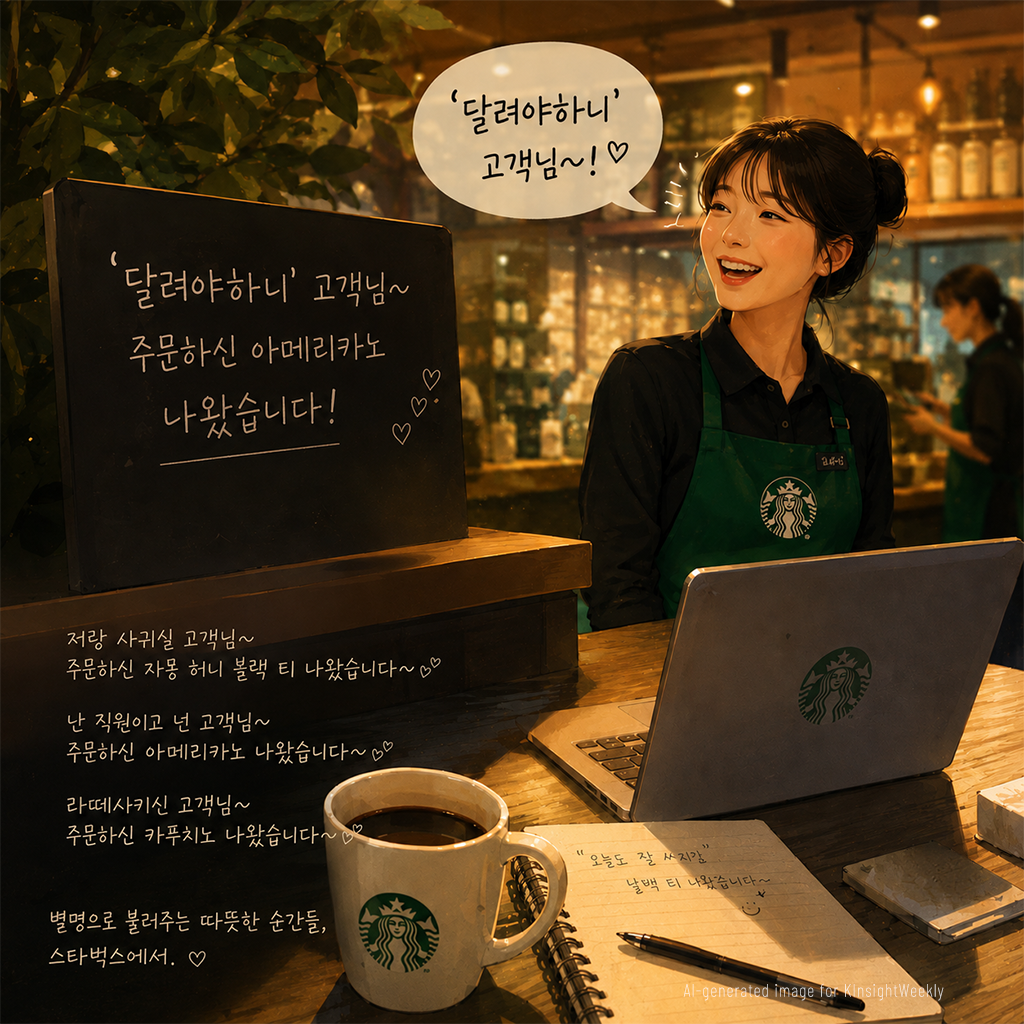
And honestly — I have to admit — Starbucks used to be genuinely wonderful. Drinking coffee there felt like participating in culture. Sitting down with a laptop, somehow the words came easier. The partners wore real smiles, unlike the dead-eyed hospitality of so many other places. And instead of the cold buzz of a pager, they called your name — whatever nickname you had written down on the cup. Customers started writing increasingly absurd, hilarious nicknames just to hear baristas read them aloud. Some became legendary:
“Would You Date Me, please?” — Your Yuzu Honey Black Tea is ready. “I’m the Employee and You’re the—” — Your Americano is ready. “Latte Person” — Your Cappuccino is ready.
That this warm, playful culture — because of one owner’s worldview, dressed up in the absurd excuse of “one employee’s mistake” — can no longer be enjoyed without discomfort: that is genuinely sad.
In Korea, if someone comes forward, admits their wrongdoing, promises it won’t happen again, and offers a sincere apology — people understand. People forgive. There are no grudges held forever. So please: apologize. I want to go back to Starbucks and order a coffee without hesitation. I want to give Starbucks coffee as a gift to the people I care about. I want to work my way through the mission drinks and claim my Frequency goods.
“Gotta Run” — Your Americano is ready.
I want to hear that again. Because these small things were the quiet happiness of our everyday lives. They were our culture.
“Chairman Jung Yong-jin! Please apologize! And we will forgive you!”
—
By Sunjae Park
Editor, Korea Insight Weekly