
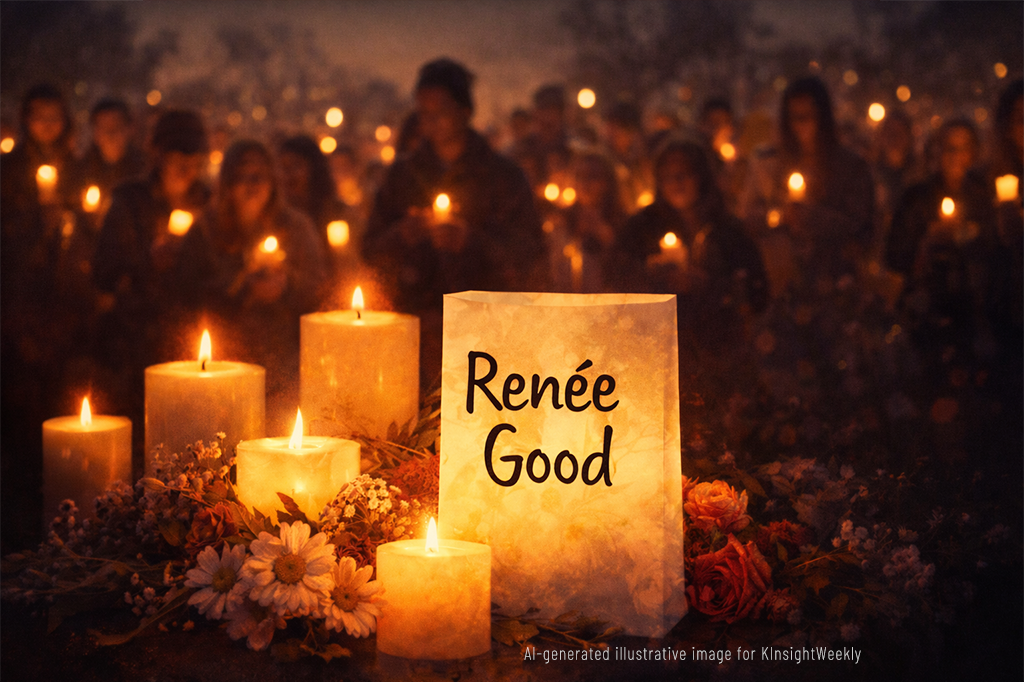
After reading this news, the shock did not leave me for days. It was a report that a woman in Minneapolis, Minnesota, had been killed after being shot three times by an ICE (U.S. Immigration and Customs Enforcement) officer.
The woman who was killed was a U.S. citizen, 37 years old, and a mother of three. Her name was Renée Nicole Macklin Good.
She had just driven her six-year-old youngest child to school and was on her way back home. As she tried to pass a parked vehicle, she encountered an ICE checkpoint.
Inside the car with her was her wife, Becca Good, and in the back seat was their dog.
The face captured on the ICE officer’s body camera was far from that of the “threatening suspect” we are usually taught to imagine. In the video, Renée smiles and says:
“That’s fine, dude. I’m not mad at you. Show your face.”
In response, an ICE officer spat out:
“FUCKING BITCH.”
Another officer shouted, “Move the car,” while yet another yelled, “Get out of the car.” Conflicting commands were hurled at her at the same time. Flustered, Renée moved the vehicle.
At that moment, an ICE officer immediately drew his gun, aimed at Renée’s head, and fired three shots. Renée died on the spot.
Her foot pressed down on the accelerator, and the vehicle moved forward about twenty meters before crashing into a utility pole and coming to a stop. People nearby screamed in shock. A doctor who happened to be passing by approached the car to check on her. However, ICE officers stopped him. “I don’t care if you’re a doctor or not!” The scene was immediately secured.
Several hours later, Kristi Noem, Secretary of the Department of Homeland Security (DHS), made a direct statement about the incident. Standing before cameras, she said:
“This vehicle was used to hit this officer. It was used as a weapon.”
“This was an act of domestic terrorism.”
Kristi Noem was already a familiar figure. In September 2025, she had been the official responsible when ICE agents detained approximately 300 Korean workers in Georgia, triggering diplomatic and international controversy. At the time, Noem said:
“You’ll know what the rules of the game are.”
Soon after, Vice President JD Vance stepped forward. Speaking to reporters, he said:
“This is classic terrorism. We’re not going to give into terrorism.”
Then President Donald Trump himself weighed in. On his social media account, he wrote:
“She violently, willfully, and viciously ran over the ICE Officer.”
“He fired in self defense.”
“It is hard to believe that he is alive, but he is now recovering in the hospital.”
Taken together, these statements amounted to this conclusion: she was a terrorist, the vehicle was a weapon, and the officer’s actions were self-defense.
But was she really a radical left-wing terrorist?
Renée Good was a white woman from Colorado, a U.S. citizen, and a mother of three. She had no known criminal record. She had, however, participated in ICE Watch activities in the Minneapolis area. This activity is known as a citizen network that observes immigration enforcement operations in real time, records them on video, and alerts local residents. Her participation as a local resident ultimately became the pretext by which she could be labeled a radical left-wing terrorist. Her wife, Becca Good, later said:
“We had whistles. They had guns.”
The ICE officer who shot her was named Jonathan E. Ross. He claimed that Renée attacked him using the vehicle as a weapon and asserted self-defense. The investigation was later taken over exclusively by the FBI. The Minnesota Bureau of Criminal Apprehension (BCA) was excluded from the investigation, and questions and suspicions circulated locally and beyond as to whether this decision was intended to protect Ross.
The government’s message was consistent. He did what he was supposed to do. He acted according to his training. The message that “we will protect him” was repeated again and again.
Jonathan Ross was a military veteran who served in the Iraq War and had worked as an ICE officer for more than ten years. He was described among family and friends as a conservative Christian, and some media outlets introduced him as a MAGA supporter.
In recent years, ICE has undergone large-scale expansion, and reports have emerged that training for new officers has been shortened to about 47 days, or roughly two months. The number “47” was also interpreted by some as symbolically connected to Trump being the 47th president.
What this massive expansion ultimately sought was large-scale arrests of undocumented immigrants. There were quotas. Reports indicated that internal targets of arresting thousands of people per day were being shared. The Trump administration emphasized speed in arrests and deportations, and as a result, operations on the ground became increasingly aggressive.
Undocumented immigrants were treated as potential terrorists, drug traffickers, and social evils, and voices resisting this were labeled radical left-wing terrorists.
I hesitated before writing this piece. I am told that to enter the United States now, one must submit all SNS records. Could a piece like this someday block my entry into the country? Such measures, which feel like ideological screening, are deeply intimidating. How did we reach a point where, in what is called the world’s leading democracy, one writes in fear of censorship?
I only hope that this will not be forgotten.
One day, a mother of three, returning home after taking her youngest child to school, spoke amid the shouts of ICE officers:
“That’s fine, dude. I’m not mad at you. Show your face.”
“FUCKING BITCH.”
Moments later, three gunshots rang out.
Her name was Renée Good.
She had done nothing wrong.
But she was killed.
If one feels no pang of conscience about this, one is not human. Leo Tolstoy wrote, more than two hundred years ago in his novel Resurrection, that one can kill without firing a gun, and that in doing so one may feel nothing at all. The passage reads:
“The most terrible thing was that he had been killed, and no one even knew who had killed whom. Marlenikov may have signed routine official papers, but he would not have thought it was his fault. The warden merely carried out an order to transfer them. The escort officer merely escorted the prisoners as he always did. He could not have foreseen that the two prisoners would die from the heat. In the end, no one committed a crime, yet those people were killed. Thus, people who committed no crime killed them.”
May Renée Nicole Macklin Good rest in peace.
—
By Sunjae Park
Editor, Korea Insight Weekly