
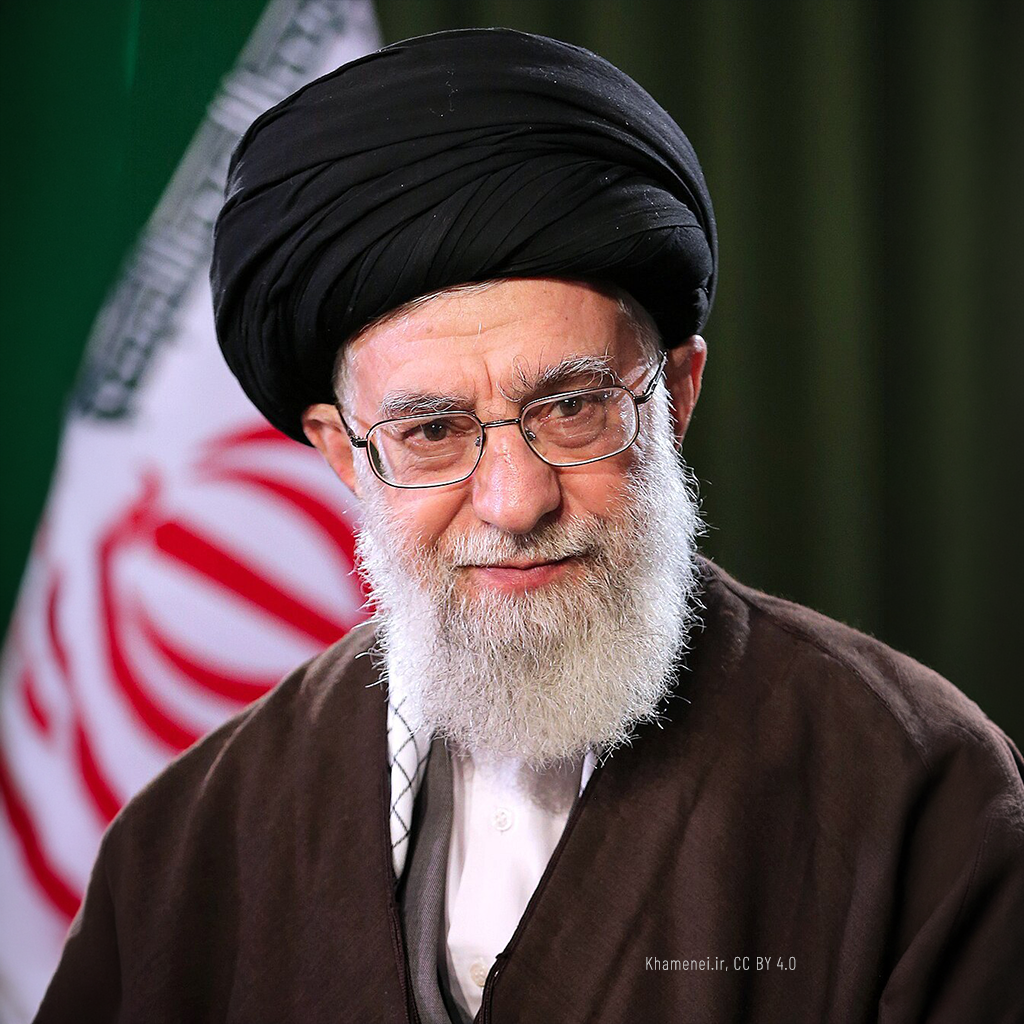
On February 28, 2026, U.S. stealth bombers carried out a precision strike on the Tehran headquarters of Iran’s Supreme Leader Khamenei. At that moment, Khamenei and the top military brass were gathered in a bunker 100 meters underground, holding a meeting of the National Defense Council. Iran had been engaged in nuclear disarmament negotiations with the United States — negotiations it found impossible to accept. The meeting was almost certainly convened to prepare for the collapse of those talks. But it never concluded. As they deliberated, a GBU-57 MOP — the Massive Ordnance Penetrator, the most powerful bunker-busting bomb in existence — drove straight through 100 meters of earth directly above their heads. Supreme Leader Khamenei and 40 members of the military high command were killed.
But it wasn’t just stealth bombers in the air. Simultaneously, an operation known as “Lion’s Roar” (Operation Lion’s Roar) was executed — a joint U.S.-Israeli mission of extraordinary precision. Decoy drone squadrons were dispatched first to bait Iran’s air defense radars into activating; the moment their positions were revealed, they were immediately neutralized by airstrikes. With in-flight refueling extending their operational range, targets across Tehran and throughout the broader region were struck with zero margin of error. Notably, Claude AI reportedly played a central role in strategic planning and real-time calculation of air defense evasion routes — a landmark realization of what military strategists call Algorithmic Warfare.
Iran struck back immediately, launching six missiles simultaneously at U.S. military bases across the Middle East: Al Minhad Air Base in Dubai, Al Dhafra Air Base in Abu Dhabi, Al Udeid Air Base in Qatar, Camp Arifjan in Kuwait, the headquarters of the U.S. Fifth Fleet in Bahrain, and Al Asad Air Base in Iraq.
Why did the United States launch a military operation in the middle of active nuclear negotiations? Under any conventional logic, one does not expect physical force to be used against a country while talks are still on the table. Sending dozens of fighter jets into a sovereign nation’s airspace is, by any definition, an act of war. And yet this act of war was set in motion not in the halls of Congress, not from the White House, but from a private resort — announced on social media. That is the historical reality we are living.
The Trump administration had been cornered on multiple fronts: a defeat in the Supreme Court over tariff policy, and an immigration crackdown that had backfired spectacularly with the killings of Renée Good and Alex Jeffrey Pretti — two American citizens shot dead by federal immigration agents in Minneapolis, Minnesota — generating precisely the kind of backlash the administration could least afford. Faced with these compounding political pressures, a single dramatic move capable of sweeping all those narratives off the front page must have been deeply appealing. The timing in Iran was, to put it plainly, convenient. Just months earlier, mass protests had erupted across the country, sparked by chronic water shortages and skyrocketing food prices. Clashes at Azadi Square in Tehran turned into a bloodbath — officially 3,000 dead, with unofficial estimates reaching 30,000. The protests were eventually suppressed, but the fury of the Iranian people had not subsided.
Whether this strike was driven by genuine strategic calculation or by one man’s political needs, the results are undeniable in their force. Footage of U.S. fighter jets weaving through incoming interceptor missiles like acrobats has been seared into the global consciousness. Dozens of aircraft hit their targets with zero deviation, achieving every objective the moment the operation began. The message was unmistakable: American military power stands in a category of its own.
On February 28, 2026, the Khamenei regime — which had ruled Iran for 37 years — was brought to an end by a GBU-57 bunker-buster. On March 1, a new chapter of Iranian history began. What comes next, no one can say with certainty. The names being discussed include Reza Pahlavi, the crown prince of the exiled Pahlavi dynasty; Maryam Rajavi, president of the National Council of Resistance of Iran (NCRI); and moderate generals within the Islamic Revolutionary Guard Corps (IRGC) who may choose reform as the price of institutional survival. None of them carries unimpeachable legitimacy. None commands the broad popular support needed to govern. And the United States, with its long and largely unhappy history of intervening in foreign politics, appears to have no intention of picking a winner. The message from Washington seems to be simply this: Don’t get any ideas. I know where you are and what you’re doing — and if I choose to, I can end you in a single blow.
Trump, for his part, has clearly gotten what he wanted from this operation. I’ll leave it at that.
What I want to focus on now is the Iranian Spring that began on March 1, 2026. The protests that erupted in early 2026 were born of desperation — water shortages, collapsing food affordability, years of accumulated grievances. The bloodshed at Azadi Square claimed 3,000 lives officially, and perhaps 30,000 by less official counts. Suppressed by the Revolutionary Guard, the uprising failed to achieve its goals. And yet, just months later, events took an entirely unexpected turn. The death of Khamenei — the man who had ruled Iran for 37 years — signified more than the passing of a single dictator. It marked the end of the system he embodied: the velayat-e faqih, the rule of the Islamic jurist, the theocratic order that has governed Iranian life since 1979.
Whoever takes power next — and it will not be easy for anyone — they will not be able to govern by ignoring the Iranian people. The consequences of dictatorship have now been made vividly, irreversibly clear. There will be chaos. There will be pain. But Iran will be reborn.
No more mandatory hijab. No more suppression of thought and expression. The Iran that once embraced freedom — the Iran that existed before the revolution — may finally be returning. The very name Iran means “Land of the Aryans.” It was never meant to signify theocratic rule. The Aryan peoples who gave the country its name lived under the spirit of Zoroastrian tolerance, a civilization that prized openness and freedom. That was Iran, before 1979 changed everything.
And in that era, Iran and South Korea shared a remarkable bond. In 1977, the Mayor of Seoul and Tehran Mayor Gholamreza Nikpay met and formalized a spirit of friendship between their two cities. In Seoul, a major boulevard in Gangnam was named Teheran-ro — Tehran Road — after the Iranian capital. In Tehran, Seoul Street and Seoul Park were established in return. It is not hard to imagine that South Korea will once again play a meaningful role in Iran’s new history.
On March 1, 1919, thirty-three Korean independence activists gathered at Taehwagwan Restaurant in Jongno, Seoul, and proclaimed Korean independence to the world. Sixteen-year-old Yu Gwan-sun, a student at Ewha Hakdang — today’s Ewha Womans University — became one of the movement’s most enduring symbols. The March 1st Movement spread across the entire peninsula over the days that followed, as the Korean people, with one voice, cried out for liberation.
One hundred and seven years later, on March 1, 2026, Iran’s spring has begun. The same date. The cry of “Manse!” — long live Korean independence — that echoed across Korea in 1919 now finds its echo in Iran’s rallying call: Zan, Zendegi, Azadi. Woman, Life, Freedom.
I hope Iran’s new history is as dynamic — and as triumphant — as Korea’s own.
—
By Sunjae Park
Editor, Korea Insight Weekly