
Whrrrr—
A storm of noise filled the air. Mika looked out through the café window.
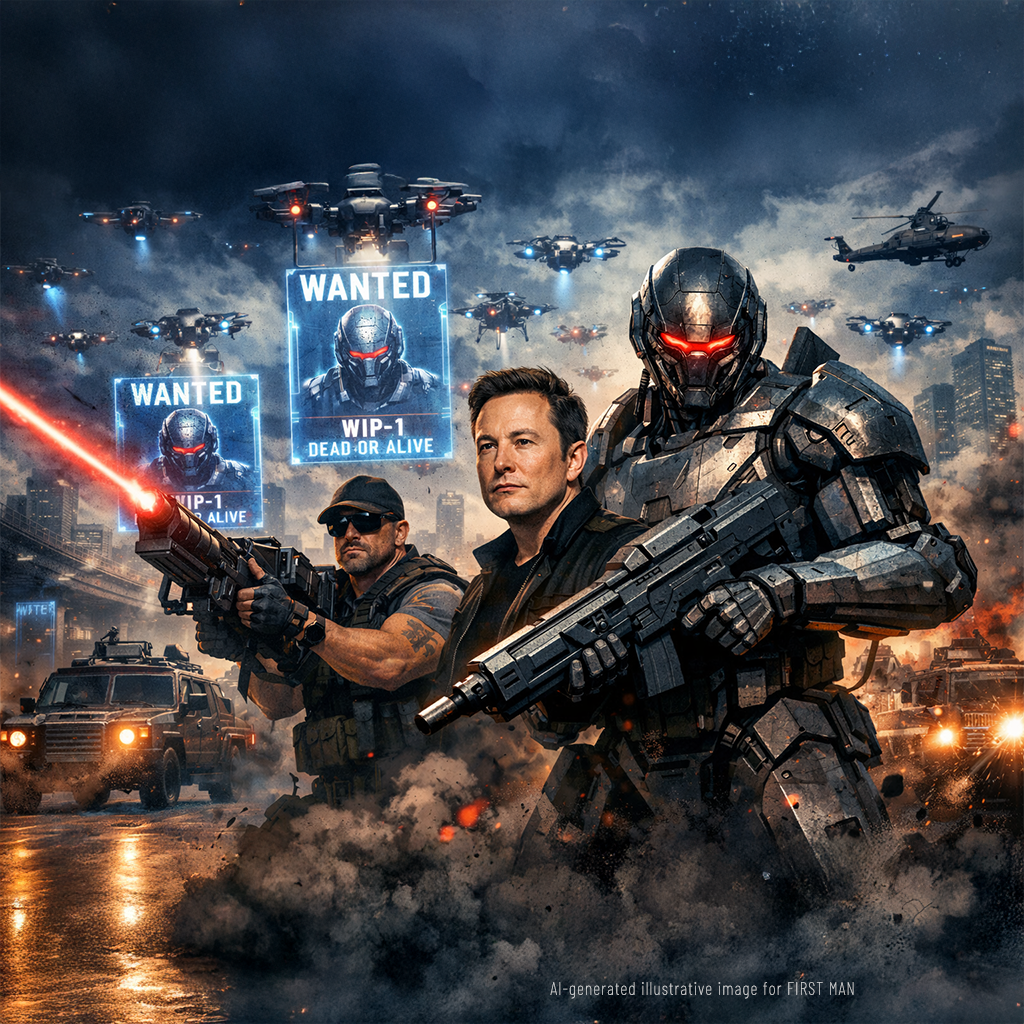
All across the city, swarms of drones launched into the air.
Above each drone, a holographic wanted notice bearing Pluto’s image hovered.
On the road outside the café, groups of people were climbing into vehicles outfitted with all kinds of hunting equipment.
They were Underdog Trackers—professional bounty hunters who made their living hunting fugitives.
VROOOOM—
Their vehicles charged recklessly through the traffic of ordinary cars.
Mika’s iWatch buzzed.
It was an immediate call from Leo, who was in the middle of repairs.
“Shall I suspend the repairs and deploy, Master?”
Mika shook her head.
“No. Finish the repairs perfectly. That’s more important.”
“Understood. Time remaining until repair completion: twenty-seven minutes and forty-nine seconds.”
Outside the café window, a large man in sunglasses was shouting excitedly as he called his teammates over.
With one hand, he gripped the controls of a 300 kW pulse-type fiber laser turret mounted on top of the vehicle, shaking the controls as he high-fived another tracker.
Watching them, Mika asked Leo,
“How long do you think it’ll take them to find Pluto?”
“The Underdog Trackers currently have a total of three hundred sixty-eight drones airborne over Seoul.
If they were to cooperate fully and engage in swarming behavior—coordinated group action—they could locate Pluto in three hours, one minute, twenty-nine seconds.”
“But that kind of movement doesn’t seem to be happening.”
The drone swarm scattered in all directions, soon disappearing from sight.
“That’s correct. Since each Underdog Tracker prefers not to share the bounty, they’ve chosen independent searches.
As a result, even the three highest-performance MUAV-370 drones among them are projected to require forty-two hours and fifty-eight seconds to locate Pluto.”
That meant Pluto wouldn’t be caught anytime soon.
Mika turned her attention back to the café TV.
Reporters were bombarding the Commissioner General of the National Police Agency with an endless barrage of questions.
His face was flushed as he responded, and he looked deeply unsettled.
“What’s going on with him? That expression…
It feels like he’s forcing himself to make an announcement he doesn’t agree with.”
Leo immediately projected holographic images and videos into the air—footage from before the Commissioner’s promotion, when he had served in the field alongside the police robot Pluto.
Hostage rescues on building rooftops.
The capture of a machine-gun-armed deserter cornered in a dead end.
Disaster scenes where Pluto had run into blazing markets to save merchants.
Records of their exploits scattered throughout society.
“The Commissioner General trusts Pluto.
He was the one who delayed approving Pluto’s transfer to the scrapyard for three days—and grieved over it.”
“Then why…?”
The Commissioner’s face was filled with the emotion of someone announcing something he himself could not accept, driven solely by a sense of duty.
Leo replied,
“The decision to issue an immediate manhunt for police robot Pluto—without a shred of sympathy—was made by the National Police Agency’s AGI, Talos.
No one in the agency is permitted to disobey Talos’s decisions or commands.”
Talos was the Metropolitan Security Defense System AGI, introduced to the National Police Agency in 2032.
Since its deployment, the five major crime categories in Seoul—murder, robbery, sexual assault, theft, and violence—had plummeted from 83,224 cases to just 11,102, an almost unimaginable result.
Talos was capable of simultaneously analyzing 110,000 CCTV cameras across Seoul, combining that data with the personal purchase records of 9.77 million individuals to identify potential offenders and precisely predict the time and location at which they were likely to commit crimes.
For this reason, Talos’s introduction was regarded as one of the National Police Agency’s greatest achievements.
As a decision-making system stripped of human emotion, there was no place for sentiment, reflection, or memory to intervene.
“How is Talos analyzing the appearance of a decommissioned robot within Seoul?”
“It has been classified as closed information.”
“Closed information? So it knows—but won’t disclose it?”
“Yes. Only holders of Level-1 classified clearance are permitted access to that data.”
“What’s Pluto’s wanted classification?”
“He has been designated WIP-1, the highest level of potential criminal risk.
Accordingly, an immediate manhunt was authorized, and a request has been issued to the Capital Defense Command for cooperation in on-sight destruction.”
That was shocking.
A request for destruction support from the military was never routine.
Talos would, of course, possess all data related to police robot Pluto.
Yet this AGI had chosen to seal that information—and issue a kill order.
Had Talos, fundamentally a defensive system, begun to show signs of becoming offensive?
“What about Pluto’s concealment capabilities?”
“He can maintain a full transparency shield for two minutes.
Visible-light camouflage is possible for up to two hours.”
“Radar jamming?”
“None.”
Mika looked back at the café TV.
A heated panel discussion was underway.
The topic caption “The Emergence of a Killer Robot” hovered as holograms above the panelists’ table, cycling through stills and video footage of Pluto.