
What BTS’s Comeback Concert at Gwanghwamun Left Behind
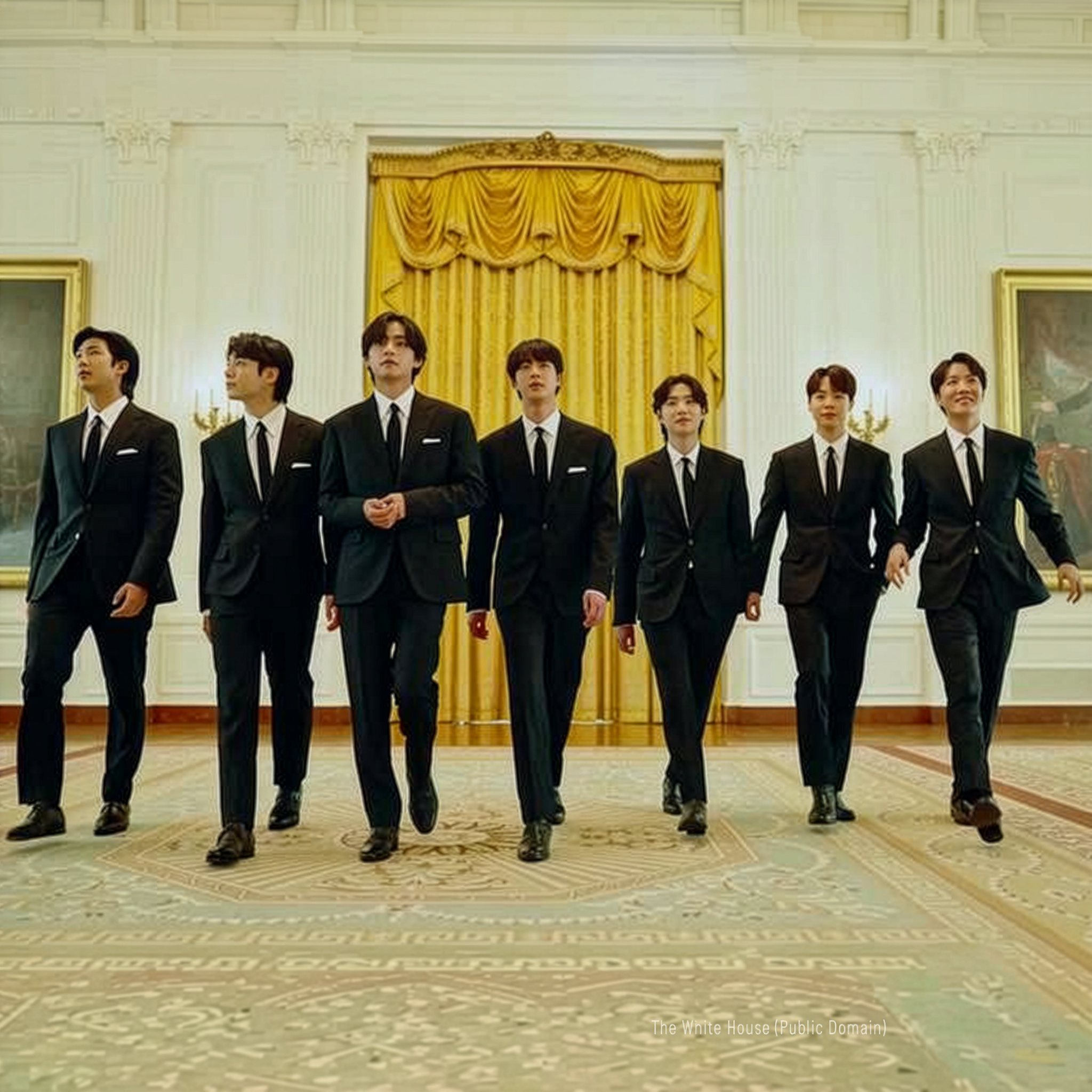
At eight o’clock on the evening of March 21, 2026, the opening began. A low, traditional melody settled over Gwanghwamun Square — Arirang, sung by the female vocalists of a traditional Korean music ensemble. Neither fast nor elaborate, the sound was mournful and quietly aching. On the screen, a video played: the seven members of BTS walking out from before Geunjeongjeon Hall at Gyeongbokgung Palace. Each had completed approximately eighteen months of mandatory military service. When the footage ended and the members walked out onto the stage beyond Gwanghwamun themselves, the crowd erupted.
The heart of this comeback lies in the album title itself. Arirang — a Korean folk song inscribed on UNESCO’s Representative List of the Intangible Cultural Heritage of Humanity — was chosen as the title of BTS’s fifth studio album. This was no mere marketing decision. RM explained during the album’s development that he wanted something reflecting the fact that all seven members are Korean, and that Arirang holds within it longing, love, and the full weight of human experience. The word they chose to carry everything they had missed — society, their fans, each other — was Arirang.
The album’s narrative reaches even deeper. A promotional video features the seven members listening to a recording of Arirang made in the United States in 1896. The story of nameless Koreans who sang this song on foreign soil, longing for a homeland under occupation, is woven together with the story of BTS returning after a long absence — connected, as the production team described it, by a red thread of fate. Seven young men stepping back onto a stage, and seven others who once carried this song across an ocean: the same longing, across a century. Critics received the album as simultaneously the most personal, the most Korean, and the most universal work BTS has produced since their hiatus.
The music video teaser for the title track “SWIM” drew an immediate and passionate response from fans around the world. A white sailing ship named ARIRANG glides across sunlit water; the camera slowly pulls back to reveal seven figures standing together, gazing steadily ahead. The image does more than look beautiful. It superimposes two pictures of young men — those who once boarded ships for America with nothing but a song, and seven others now setting sail again for the world after laying down their uniforms. That the ship bears the name ARIRANG is not incidental. The opening line, “I just wanna dive,” sung by Jin, captures the feeling of throwing oneself back into the current after a long stillness. When it rang out live at Gwanghwamun for the first time, the square answered with a roar.
The members’ costumes were equally deliberate. All seven wore black, though each in a distinct silhouette and cut. The central concept, developed by designer Song Zio, was “Lyrical Armor.” Working through individual consultations with each member, Song assigned a distinct character to each: RM as hero, Jin as artist, Jimin as poet, Suga as architect, Jungkook as pioneer, J-Hope as voice, and V as nobleman. The fabrics — hand-woven Korean cotton and linen — were chosen to evoke the texture of brushwork in traditional Korean ink painting. The unity of black was not a stylistic convenience. It was a declaration: seven men with seven distinct stories, dressed in a shared armor, stepping back onto the stage.
Gwanghwamun has always been a place where people gather. Since the Joseon dynasty it served as a site of petition and protest, where scholars staged demonstrations before the palace gates. In the modern era it became a symbol of democracy. In the winter of 2016, candlelight held by millions of citizens filled this square and led to the first presidential impeachment in South Korean constitutional history — a peaceful civic revolution that astonished the world. More recently, in 2024, the glow of K-pop lightsticks replaced candles as crowds gathered once again to demand accountability. Professor Lee Byoung-min of Konkuk University’s Department of Culture Contents has described this broader phenomenon as one in which “the city of Seoul itself is being consumed as global content.” On this night, that consumption took a different form. In place of political chants, there was music. In place of placards, there were lightsticks. In place of anger, there was longing and joy. A plaza that has served for centuries as a site of historical weight became, in a single evening, a site of cultural pilgrimage. The two identities did not conflict. The character of Gwanghwamun as a space that belongs to the people seemed only to resonate more deeply with what BTS has always represented. The square has long held the mood of its time, and on this night that mood was violet.
The scale of the event as an instance of content tourism is legible in the numbers. In the forty-eight hours following the concert announcement, online searches for travel to Seoul increased by 155 percent compared to the previous week, and hotel bookings by foreign visitors rose by 103 percent. Reservations came from across the globe: 41 percent from Chinese-speaking regions, 29.2 percent from the Americas and Europe, and 26.2 percent from Southeast Asia. A twenty-four-year-old American fan named Sarah Miller flew in a week early to attend the first full-group performance in over two years. A thirty-one-year-old French fan named Lukas Bernard took a month off work after learning that a BTS concert would be held at Gyeongbokgung and Gwanghwamun — places he had known only through dramas and YouTube. A fan who had come to Seoul from Russia to study told the BBC that BTS was the reason she was there at all, and that through them she had begun learning Korean history, culture, food, sport, and language. What unfolded at Gwanghwamun that night was content tourism in its most complete form: a cultural work generating physical movement toward a specific place, and that movement expanding into a broader engagement with an entire culture.
The concert ran for approximately one hour. The members presented new material with a composed, assured presence — the kind that comes from having grown up, from having been somewhere difficult and returned. But an hour felt short against the weight of more than two years away. Had there been an additional hour — a talk session, a conversation with the members — it might have gone some way toward closing that gap. What were those years like? What did they carry with them through it? What does it feel like to stand on this stage again? There was much that fans wanted to hear in the members’ own words, and the wish to stay a little longer, to be a little closer, was entirely understandable.
It was not the high-voltage performance of years past. But they came back, and they came back well — steadier, more settled, more themselves. They will soon set out on a world tour, as if aboard that white ship bearing their name. May the voyage be a good one.
—
By Sunjae Park
Editor, Korea Insight Weekly
Leave a Reply