
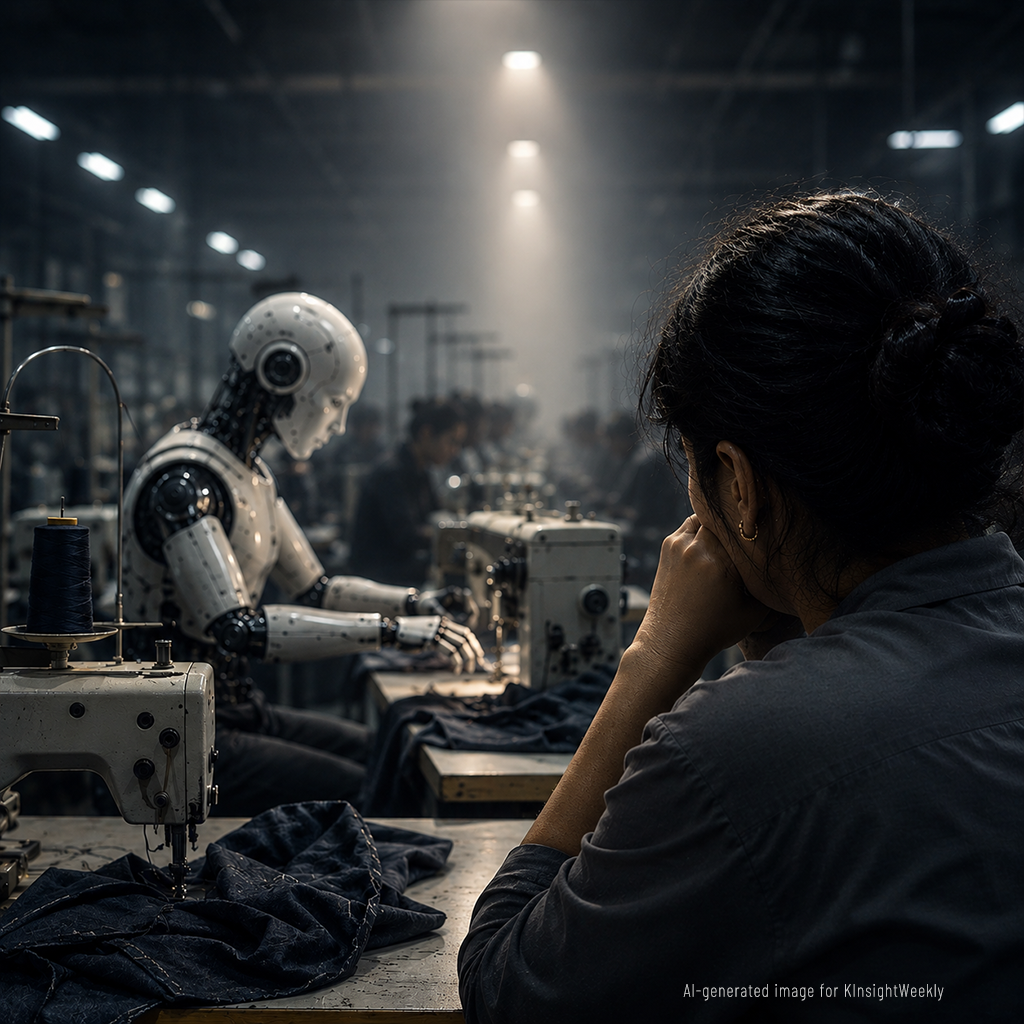
In May 2026, at a factory in Karur, Tamil Nadu, India, workers sat at sewing machines with GoPro cameras mounted on their heads. The cameras recorded their hand movements and work processes from the worker’s own point of view — so-called “egocentric data,” which captures the interaction between human movement and the surrounding environment from a first-person perspective. In this scene, reported by the Guardian on June 24 and introduced by HuffPost Korea, the data workers generate today a laborer leaves behind today become the training material for tomorrow’s humanoid robots.
Couldn’t we call AI humanity’s apprentice?
At first, it sounds like a strange question. But as I read the article, I began to think this question might actually be the most accurate way to describe our present reality.
What caught my eye in the article was not the performance of the cameras or the robots.
According to the report, the workers wearing cameras became conscious that their every movement was being recorded. Silence replaced small talk; careful concentration replaced casual handling. On the surface it looked like a surveillance device meant to boost productivity, but what the company was buying was not the product of surveillance.
To put it precisely, it was data containing the workers’ skill.
The gaze and the hand movements recorded today were becoming the textbook that AI and robots would open tomorrow.
The moment I saw that scene, I was reminded of the countless workers’ hands I had watched on garment factory floors years ago.
I worked in the garment manufacturing industry for about eight years. For roughly six of those years I developed clothing samples on a sample team, and for the following two I worked in Industrial Engineering (IE). In my IE role, I analyzed production processes, observed workers’ motions, and calculated the Standard Minute Value (SMV) — the standard time required for each task.
Whether I was managing samples or analyzing production lines, what I watched most were the workers’ hands.
A skilled worker’s hands were different. Which part of the fabric to grip, at what angle to feed it into the sewing machine, where to place the hands for the next motion — they never had to think about any of it. The body moved first. Unnecessary motions naturally disappeared, and each movement flowed into the next as a single stream.
That difference cannot be explained simply by saying their hands were fast.
The feel for reading the condition of the fabric, the judgment to respond to problems before they arise, the ability to adjust the sequence of work, and movements ingrained in the body through countless repetitions — all of these work together. You can write work methods down in a manual, but the senses and judgment embedded in them can never be fully captured in sentences.
We call that skill.
At the time, I understood that skill as a shop-floor capability that raised productivity and quality. But now, researching smart factories and AI-based garment manufacturing, I have come to see those workers’ movements in a new light.
I am currently researching how IoT, vision, and AI technologies can be applied to garment manufacturing sites. In the past, a person directly observed workers’ motions and measured their time; now, sensors and cameras record the work environment and movements, and AI can learn consistent patterns from them. Skill that once lived only in a person’s body and experience is being converted into a form that can be recorded, analyzed, and learned by other systems.
Through that process, one fact has become clear.
What AI learns is not labor — it is skill.
AI does not invent sewing techniques on its own. It gains its abilities by observing human hands and finding consistent patterns in repeated work. The order in which fabric is handled, the way processes are connected, the way unexpected situations are handled — all of it begins with people.
In this sense, AI resembles an apprentice learning a craft at a master’s side.
An apprentice does not learn a craft from the master’s explanations alone. They spend long hours watching the master’s hands, repeating the same motions, gradually absorbing even the senses that words cannot convey. Today’s AI, too, grows through the recorded movements and judgments left behind by countless workers.
Of course, AI cannot be regarded as a being like a human. AI does not understand the meaning of its experience, nor can it take responsibility for its judgments. Nor does it remember its teachers with respect or gratitude, as a person would.
And yet, from the standpoint of learning, couldn’t we think of AI as a new kind of apprentice — one that inherits the skill humans have accumulated over so long?
Seen this way, the questions we ought to ask also change.
Until now, we have talked mainly about how far AI can replace people, which jobs will disappear, and how many processes can be automated. But if AI is a being that grows by learning human skill, then before we evaluate its performance, we should first look at where that ability began.
Skill is not built in a day.
It is the accumulated result of hours spent repeating the same task, countless failures and corrections, and judgments made in search of a better way. The knowledge built up in one person’s body is now becoming data, and through AI, it is expanding into the technological assets of companies and industries.
The problem is that in this process, the very people who left that skill behind gradually become invisible.
AI’s performance is measured in numbers and celebrated as technological achievement, but whose hands and whose experience that performance came from is easily forgotten. Workers may be paid for the hours they spend being filmed, but they may never receive adequate explanation or compensation for the value their behavioral data will generate in the future AI industry.
One worker interviewed by the Guardian, who says she is not fairly paid even for the work she does now, captures that gap precisely: “Who is going to pay us when we’re replaced by robots?”
There are also questions of privacy and labor rights.
A head-mounted camera does not stay on the worktable. It can capture the walk to the break room taken by someone who has forgotten they are wearing it, or a private conversation with a colleague. Who draws the line between work data and private life, and where? Workers must be able to know what purposes the recorded data serves, how long it is kept, and whether it is used by other companies or for other technologies.
But the core of what I want to say in this essay is not only about who should own the data.
If AI learns human skill, then the people who contributed to that learning deserve to have their value recognized as well.
If that skill is used to raise industrial productivity and technological competitiveness, we need a discussion about how to acknowledge and respect that contribution. Beyond a simple compensation for participating in the recording, society and companies must consider how to value the skill data workers have provided.
I am not arguing that all data should belong to individuals. I am simply saying that if AI’s skill was learned from people, then the people who taught it deserve to be remembered too. Not only the developers and researchers who designed the AI, but also the workers who recorded their experience and craft so that AI could learn — they are essential authors of this innovation.
Nor should the purpose of the smart factory be simply to reduce headcount.
Technology should be used to record and preserve shop-floor skill, ease workers’ burdens, and create safer, more efficient environments. It should pass skilled workers’ knowledge on to the next generation before it disappears — while ensuring that the people who provided that knowledge are not left behind by the very progress it enables.
Otherwise, we may fall into a contradiction: building AI that has learned human skill, while forgetting the very people who taught it.
Let me return to the question I posed at the beginning.
Couldn’t we call AI humanity’s apprentice?
Now I find myself nodding at that question a little more clearly than before.
Before AI replaces people, it first learns from them.
Today, too, AI is growing with someone’s gaze and fingertips, someone’s judgment and experience, as its textbook. If so, what we must remember is not only AI’s remarkable ability.
It is the countless nameless teachers who taught it.
From whom did AI learn?
And what will we give back to those teachers?
Reference: The Guardian, “‘Who is going to pay us when we’re replaced by robots?’: The Indian factory workers told to film themselves for AI” (June 24, 2026); HuffPost Korea, “Why Are Cameras Mounted on the Heads of Indian Factory Workers?” (June 24, 2026)
About the Author
Kim Ga-ram is a master’s student at the Graduate School of Metaverse, Konkuk University, researching smart factories and AI-based garment manufacturing. She worked in the garment manufacturing industry for about eight years in sample development and industrial engineering (IE), and continues her research on AI and digital transformation grounded in that field experience.
Leave a Reply