
April 23, 2026. Pyeongtaek. About 40,000 people gathered in a square next to the Samsung Electronics campus. The police estimated 30,000; the union claimed 40,000. It was the rally of Samsung Electronics’ Cross-Company Labor Union. Flags flapped in the wind. Labor songs filled the air. Their demands were two.
A 7% wage increase. And the calculation of performance bonuses based on 15% of operating profit, with the cap on those bonuses abolished.
The union chairman, standing on the platform, spoke.
“The company says every year that it is in crisis. Yet the ones who lifted Samsung Electronics into the world’s number one semiconductor company through that crisis were not the executives. The ones who stayed up through the night to raise yields are the union members gathered here today.”
Applause rose. He continued.
“If we assume this year’s operating profit at 300 trillion won, that means a daily profit of 1 trillion won. Stopping for 18 days means 18 trillion won disappears. Considering equipment backup and recovery, the figure rises to 30 trillion won.”
The applause grew louder.
So if you don’t want to lose that much money, accept our demands. Otherwise, we strike. That was the message.
Then the general chairman took the microphone and added one line.
“Outside, our cry is dismissed as ‘the greed of well-fed pigs.’”
The square applauded again…
That same day, with one road between them, another rally was being held. Across from the front gate of the Pyeongtaek campus stood members of the Korea Shareholder Movement Headquarters. Their flags, compared to the 40,000 across the way, were small and plain. What they shouted was simple.
“Our dividends have been frozen. And now you want to give 40 trillion won more to employees?”
The dividends had been frozen at 11 trillion won.
The bonus pool the union demanded — assuming an operating profit of 270 trillion won — would total 40.5 trillion won. Translated into the average bonus per memory-division employee, that comes to about 620 million won. If the company has a better year, the figure approaches 700 million won.
700 million won.
A bonus of 700 million won for a single worker? The path that led to this number — a number ordinary citizens can hardly imagine — runs as follows.
Last September, SK Hynix’s labor and management reached an agreement. The cap on performance bonuses was abolished. Ten percent of operating profit would be distributed as Profit Sharing (PS). The agreement passed with 95.4% support among delegates.
It was an event that overturned Korea’s compensation framework for its major corporations.
From that day, the Samsung Electronics union began comparing themselves with SK Hynix.
“Those guys get up to 1.2 billion won. And us?”
That a sense of relative deprivation grew after the SK Hynix case is fully understandable.
Five days after the rally, the chairman was in Southeast Asia. A week-long vacation. Twenty-three days before the general strike scheduled for May 21 — the strike whose 18 trillion won loss he himself had brandished. From his vacation, he posted the following on the union’s website, urging members’ participation in the strike.
“If, even in the coming general strike, you side with management and obstruct your colleagues’ dedication, you can no longer be considered a colleague.”
After the rally, some members of the Cross-Company Union began to quietly leave.
Withdrawal applications, which usually numbered fewer than 100 a day, exceeded 500 on April 28 — the day the chairman left the country. The next day, they passed 1,000. Between April 23 and May 2 — in just ten days — over 2,500 members left the union.
Why did they leave?
The 15%-of-operating-profit bonus the union demanded applied only to the semiconductor division (DS). For the home appliance and mobile division (DX) — whose first-quarter operating profit had fallen 36% year-on-year — the same union presented no demands at all.
Union dues had been raised fivefold in January, from 10,000 won to 50,000 won. They held the same flag of the Cross-Company Union, but the weight of the envelope they would receive beneath that flag — for some, was 600 million won; for others, zero.
The American political economist Mancur Olson wrote a book in 1982.
The Rise and Decline of Nations.
His argument went like this. The quietest way a society loses its vitality is when interest groups — those who seek only to expand their share of the boom — accumulate throughout that society. Because their gains are concentrated and their costs dispersed across the whole society, no one can stop them.
He gave these groups a name. Distributional coalitions.
What Olson observed about distributional coalitions was that, with time, they pursue ever smaller and narrower group interests. And the end of that pursuit — without an external shock — was the slow ruin of the entire society.
That insight, written in 1982, was being replayed on the square in Pyeongtaek in 2026.
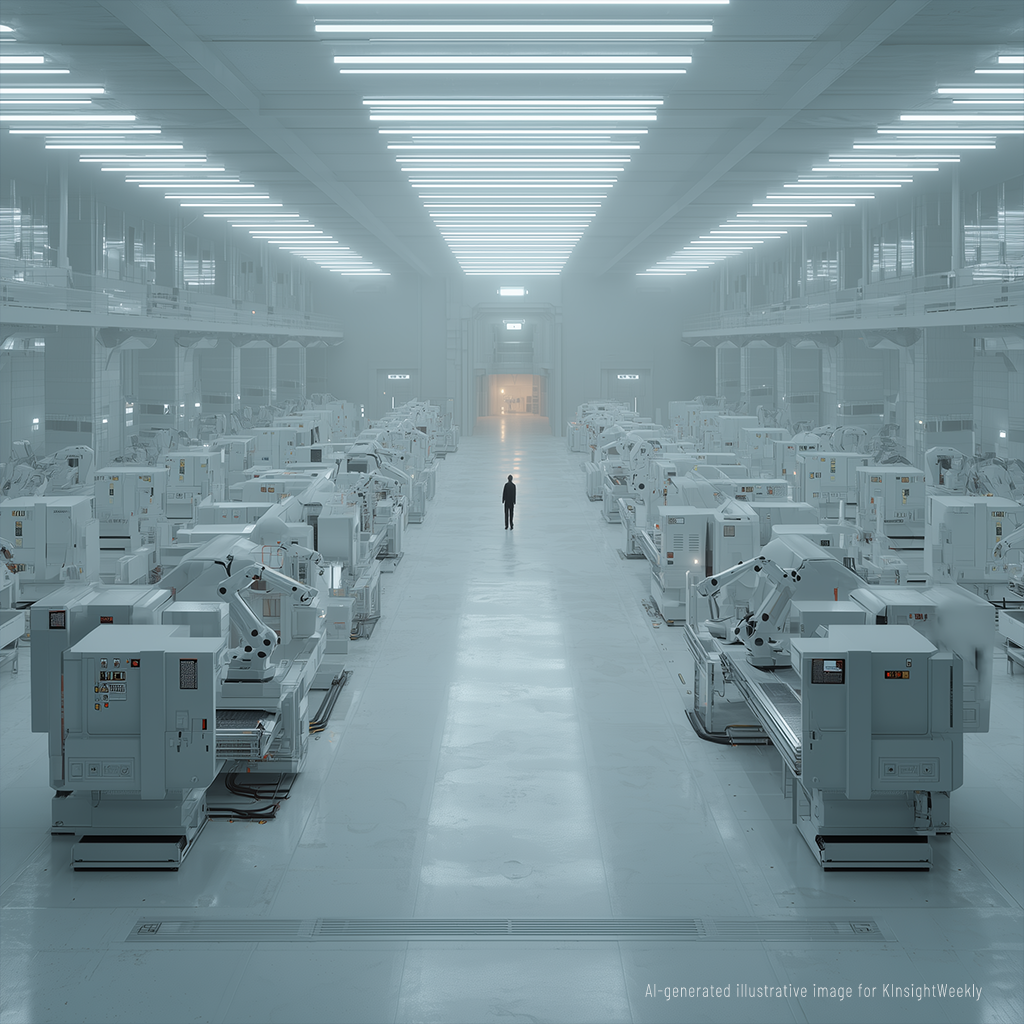
Samsung Electronics announced that, by 2030, it would convert all its domestic and overseas production plants into “AI Driven Factories.”
“The future of manufacturing innovation goes beyond mere automation. It is the construction of an autonomous manufacturing site where AI understands the floor and executes the optimal decision on its own.”
In plain words: “There will be no people in the factory of 2030.”
This is the company’s answer to the Cross-Company Union.
For a company that must honor its supply contracts, eliminating union risk is a matter of life and death. And the final answer to eliminating that risk is, in the end, a workplace without workers. No one can stop this current of history either.
The 40,000 in the square demanded 15% of operating profit. The company answered like this:
“We are building a factory that can take 100% of the operating profit. As for why we must do so — you yourselves are telling us.”
Is this right?
When company and union turn their backs on each other and race to the extreme, both die in the end. Knowing this, must it be done this way to find peace?
There is no other choice?
No. You know clearly what you need to do.
Withdraw the strike. As the union of the country’s number one company, present a new spirit for the age.
What absurdity is this, you ask? Why should we bear such an unreasonable responsibility?
Because we have never received a temptation as powerful as the one you have received. The company creates enormous profits, and so you enjoy substantial welfare benefits and live on more-than-sufficient salaries. And on top of that, demanding bonuses at a level ordinary citizens can hardly imagine, and saying “if the factory stops, 18 trillion won is lost — so accept our demands now” — that level, to borrow a line from a film, “crosses the line.”
Many ask whether, in that square where the labor songs ring out, the noble value of labor still exists — whether the spirit of labor built upon the sacrifices of those who came before still remains.
I want to ask.
Is receiving that much money all you really want?
If you ask, “the company made enormous profits, so naturally we are only asking for our share — what is wrong with that?” — I have nothing to say. If you tell me to stay silent, again, I have nothing to say. We are not you, and we cannot know your exact position. Then, all the more, if you tell me that talk of the spirit of labor or the value of labor is nothing but empty words — again, I have nothing to say.
There is no defense I can offer.
But — a few among you must know. A very small few must at least feel that what is happening now is not right.
Why do we work?
Even now, society is drifting toward ruin under the weight of “distributional coalitions” — like a frog in slowly heating water. To pour oil onto that fire — is that what the union of Korea’s top company must do?
If we say what kind of social discomfort this action provokes — that it almost resembles NIMBY behavior — do those of you in the warm sun have nothing to say but “mind your own business”?
I know. If I were inside that sunlit zone, I cannot guarantee how I would act either.
But within that sunlit zone, a few must be feeling a dilemma. They must clearly feel that something is wrong. That this is not right for the future — those few must surely know.
I appeal to the conscientious few within the Cross-Company Union.
The Samsung Electronics Cross-Company Union is not just any union. Just as Samsung is the symbol of Korean enterprise, the Samsung Cross-Company Union is the symbol of Korean labor. Our future depends on you. So I plead.
“Please withdraw the strike, and be a leader.”
We have never seen our company prosper as yours has, never created such enormous profits. So we have never received the temptation you have received. We do not know the Sirens’ song. And so we cannot fully know the heart of those who made such demands.
But — surely you, too, know in your heart. That what is happening now is not right.
I hope, at the very least, that we may become a generation that is not ashamed before the next.
What impact this action will have on the next generation — what kind of environment it will create — you, who stand at the front line of the industry of the future, must know better than anyone.
Are you not now in the very position to deliver the message that the world is not all about money? Noblesse Oblige is now demanded not only of corporations, but also of the unions of major corporations. Because their social influence has grown too large to ignore.
Please — remember why unions first came into being on this soil.
—
By Sunjae Park
Editor, Korea Insight Weekly