
At around 2 a.m. local time on January 3, 2026,
a series of explosions echoed across the skies above Caracas, the capital of Venezuela. Loud detonations rippled through the city. Awakened residents reported seeing aircraft flying low overhead and military vehicles moving through the streets. In some neighborhoods, witnesses said they heard gunfire. Within minutes, Caracas slipped from an ordinary night into a state of near wartime tension.
At first, no one could clearly grasp what was happening. Was it a coup? An internal clash? A foreign attack? Conflicting rumors flooded radio broadcasts and social media. Then, several hours later, a breaking report stunned the world:
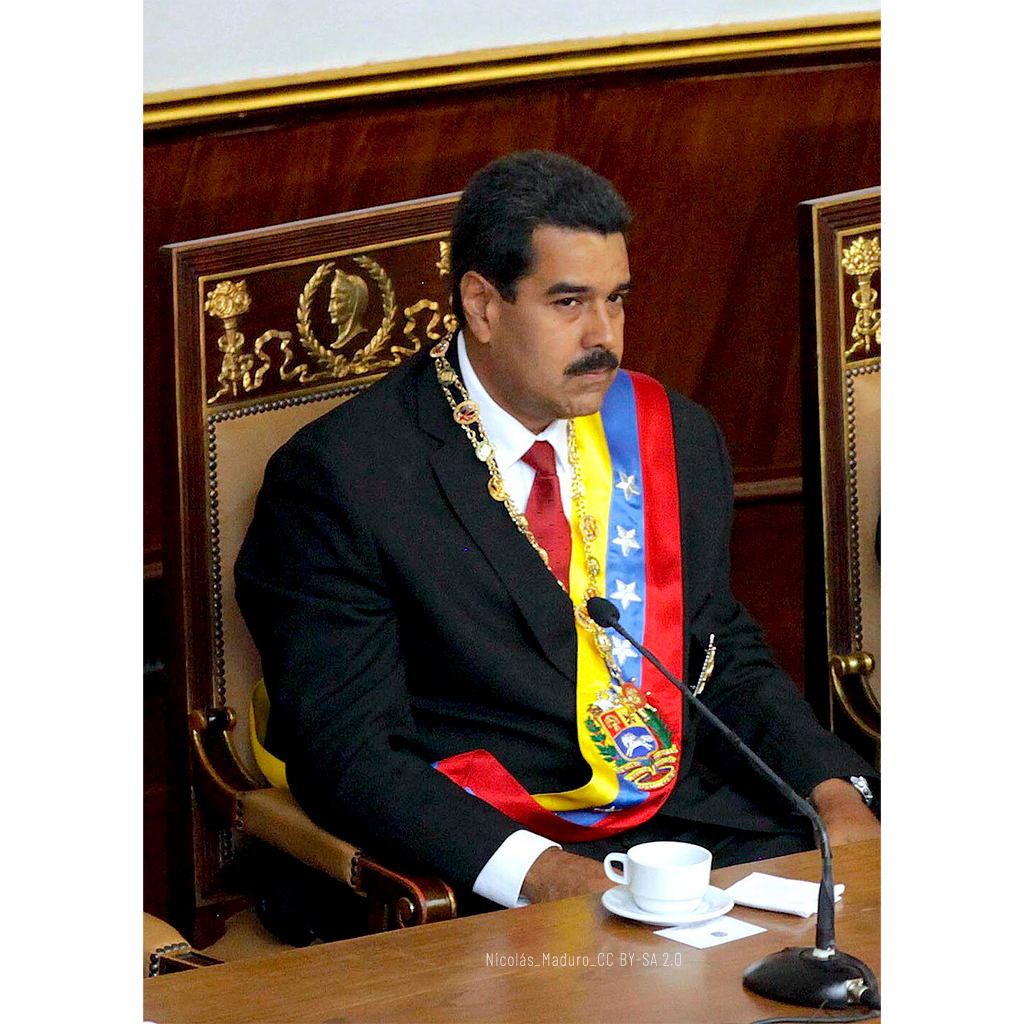
Venezuelan President Nicolás Maduro had been captured and was being transported to the United States.
The image was almost unimaginable. A sitting president of a sovereign nation, seized in the middle of the night without warning and flown to another country. What made the shock even greater was the identity of the actor behind the operation: the United States, long self-styled as the world’s police.
A Tension Long in the Making
This crisis did not erupt overnight.
For months, military and diplomatic tensions between the United States and Venezuela had been steadily building. Since late 2025, U.S. naval operations targeting vessels believed to be linked to Venezuela had intensified across the Caribbean. These operations reportedly resulted in nearly 100 casualties. Washington described them as part of its ongoing “war on drugs,” aimed at intercepting narcotics trafficking.
These actions were carried out without a formal declaration of war or prior diplomatic warning.
In the early hours of January 3, the United States launched a coordinated operation combining airstrikes and special forces. Venezuelan President Nicolás Maduro and his wife, Cilia Flores, were taken into custody and transferred to the United States. U.S. officials insisted that Maduro was not being treated as a head of state, but as the leader of an international drug trafficking organization. According to Washington, this was not an act of war, but a law-enforcement operation.
Global Shockwaves
The international community did not readily accept that explanation.
The United Nations expressed grave concern, emphasizing principles of national sovereignty and territorial integrity. Many warned that capturing and transferring a sitting president without a declaration of war could constitute a violation of international law.
China said it was “deeply shocked,” stressing that no justification could excuse an infringement of state sovereignty. Russia responded even more forcefully. The Russian Foreign Ministry labeled the incident an illegal abduction and demanded President Maduro’s immediate release.
The United Kingdom stated that it had no involvement in the operation, while many European governments adopted a cautious stance. Israel, however, publicly welcomed the U.S. action.
The world confronted a single, unsettling question:
Was this law enforcement—or invasion?
Oil and an Old Rivalry
To understand this moment, one must look back at the long and hostile relationship between the United States and Venezuela. For more than two decades, the two countries have existed in a state of near-permanent confrontation. After Hugo Chávez openly embraced an anti-U.S. stance, Venezuela declared its intention to break free from American influence. His successor, Maduro, continued that course.
Maduro deepened ties with China and Russia while defying U.S. sanctions. Washington cited democracy, human rights, and drug trafficking as justification for its pressure. Yet another word has consistently loomed larger than the rest: resources.
Venezuela possesses the largest proven oil reserves in the world, along with abundant strategic minerals, including rare earth elements. U.S. officials have repeatedly suggested that️ that American energy companies should regain access to Venezuela’s oil sector. After the operation, remarks even surfaced suggesting that Venezuelan oil could help offset the cost of the intervention itself.
Blocking the flow of Venezuelan resources to China and Russia—and redirecting them back into the U.S. sphere of influence—has emerged as a central explanation for Washington’s actions.
A Divided Night in Venezuela
Inside Venezuela, reactions were sharply divided.
Some citizens who had long opposed Maduro’s rule took to the streets in celebration. Years of hyperinflation—so severe that buying a cup of coffee often required carrying boxes of cash—along with widespread corruption and concentrated power, had fueled deep resentment.
Opposition leader and human rights activist María Corina Machado declared that “a moment of change has arrived for Venezuela,” emphasizing the legitimacy of political transition.
The government, meanwhile, declared a state of emergency and condemned the operation as a violation of national sovereignty. Many Venezuelans were left stunned, watching in fear as their president vanished in the middle of the night.
The Questions That Remain
Whatever the justification, this event is virtually without precedent.
A sitting president of a sovereign state, labeled a criminal and seized in a surprise operation, then transferred abroad. Governments around the world reacted with disbelief, calculating the precedent such an act might set.
South Korea, for its part, issued safety advisories to roughly 70 South Korean nationals residing in Venezuela, while refraining from political commentary.
Yet the questions remain.
Under the banner of national security and crime control, is it truly possible in the 21st century for a great power to remove the leadership of a weaker nation by force?
From Washington’s perspective, bringing Venezuela—long seen as a persistent thorn in its side—under control may have appeared inevitable. At the same time, for Venezuelans who have endured decades of authoritarian rule and hyperinflation, this rupture may feel like the first real chance for a new beginning. One plausible scenario envisions the United States securing strategic resources and influence, while Venezuela gains stability and an opportunity for reconstruction. A crisis that has festered unresolved for 27 years may now be forcibly sealed by external shock.
If Nobel Peace Prize laureate María Corina Machado, widely regarded as the international symbol of Venezuela’s democratic movement, were to lead the next government through elections—assuming that a leader with a fragile local base could forge a grand bargain with the military cartel and the colectivos—the country could indeed enter a fundamentally different future. Yet the weight of that future cannot be separated from the fact that the political order shaping it was designed in the aftermath of foreign military intervention. The United States has been explicit: until a new government takes power, it intends to govern Venezuela in the name of transitional stability and order.
How, then, are China and Russia interpreting this moment?
What does North Korea see when it watches a sitting president taken in the middle of the night by U.S. special forces?
As China continues to fix its gaze on Taiwan under the banner of “One China,” what precedent does it read in this episode?
Does Russia, having invaded Ukraine, believe it has now found yet another justification for its own actions?
What, exactly, is unfolding in the world today?
One reality is unmistakable.
Nations no longer regard international norms or guarantees as absolute safeguards. As a result, the expansion of military power and deterrence is increasingly viewed as the only viable answer.
The dawn of January 3, 2026, in Caracas was not merely the end of one city’s night.
It was the moment when the boundary line of the international order itself was violently shaken.
—
By Sunjae Park
Editor, Korea Insight Weekly
Postscript.
January 4, 2026. U.S. President Donald Trump referred to Venezuela’s Vice President Delcy Rodríguez as the figure expected to lead the next governing arrangement. She is widely regarded as part of the core of Venezuela’s power structure, alongside her brother Jorge Rodríguez, the president of the National Assembly. The United States appears to be pursuing a strategy of surgically removing Nicolás Maduro while leaving the existing power framework largely intact, demanding only that it realign itself as pro-American.
It was a deeply shocking development. At the same time, it forced a sobering realization: that my own hopes for Venezuelan democracy—once projected onto María Corina Machado—were shaped by a naïve and overly optimistic reading of global power politics. It feels unsettlingly reminiscent of Korea’s own modern history.