
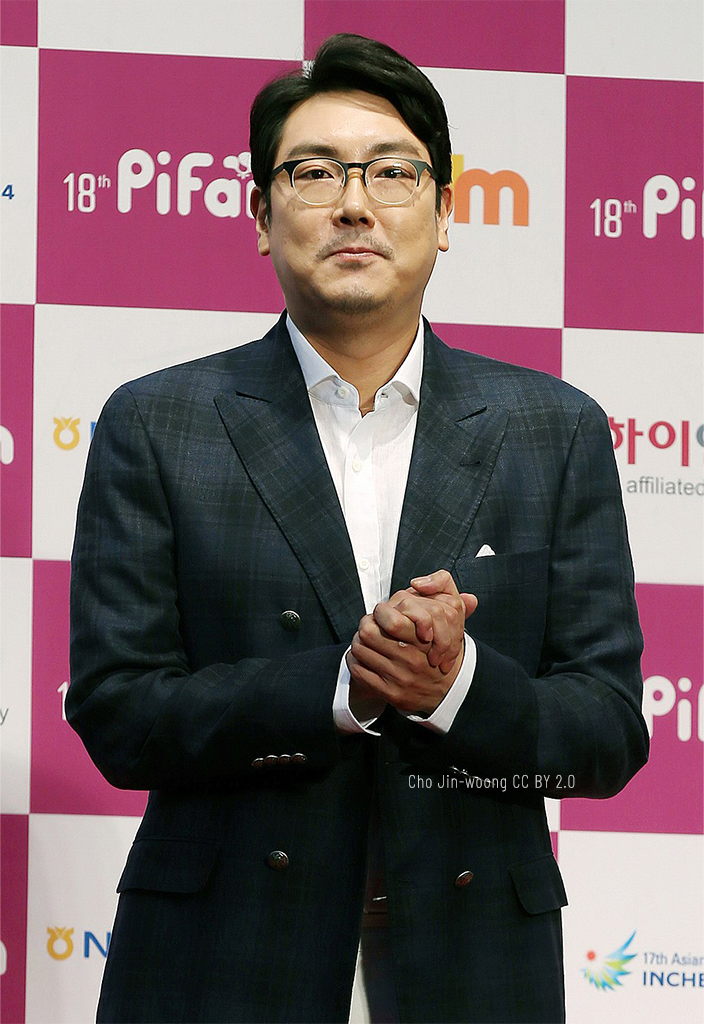
On the morning of December 5, 2025,
Dispatch published an explosive report titled:
“‘That’s why he used his father’s name’… Cho Jin-woong, the actor who was once a juvenile offender.”
The article began by revealing that the actor known publicly as Cho Jin-woong was born Cho Won-jun,
and that his current stage name was taken from his father.
What followed hit even harder.
Sources claimed he had been involved in a car theft ring as a high school student,
that he had faced charges under the Act on Special Cases Concerning the Punishment of Specific Violent Crimes—including robbery and rape—
and that he had been sent to a juvenile facility under a protective disposition.
Witnesses described him driving a stolen car around the neighborhood,
continuing the offenses,
and alleged he had been tied to a sexual assault case.
Dispatch posed a final pointed question:
“Did he adopt his father’s name as a stage name to conceal his criminal past?”
The impact was immediate.
Real-time search rankings were flooded with three terms:
Cho Jin-woong · Cho Won-jun · Juvenile offender.
A Wave of Follow-Up Reports — The Night of December 5
By that afternoon,
major news outlets—Chosun Ilbo, Kyunghyang Shinmun, News1, Yonhap News TV—
had all pushed out follow-up articles.
That evening, his agency, People Entertainment, released an official statement.
“It is true that he committed wrongdoing as a minor.”
But on the sexual assault allegation, they drew a clear line:
“That part is untrue and has no connection to him.”
They added:
“Because the incident took place 30 years ago, it is difficult to verify every detail.”
Soon, news outlets uncovered incidents from his adult years as well—
a fine for assaulting a fellow theater member,
a revoked license for DUI,
and other confirmed run-ins with the law.
The agency acknowledged these too:
“There were indeed moments in his adult life when he exercised poor judgment and caused concern.”
In a single day,
the buried past of a teenager
and the carefully built career of the adult he became
collided in the public square.
Public Reaction — Sharp and Immediate
Online communities split almost instantly into two opposing camps:
1. “Irredeemable / Discard Him”
- “The victim suffered for life while he became a national actor.”
- “This man stood on a national commemorative stage?”
- “A former juvenile offender should never be a public figure.”
2. “This Destroys the Purpose of Juvenile Justice”
- “This happened 30 years ago.”
- “The whole point of juvenile law is rehabilitation.”
- “Why is the standard for exposing someone’s past so arbitrary?”
3. Fatigue with Dispatch’s Annual December Exposés
- “Another celebrity taken down in December.”
- “Why now? What is this meant to distract from?”
The debate quickly outgrew the man at the center of it
and turned into a national argument about justice, memory, and forgiveness.
December 6 — The Retirement and the Apology
On the evening of December 6,
multiple outlets pushed breaking news:
“Cho Jin-woong announces suspension of all acting activities.”
He acknowledged the wrongdoing of his youth,
admitted the protective disposition,
and recognized the DUI and assault incidents of his adult years.
That night, his official apology was released.
Full Text of Cho Jin-woong’s Apology
Hello, this is actor Cho Jin-woong.
First, I bow my head and sincerely apologize
for disappointing all those who have trusted and supported me
due to my past misconduct.
I will humbly accept all criticism
and will halt all activities as of today,
bringing my acting career to an end.
I believe this is the responsibility and duty
I must bear for my past wrongdoing.
Going forward, I will do my utmost
to stand properly as a human being.
Once again, I offer my deepest apologies.
Thank you to everyone who has loved and respected me.
I am truly sorry.
— Cho Jin-woong
With that, his acting career effectively ended.
The sequence unfolded brutally fast:
Exposure → Partial acknowledgment → Public uproar → Apology → Retirement
All within 48 hours.
The Crime of a Boy, the Life of a Man
Cho Jin-woong first appeared in theaters in Once Upon a Time in High School (2004).
He built a powerful filmography:
- Nameless Gangster
- The Admiral: Roaring Currents
- Believer
- Perfect Game
And of course, the celebrated drama Signal (2016),
where his portrayal of Detective Lee Jae-han left a permanent mark.
A single line,
a single look,
was enough for audiences to say:
“That man is the real deal.”
He stood on the stages of the Blue Dragon Awards,
Grand Bell Awards,
and the Baeksang Arts Awards.
He often said in interviews:
“I came up from Busan and tried to fix myself, little by little.”
He donated quietly,
participated in arts festivals,
and supported educational initiatives.
Perhaps the thirty years he lived under his father’s name
were not merely rehabilitation—
they were an attempt
to be reborn.
But after the Dispatch report,
those three decades collapsed under one word:
Juvenile offender.
No matter what he had done since,
the world saw only that.
A Society Losing the Belief That People Can Change
Two sentences echoed across thousands of comments:
“The victim suffers for life. The perpetrator should suffer for life.”
And—
“One crime outweighs thirty years of remorse.”
Attempts to argue for rehabilitation
were met with:
“Would you say that if you were the victim?”
Both sides hold truth.
Yet between them lies a chasm
that cannot be bridged easily.
The foundation of juvenile justice is simple:
Give minors another chance to live.
But society today seems to say:
“You may live—
but you must not rise,
must not succeed,
must not be loved.”
Legal punishment ends.
Social punishment does not.
And the latter leaves no room for explanation,
no path to repair.
What Kind of Society Are We Becoming?
This is not merely a celebrity scandal.
It is a mirror held to our collective face.
We are drifting toward a world
where the belief that people can change
is slipping away.
We are losing the word forgiveness.
Forgetting why juvenile justice exists.
Confusing outrage with moral clarity.
Building a society where:
- A sinner is a sinner forever.
- Exposure is stronger than redemption.
- Confession offers no safety, only ruin.
A society where, ultimately,
no one
can survive.
If this incident has reopened wounds for victims,
their pain must be respected.
But does erasing a person’s entire life
truly ease that pain?
Cho Jin-woong the actor has disappeared.
And with him—
his performances,
his sincerity,
his remorse,
his transformation.
Is this truly the outcome we wanted?
We may hate the sin.
But a society that hates the person—forever—
is a place
where none of us
can live.
—
By Sunjae Park
Editor, Korea Insight Weekly