
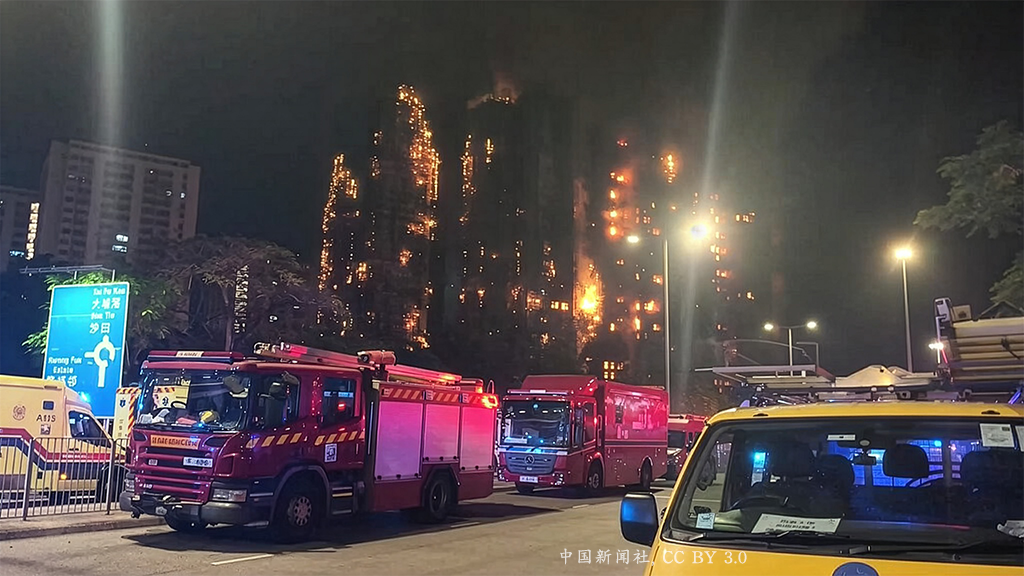
1. An Afternoon in Tai Po: A 32-Story Housing Complex
On November 26, 2025, at 2:51 p.m., a fire broke out at Wang Fuk Court, a high-rise residential complex in Tai Po, New Territories, Hong Kong.
The complex consists of eight 32-story towers supplied under the Home-Ownership Scheme. At the time of the fire, the buildings were undergoing exterior renovation, with bamboo scaffolding and green protective mesh covering the entire façade.
The blaze spread vertically and horizontally in a short period of time. According to Hong Kong authorities and media reports, flames engulfed seven of the eight towers, and it took firefighters nearly 43 hours to bring the fire fully under control.
The casualties were severe. As of November 29, at least 128 people had been confirmed dead and about 79 injured, including more than ten firefighters. Approximately 200 residents were reported missing, though the number may change as unidentified remains are examined. Local and international outlets reported that this was likely Hong Kong’s deadliest fire disaster since the 1948 warehouse explosion—77 years ago.
Roughly 900 residents were evacuated to temporary shelters set up in schools, gyms, and churches. Some survivors said they had been taking an afternoon nap when the fire broke out, leaving them little time to escape. When the flames finally subsided, homes where families had lived for decades had turned into ashes in an instant.
2. What Fueled the Flames
According to the government’s preliminary briefing, the fire is believed to have started in the protective mesh near the lower section of one tower, then quickly climbed upward along the exterior insulation made of polystyrene foam.
The key issue is that the foam panels and several renovation materials used on the façade were highly flammable. Police and fire officials noted that foam boards, insulation materials, and waterproof sheets placed around windows may not have met even minimum fire-resistance standards.
The green protective mesh surrounding the entire complex also served as a conduit for the flames. Once ignited, the tightly wrapped mesh burned like a giant torch, transmitting heat and fire through the scaffolding and into window frames and wall surfaces. Photos and videos show charred mesh and bamboo remnants hanging from blackened façades.
Hong Kong authorities had previously stated that these protective materials were “fire-retardant.” However, post-fire investigations revealed signs that the actual mesh, foam, and tarps used may have failed to meet fire-retardant requirements or differed from what had been certified.
Another confirmed issue was the malfunctioning fire alarm system. Officials acknowledged during a briefing that alarms failed to activate in multiple parts of the building.
Aging firefighting infrastructure added to the problem. Previous inspections had flagged deteriorated fire-hose pressure and inoperable hydrants on some floors, but repairs and replacements were delayed or carried out only partially.
Ultimately, substandard renovation materials, malfunctioning fire alarms and firefighting facilities, and the complacent belief that “renovation work poses low fire risk because no flame-producing tools are used” created an environment where even a small ignition—such as a discarded cigarette—could escalate into a firestorm that consumed an entire residential complex.
3. What Caused the Initial Ignition?
The exact point of ignition remains under investigation. Authorities have only offered an early hypothesis: the fire likely began in the lower mesh netting and climbed upward via the foam insulation.
But across various reports, several common points have emerged:
- Some renovation materials may have differed from what had been officially declared or approved.
- The mesh and protective sheets previously described as “fire-retardant” may actually have been easily flammable.
- Foam panels used for insulation may have acted as vertical fire channels along the exterior walls.
International and local media have noted that, regardless of the precise ignition point, the physical conditions that allowed the fire to grow were already built into the structure.
In other words, the central question now is less “Where did the fire start?” and more “Why were such materials and structural conditions permitted, and who deemed them safe?”
4. Residents Had Already Warned Authorities
What leads many to describe this as a “preventable disaster” is the fact that residents had repeatedly reported the risks.
In September 2024, residents of Wang Fuk Court filed a complaint to Hong Kong’s Labour Department, stating that the “green mesh and protective netting appeared highly flammable.”
• The department responded that the materials carried fire-retardant certification and that the “fire risk was relatively low.”
• After the fire, however, investigations suggested that the mesh and foam near window areas may have fallen short of fire-safety standards.
• Between 2024 and 2025, the Labour Department conducted 16 inspections, issuing six improvement notices and initiating three prosecutions.
• Yet fundamental fixes—such as replacing the problematic materials or verifying alarm system functionality—were not carried out.
Residents say they had even anticipated how and where the fire would spread if it ever broke out. Their warnings existed in written complaints and interviews, but they did not translate into actual action.
5. Why Were Substandard Materials Used?
Attention has now turned to the contractor responsible for the renovation project, which reportedly secured a contract worth HK$330 million. Media reports indicate the company had a history of safety violations and fines.
Hong Kong police have arrested at least 11 individuals—including company personnel—on charges of manslaughter and gross negligence. The Independent Commission Against Corruption (ICAC) has launched its own investigation into:
• Possible bribery in material sourcing
• Potential falsification of safety-inspection documents
• Irregularities in the bidding process
While the full scope of wrongdoing has not yet been revealed, available information points to several structural issues:
- Cost-cutting and pressure to shorten project timelines may have incentivized the selection of cheaper, more vulnerable materials.
- Supervisory and inspection procedures may have been reduced to paperwork that declared materials “safe” without verifying their actual performance.
- At least some oversight bodies failed to mandate work stoppages or enforce material replacement despite repeated concerns.
Thus, behind the official phrase “the cause remains under investigation” lies a deeper reality:
the hazards were already known, but the resources and authority needed to mitigate them were directed elsewhere.
6. Where Things Stand Now
The flames are out, but the crisis is not over.
Between November 28 and 29, authorities announced the completion of search and rescue operations. Parts of the buildings remain structurally unstable due to heat damage.
The Hong Kong government has pledged HK$300 million in relief funds for victims and families, while private organizations and Chinese companies have also announced donations. The Jack Ma Foundation committed HK$60 million.
Civil society groups and local organizations were among the first to respond. Restaurants, churches, and gyms quickly became ad-hoc shelters, and crowdsourced maps and apps emerged to help track missing persons and distribute relief supplies.
China’s central government ordered nationwide inspections of high-rise buildings—especially those undergoing renovation—to check for combustible exterior materials and malfunctioning alarm systems.
7. Why Do Disasters Like This Keep Happening?
This tragedy illustrates how disasters in dense, vertical cities can evolve into systemic, man-made failures.
- The temptation of cheap materials and fast timelines
• Public rental and subsidized housing often operate under budget constraints.
• These constraints tend to lead to cheaper materials, lower construction quality, and reduced safety spending. - Superficial oversight and certification
• On paper, materials appear “fire-retardant,” inspections are “completed,” and risks are “minimal.”
• In reality, hazards perceived by residents and experts remain unaddressed. - A system where those who minimize risk hold more power than those who see it
• Residents and workers raised concerns, but their warnings were overshadowed by schedules, budgets, and institutional inertia.
• What happened at Wang Fuk Court is a clear example of that imbalance. - Safety reforms that begin only after disaster strikes
• Nationwide building inspections may be necessary, but they prompt the question: Why now?
• This pattern repeats with every major incident—only after devastation do long-existing risks become “discovered.”
8. If We Could Turn Back Time
The Wang Fuk Court fire has left profound pain and grief. Considering the accumulated evidence, it is not difficult to understand why many view this as a preventable tragedy.
• Repeated warnings from residents
• Authorities with insufficient resources or willingness to respond
• Structural pressures that enabled the use of substandard materials
• And the disproportionate suffering borne by those in the most vulnerable positions
Looking back on this tragedy, one sentence keeps echoing in my mind — it was written in the notice the residents received:
“Renovation work poses low fire risk because no flame-producing tools are used.”
Fires can start anywhere, at any time.
Going forward — especially for those with decision-making power — this kind of complacency must not be repeated.
—
By Sunjae Park
Editor, Korea Insight Weekly