
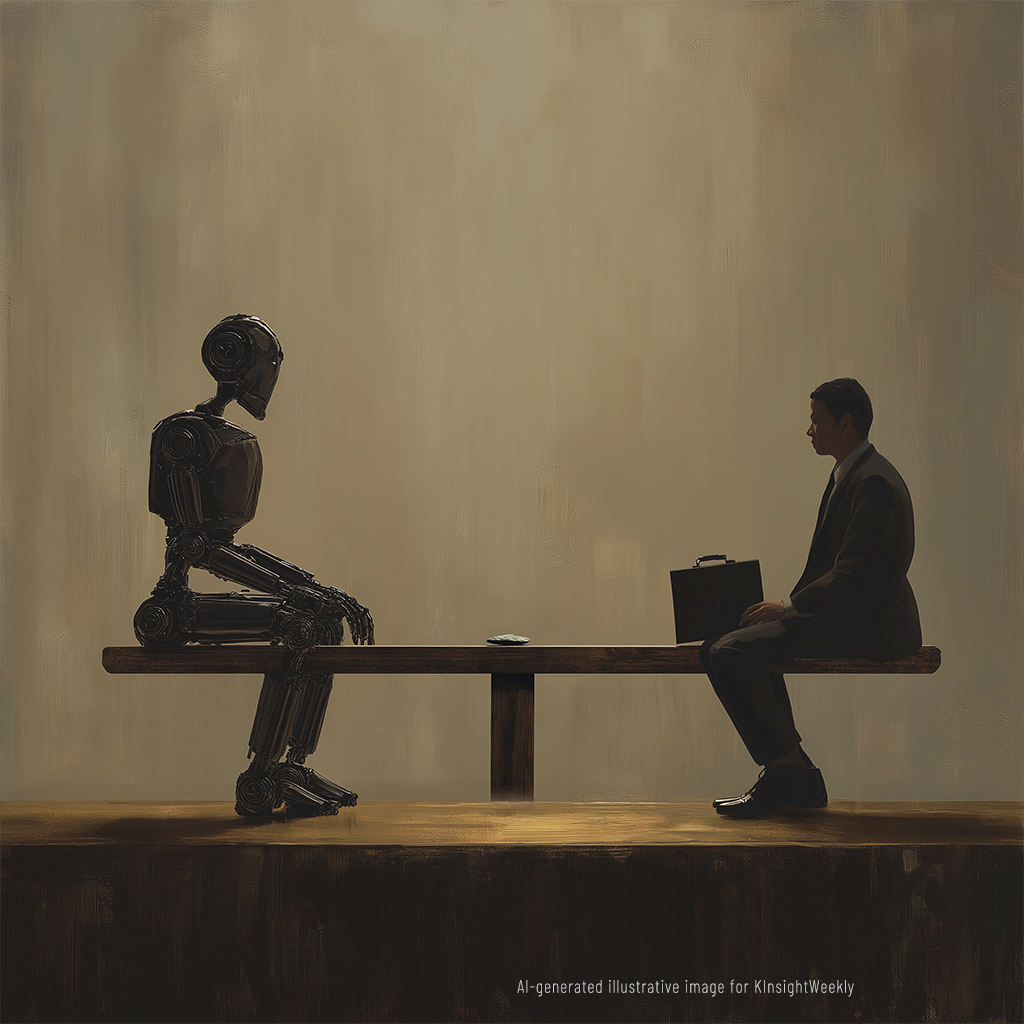
Between Anxiety and Revolution, What Remains of Human Dignity?
It is no longer difficult to find posts in Korean workplace communities saying, “My company is firing people because of AI.”
Whenever a restructuring article pops up in the IT or tech sector, the comments look almost identical:
“Sure, they’re using ‘poor performance’ as an excuse now, but once AI settles in, they’ll cut people anyway.”
There is a gap between perception and data.
But the more important truth is this: in Korea today, many people instinctively connect the word AI with their own survival.
And the news over the past month shows exactly why.
One business daily ran a headline that read:
“AI Shock to Jobs — Restructuring by AI, for AI?”
It pointed out that global tech giants like Microsoft, Google, and Meta had already executed thousands of layoffs, and the pressure is now spreading to Korean developers, designers, and other skilled professionals.
Another report described the internal mood within Korean companies:
as economic stagnation, cost-cutting, digital transformation, and AI adoption all unfold at once, employees increasingly perceive AI as simply another name for restructuring.
A Korea Times survey of 546 workers found that nearly half feel anxious about job security over the next year.
The reasons were telling:
– Economic slowdown (51.6%)
– Expansion of AI and automation (34.1%)
– Organizational restructuring (33.1%)
Another poll reported that 65% of Koreans fear losing their jobs to AI.
Whether AI is the direct cause or not,
the shared sentiment is already clear:
“The AI era = the era of job insecurity.”
An anonymous post on Blind, a workplace community app, claimed that 19,000 tech jobs were cut in September 2025 alone, and that “AI” was explicitly cited in many of those cases.
Companies insist these are not AI-driven layoffs but part of broader “efficiency measures.”
But for employees, once the memo hits their inbox, a single thought arrives first:
“What if I’m next?”
2. The United States: “I was fired because of AI.”
Is Korea overreacting?
The American landscape suggests otherwise.
One analysis reported that from January to early June 2025,
77,999 U.S. layoffs were explicitly attributed to AI.
The Los Angeles Times noted that 48,414 layoffs cited AI as an official reason—
and that over 30,000 AI-related layoffs occurred in October alone.
Individual corporate cases make the picture even clearer:
– IBM announced that about 7,800 back-office jobs could be replaced by AI and slowed hiring in that area.
– Duolingo cut 10% of its contract translators and editors in 2024, explaining that most of the work could now be done by AI.
– One software firm fired 80% of its staff, saying employees failed to adapt to AI. Its CEO stated he would “make the same decision again.”
The LA Times also cautioned that AI is sometimes a convenient justification for correcting over-hiring.
Even so, one fact is undeniable:
Companies are already listing AI as a formal reason for layoffs—by the tens of thousands.
Korea’s anxiety is not an illusion.
3. Looking Back: Goldman Sachs and the Disappearing Trader
This anxiety did not emerge overnight.
A symbolic episode unfolded in the financial sector years ago.
In 2017, Goldman Sachs introduced the AI-driven trading system Kensho,
and the firm reportedly cut nearly all of the 600 traders in its New York equities division—
leaving just two engineers behind.
Work that once required 15 people over four weeks
could now be done by AI in five minutes.
This was one of the first moments in which
“AI replaces humans” stopped being a prediction and became a measurable reality.
4. Which Jobs Are Disappearing—and Which Ones Are Growing?
A recent global analysis examined a staggering 180 million job postings
to determine which jobs are actually shrinking and which are expanding.
The jobs in decline share a pattern: repetitive, rule-based, decomposable into steps.
– Basic copywriting, simple graphics, logo creation
– ESG/compliance reporting and other document-heavy tasks
– Medical scribing and transcription work
Meanwhile, jobs on the rise require far higher cognitive abstraction and technical fluency:
– Machine learning engineers (the fastest-growing job in 2025)
– Data-oriented roles
– AI orchestration and systems architecture
– Big-data specialists, fintech engineers, AI/ML experts, software analysts
In short:
“AI will eliminate everyone” is an exaggeration.
But “AI will make certain kinds of people more valuable—and others less so” is far closer to the truth.
5. Korea Is Pouring Money Into AI
The Korean government and major corporations see AI not as a threat but as an opportunity.
The 2025 R&D budget allocates ₩1 trillion solely to AI research.
The 2026 plan goes further—
₩10.1 trillion will be invested in AI, including
– 15,000 high-performance GPUs,
– a national AI Growth Fund targeting ₩100 trillion.
The president declared that AI will be integrated across industry, the public sector, and daily life,
and announced multi-trillion-won investments in talent development.
Global firms are moving too:
AWS plans to invest $5 billion in a Korean AI data center by 2031,
and Korea has joined the UAE–U.S.–backed Stargate Project, one of the world’s largest AI data-campus initiatives.
Domestically, 82% of executives say they will increase AI investment.
By the numbers, Korea is essentially all-in on AI.
6. Then Why Doesn’t the Future Feel Bright?
Despite these massive investments,
public sentiment leans more toward anxiety than optimism.
– 60% of Koreans fear “falling behind” in the AI transition
– 65% fear losing their jobs
– Bank of Korea research shows that in AI-exposed industries,
jobs for people in their 20s and 30s shrink
while jobs for those over 50 expand
Summarizing the paradox:
- Government and companies are accelerating AI investment.
- New jobs are indeed being created.
- Yet access to these new opportunities is profoundly unequal.
Those with AI tools, education, and computing resources can rise.
Those in repetitive or low-skill roles face something different:
AI feels less like innovation, and more like a future dismissal letter.
To many Koreans,
AI is not a “life-changing opportunity”
but a wave large enough to wash them out.
7. An Unstoppable Revolution—But Unlike the 18th Century
What we are witnessing is not a simple technological upgrade.
It is a revolution.
The Industrial Revolution replaced human muscle.
The AI revolution replaces the human mind—
our judgment, planning, reasoning, and even our creativity.
Historian Yuval Harari warned:
“Being exploited is painful, but being unnecessary is far worse.”
Once, humans were indispensable—exploited, yes, but needed.
AI brings the possibility of a new class emerging:
people whom the economic system simply does not require.
8. The Rise of the Precariat
Economist Guy Standing coined the term precariat—
a blend of precarious and proletariat—to describe a rapidly growing class:
– non-regular, unstable jobs
– contracts that can vanish anytime
– endless retraining
– unpaid labor like job hunting, interviews, self-development
This describes a large swath of today’s Korean workforce:
platform workers, contract developers, freelance designers, content creators, office workers perpetually told to “upskill.”
AI accelerates this instability, making it broader and deeper.
9. When Labor Disappears, What Rights Remain?
Modern democracy and welfare states were designed around
the idea of the working citizen:
You earn wages through labor.
You pay taxes.
You receive rights and protections.
But in a society where AI and robots generate much of the production,
labor-based rights begin to unravel.
If you lose your job and your wages,
where do your rights come from?
Standing proposes one answer:
Basic Income.
Harari poses an even sharper question:
“The biggest threat isn’t unemployment—it’s irrelevance.
If technology no longer needs humans, what do humans live for?”
10. Will We Each Own a Personal Robot Someday?
Perhaps one day, like cars,
“a personal robot for everyone” will become a household standard—
a home assistant, health monitor, work agent, emotional companion.
But here’s the real question:
Will we be able to afford one?
If people lose income,
lose stable jobs,
lose even political and economic voice—
how will they buy the very robots whose productivity they depend on?
If only those who can purchase AI infrastructure
receive the benefits of its output,
the future may not be bright at all—
but brutally unequal.
A future rosy for some,
blood-red for others.
The AI revolution has already begun,
and it cannot be stopped.
So the question we must ask is not:
“How many jobs will AI eliminate?”
but rather:
“Can humans still live with dignity in the age of AI?”
Facing that question—
that, perhaps, is the first preparation we must make
as another sleepless night approaches.
—
By Sunjae Park
Editor, Korea Insight Weekly